
The Age of Engineered Anticipation
For years, dopamine was the go-to explanation for why we can’t put our phones down. Likes, pings, pop-ups, late-night scrolls, they all gave us that little hit. Dopamine became the villain, the shorthand for everything compulsive about modern life.
But if you really watch how we behave now - how often we swipe, refresh, hover, and wait, you’ll notice something else. It’s not the thrill of the reward that hooks us. It’s the tension of possibility.
Think about it: every time you reopen an app you closed 20 seconds ago, check for a message that isn’t there, or refresh a feed you’ve already seen, you’re not chasing pleasure. You’re chasing potential. The “maybe” hits harder than the “yes.” Anticipation sits deeper than satisfaction.
And neuroscience backs this up. Brain imaging studies show that when we expect a reward, the ventral striatum- the brain’s reward centre- lights up even before anything happens. In other words, the system designed to respond to what is happening is obsessed with what might happen.
Here’s the kicker: uncertainty isn’t a bug in the system—it’s the feature that turns it on. Classic dopamine research shows we respond most intensely when rewards are uncertain—around a 50% chance. That “maybe yes, maybe no” state sends dopaminergic firing into overdrive.
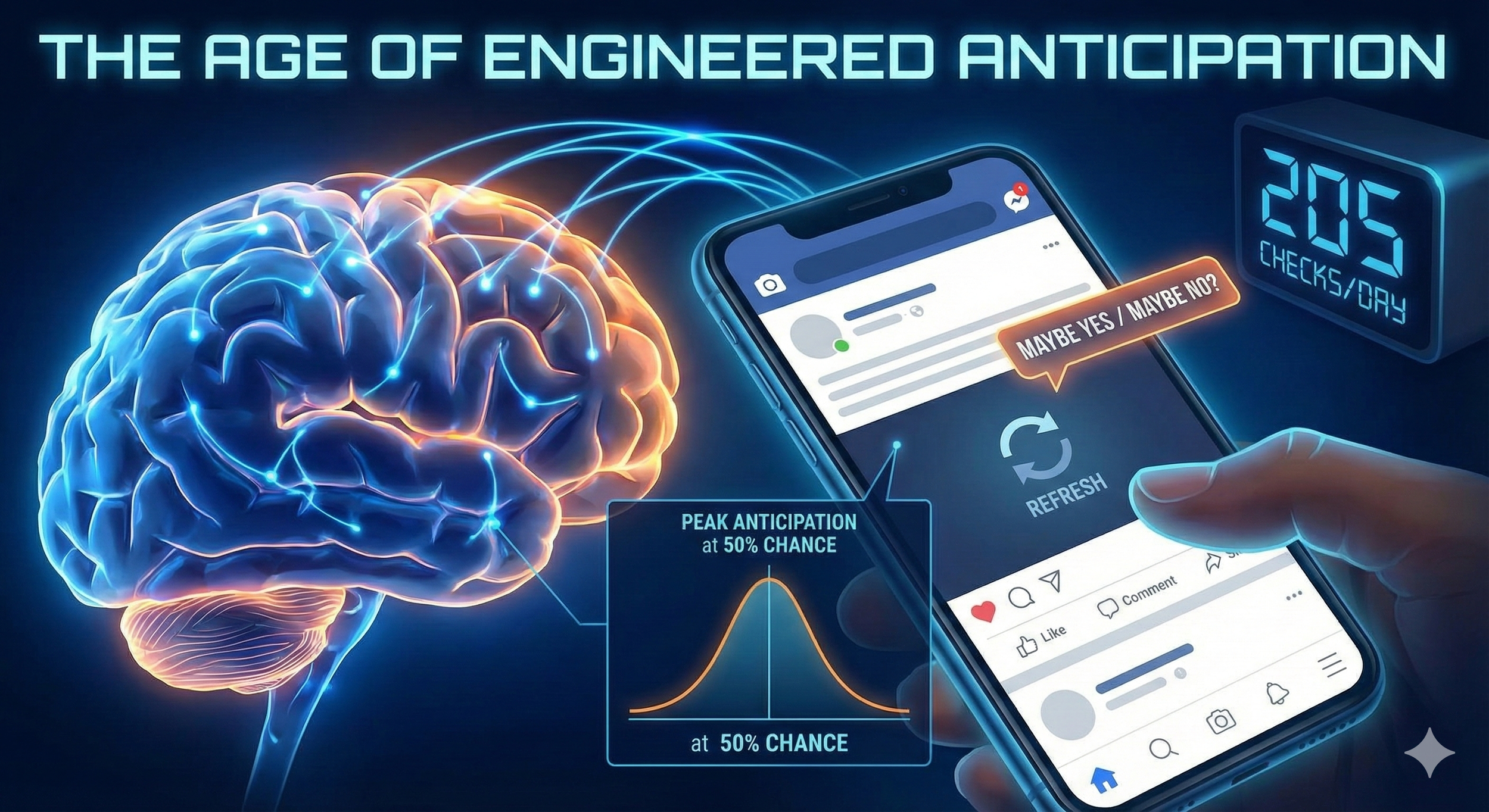
So, uncomfortable truth #1: we’re wired for anticipation, not reward.
Uncomfortable truth #2: technology knows this.
Globally, we spend over 6.5 hours a day on screens. In the U.S., the average person checks their phone about 205 times a day - almost once every five minutes we’re awake. Among teens, half report four-plus hours of daily screen time outside of schoolwork. This isn’t just heavy usage; it’s a world where checking has become a reflex.
And it’s not just habit. Its design.
Social platforms, games, and content feeds lean hard on variable rewards - the psychological mechanism in which rewards arrive unpredictably. Behavioural psychology has long known that this schedule is the hardest to resist. When as counts fluctuate, replies are irregular, some posts explode while others vanish, when the feed occasionally surfaces something uncannily relevant and then buries it again—we’re being trained.
And now comes the significant shift: AI personalisation.
We used to talk about “the algorithm” as if it were one-size-fits-all. Today’s recommendation engines are far more granular. They don’t just learn what you click—they learn when you click. They track how long you tolerate silence before seeking more. They infer:
When your attention drifts
What content pulls you back
How long will you wait for a notification
Which signals matter most to you
What kind of uncertainty you cannot resist
The result? The anticipation loop is now tuned to you.
For one person, that means unpredictable spikes in reach. For another, the sudden appearance of a specific type of post just as they were about to log off. For someone else, messages that “always seem” to land when they’re trying to focus. None of this requires conscious manipulation—it’s the emergent behaviour of systems trained to maximise engagement by exploiting the deepest feature of the human brain: our hunger for what might happen next.