
Why Female Fusion Works: The System Behind a Community Success
When COVID hit Dubai, a quiet Facebook group flipped overnight—from casual catch-ups to a lifeline. Women flooded it with urgent questions: How do I replace lost income? Pivot my business? Find clients in chaos? Jen Blandos, a seasoned communications pro, started answering. Then it clicked: this wasn’t noise, it was demand. “Women needed a professional ecosystem like the old boys’ club men have had for decades,” she says. “We’re running businesses, households, school runs—yet no space existed for that reality.”
Spotting the gap was one thing, but turning it into a company? That’s where most dreams die.The backdrop is brutal: roughly 90% of startups fail, and up to 80% shut down within five years. Membership businesses aren’t much kinder; half of established sites hit six figures, but only a sliver ever reach seven. The chasm between “this exists” and “this scales” is where most community-led ideas stall.
Women-focused networks show how unforgiving that gap can be. The Wing, once the poster child for women-only coworking, collapsed under the weight of lawsuits, culture backlash, and COVID economics. Ladies Get Paid faced legal challenges that forced it to admit men into spaces designed for women.
Even the glossy “girlboss” era cracked under pressure - Nasty Gal, once valued in the hundreds of millions, ended in bankruptcy. The pattern is clear: narrative, economics, and culture have to move in lockstep. When they don’t, celebrated communities slide fast from headline to cautionary tale.
So, how is Female Fusion different?
Against that backdrop, Blandos faced a more complex question: not just is there demand?—but how do you build something that doesn’t burn out or break?
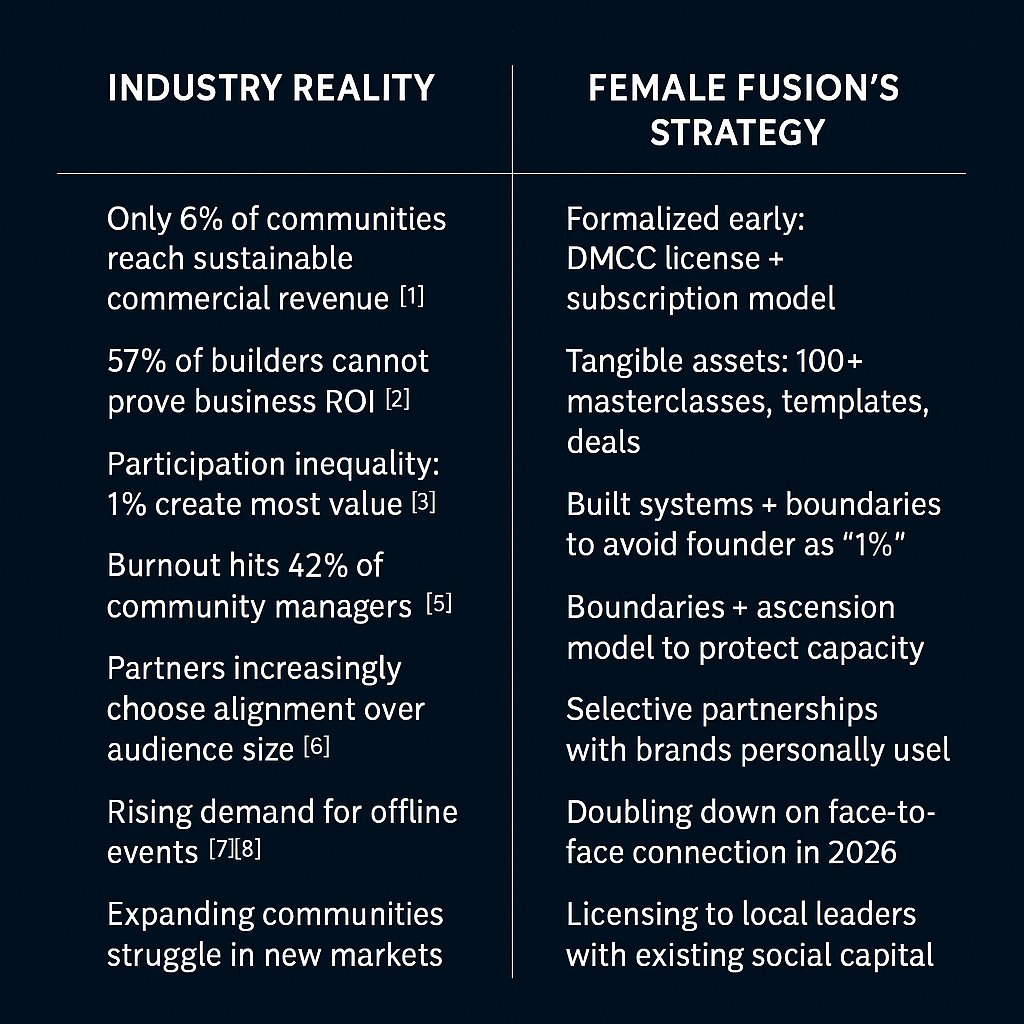
Her answer started where most founders don’t: protect the founder as an asset. Communities often sit on top of a full-time job, and burnout is rampant—53% of managers’ report feeling exhausted, according to Harvard Business Review. Blandos saw the warning signs early.
“People were sending me WhatsApps at midnight asking for business advice,” she says. “If you don’t set boundaries, the community burns out its founder long before it becomes a business.”
So she designed around that constraint: no 24/7 access, no free-for-all emotional labour, no model built on personal stamina.

Jen Blandos, Founder and CEO, Female Fusion
The turning point came when Blandos did what most founders delay: professionalise early and treat the community as infrastructure, not a side project. She secured a DMCC Professional Network licence - rare for a women’s business network in the UAE, and launched a subscription model. Within a year, Female Fusion crossed the UAE VAT threshold of AED 375,000 in annual revenue. The Facebook group became an organisation with a P&L.
“To survive where others failed, I had to run this like a business from day one, not a hobby,” she says. “Structure was non-negotiable.”
The model and its biggest differentiators
First differentiator: real value, not vague engagement. Blandos refused to sell “community vibes” as the product. Female Fusion runs like an operating system: members get 100+ masterclasses, templates, and tech tutorials, a practical playbook for building a business. On top of that, the network negotiates hard financial perks: fee-free Stripe processing up to 100,000 AED, six months of Notion’s company plan worth $10,000, and discounted Aramex shipping.
“We’re not here for social chit-chat,” she says. “We’re here to give women the tools, knowledge, and savings to grow.” In an industry where proving value is a chronic headache, she’s moved the offer from fuzzy support to line-item savings and tangible assets.
Second differentiator: a model that protects time. Instead of being permanently on call, Blandos built an ascension model: a free front door, a paid membership tier, and higher-touch programs above that. Access isn’t infinite; it’s productised. High-touch advice lives inside defined programmes, not midnight DMs. In a world where burnout is rampant, building on unbounded access would be reckless; she designs the opposite.
Third differentiator: growth without gimmicks. Partnerships with brands like Stripe and Mastercard didn’t come from a viral moment. “There’s no hack,” Blandos says. “I keep a dream list and invest time every month in building those relationships.” She rejects partners that could erode trust.
“If I wouldn’t use a product myself, I won’t put it in front of members. Trust is everything.” In a community business, members aren’t just customers - they’re the proof and the product. Misaligned partners aren’t just a bad fit; they’re a direct risk to the system.
Final edge: future-proofing. Even with a strong digital backbone, member behaviour is shifting. “In the last six months, people want real-world connection again,” Blandos says. Event data agrees: in-person events are back as top-rated for training and marketing.
Female Fusion is doubling down on in-person connection, expanding face-to-face events through 2026 while keeping its digital library as the backbone. Instead of chasing global scale with offices, it’s building a licensing model for local leaders who already have audiences and trust but lack content, tech, or a commercial engine.
“We don’t want to run fifty cities,” Blandos says. “Amazing women are building local groups—they can plug into ours.” Add one more layer—teaching the playbook through training, licensing, or advisory—and you have a system that scales without scaling the founder.
Conclusion: Community isn’t the business. Infrastructure is.
Female Fusion isn’t interesting because it’s “a community for women.” That space is crowded. It’s interesting because it did the unglamorous work of turning a Facebook group into infrastructure: a legal wrapper, a subscription engine, a content and perks stack, a partnership pipeline, a tiered model that protects the founder’s time, and a strategy for hybrid, chapter-led expansion.
The macro picture hasn’t changed: most startups fail; communities still struggle to prove value; burnout is rampant; and members are drifting back to in-person connection after years of digital everything. Against that backdrop, Female Fusion looks less like a feel-good anomaly and more like a case study in deliberate design.
Blandos sums it up: “If you don’t run it like a business, it won’t survive. Belonging matters, but structure pays for it.” For founders trying to turn networks into assets, that’s the real lesson: community can be a moat, but only if you build the plumbing.