
Global startup funding hits $297 billion in Q1 2026 as AI mega-deals and sovereign capital rewrite the investment playbook
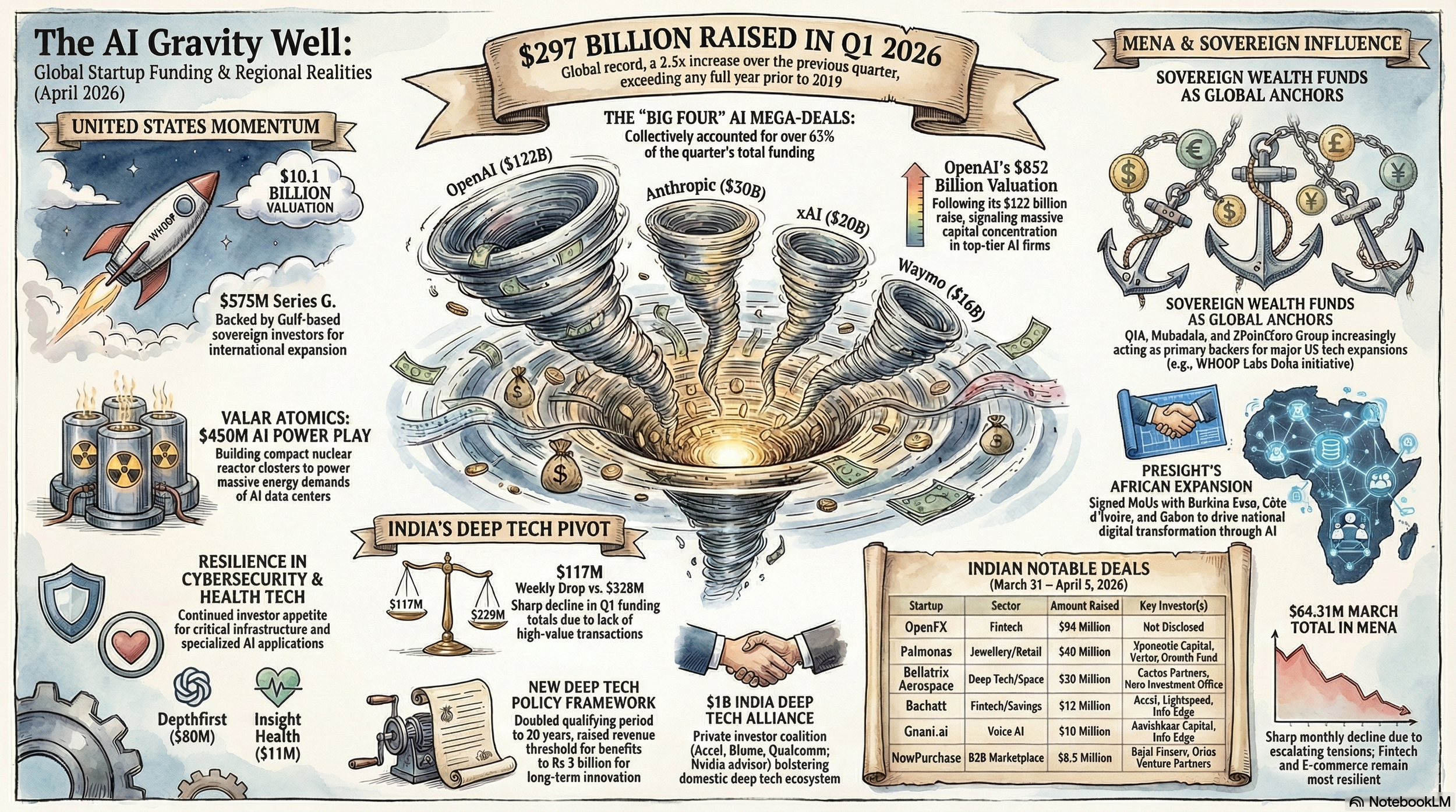
Global venture capital activity reached an unprecedented $297 billion in the first quarter of 2026, more than doubling the $118 billion raised in the preceding quarter and surpassing every full calendar year of VC deployment recorded before 2019. The figures, published by Crunchbase at the start of April, establish Q1 2026 as the single most consequential quarter in the history of startup financing and confirm that artificial intelligence has moved from investment theme to investment engine.
Four deals alone accounted for more than 63% of the quarter's total. OpenAI closed a $122 billion round at an $852 billion valuation, the largest funding event in Silicon Valley history, with backing from Amazon, Nvidia, and SoftBank. Anthropic raised $30 billion at $380 billion, xAI secured $20 billion, and Waymo closed a $16 billion round. Together, these transactions raised $188 billion and redrew the map of what is possible in private markets. Yet even setting aside the mega-deals, investors and founders across geographies report that seed-stage AI startups are commanding higher valuations at earlier stages than at any prior point in the cycle, suggesting the market heat extends well beyond a handful of headline names.
The week of 31 March to 5 April offered a more granular view of how that capital is moving across three of the world's most consequential startup markets: the United States, India, and the Middle East and North Africa.
United States: infrastructure bets dominate as AI demands power, compute, and security
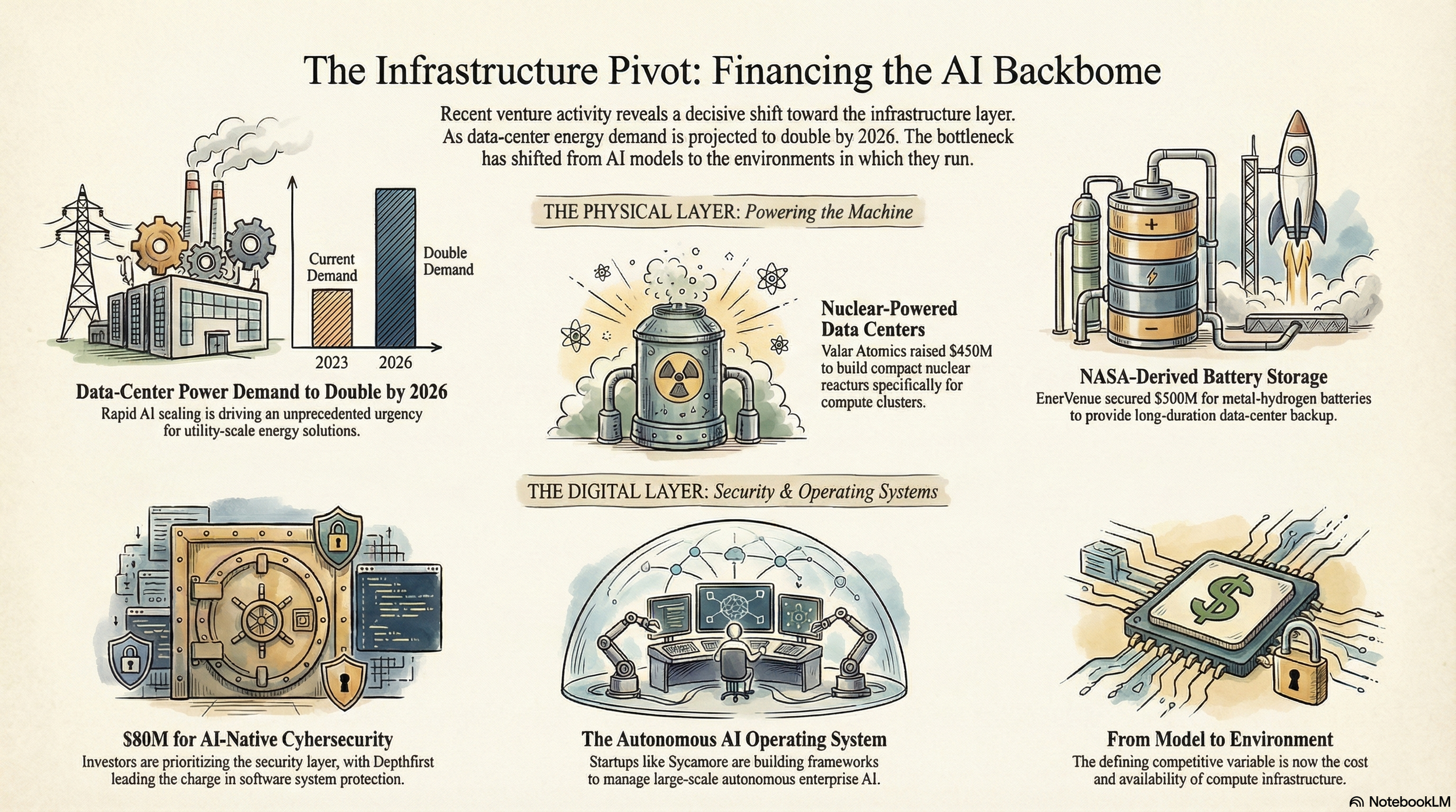
The deals flowing through US venture markets in the opening days of April reflect a decisive pivot towards the physical and digital infrastructure that AI requires to function at scale. The headline transaction of the week was WHOOP's $575 million Series G at a $10.1 billion valuation, led by Collaborative Fund and notable for the strong GCC participation it attracted. Beyond WHOOP, the dominant theme was energy and compute.
Valar Atomics, a California startup building clusters of compact gas-cooled nuclear reactors designed to power AI data centres, announced $450 million in combined equity and debt financing, lifting its valuation to $2 billion. The round came within months of a $130 million Series A and included backing from defence-tech veterans Palmer Luckey and Palantir CTO Shyam Sankar. EnerVenue secured $300 million in a Series B extension to commercialise NASA-derived metal-hydrogen batteries for long-duration grid storage, targeting utility-scale and data-centre backup applications where lithium-ion falls short on lifespan.
Cybersecurity also drew significant capital. Depthfirst, an applied AI lab focused on securing software systems, closed an $80 million Series B led by Meritech Capital. Sycamore raised a $65 million seed round to build what it describes as an operating system for autonomous enterprise AI, while Alcatraz closed a $50 million Series B.
The pattern across these transactions points to something structural rather than cyclical. Investors are no longer betting exclusively on AI applications; they are funding the power, the chips, the security layer, and the infrastructure that makes large-scale AI deployment possible at all. Data-centre power demand is projected to double by 2026, and capital flowing into nuclear, battery storage, and AI-native security reflects investor conviction that the bottleneck is no longer the model but the environment in which it runs. For enterprise technology buyers and builders globally, the cost and availability of compute infrastructure will be a defining competitive variable for the next several years, and the companies solving that problem are attracting capital at a speed that mirrors the urgency of the problem itself.
India: a cautious week masks a structurally shifting market
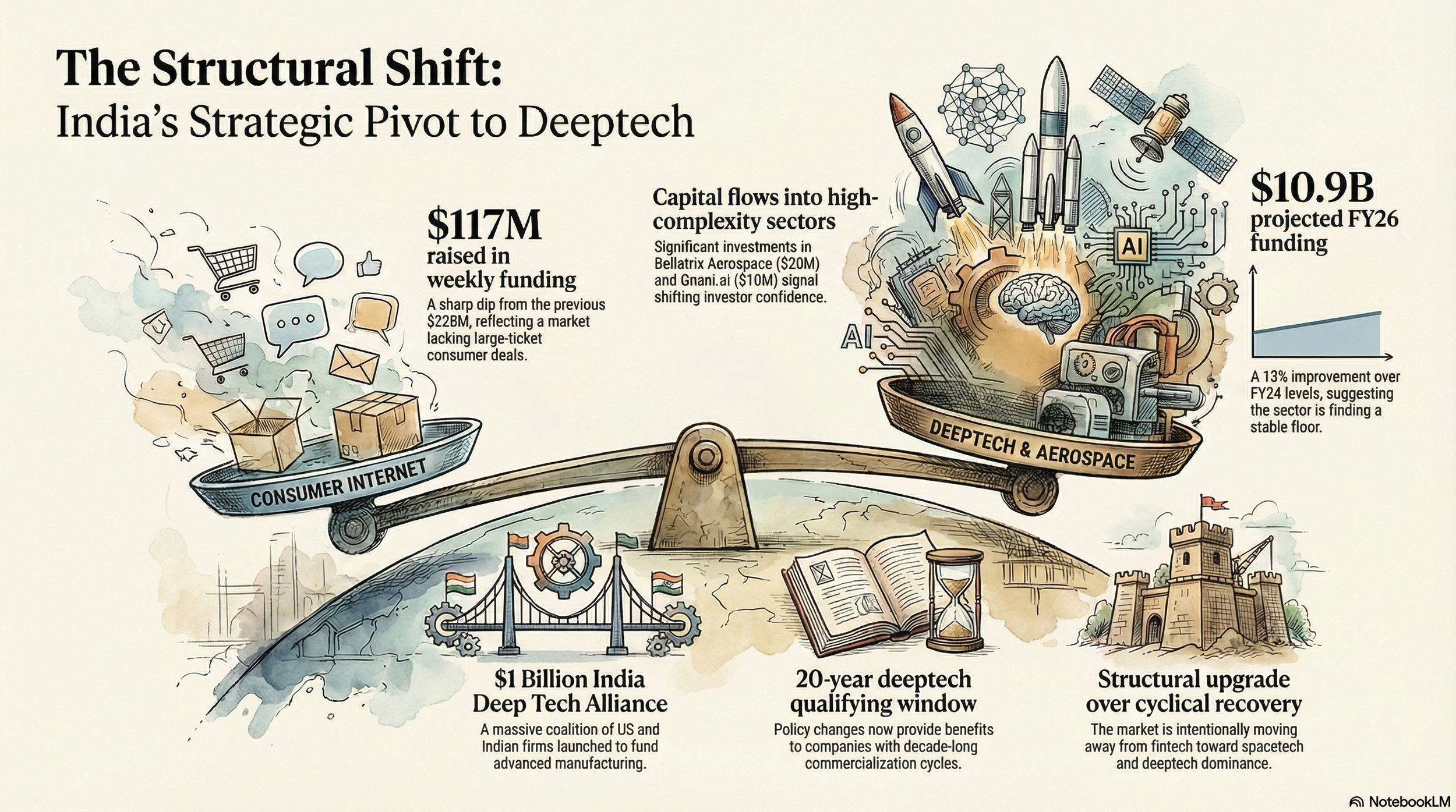
Indian venture capital told a more measured story in the same window. In the week spanning 28 March to 3 April, startups raised $117 million across 20 deals, down sharply from $328 million across 22 deals the prior week. The deal count held, but the absence of large-ticket transactions pulled totals down. Tracxn's India Tech 2025-26 report placed full-year FY26 tech funding at $10.9 billion, a 23% decline on FY25 but a 13% improvement on FY24's $9.7 billion, suggesting a sector finding its floor rather than entering freefall.
The week's transactions reflected where Indian investor confidence currently resides. Bellatrix Aerospace raised $20 million from Cactus Partners and Hero Investment Office, underscoring sustained appetite for spacetech. Savings platform Bachatt secured $12 million from Accel, Lightspeed, and Info Edge Ventures. Voice AI startup Gnani.ai raised $10 million from Aavishkaar Capital and Info Edge Ventures. NowPurchase, a B2B marketplace for metal manufacturers, brought in Rs 80 crore from Bajaj Finserv and Orios Venture Partners. OpenFX raised $94 million on 31 March. Jewellery brand Palmonas closed a $40 million Series B led by Xponentia Capital and Vertex Growth Fund.
The corporate news layer added complexity. Fidelity cut Gupshup's valuation to $300 million, a significant markdown for a once high-profile messaging platform. Myntra CEO Nandita Sinha was reported to be stepping down. Flipkart-backed NeuroPixel.AI shut operations amid financial strain. Garuda Aerospace, by contrast, moved forward with a confidential filing for a Rs 1,000 crore IPO.
The policy environment delivered arguably the most consequential development of the week. India doubled the qualifying period for deep tech companies under its startup framework to 20 years and raised the revenue threshold for startup-specific benefits to Rs 3 billion. Simultaneously, US and Indian venture firms launched the India Deep Tech Alliance, a $1 billion-plus coalition including Accel, Blume Ventures, Celesta Capital, Premji Invest, and Qualcomm Ventures, with Nvidia as adviser.
Taken together, the data points to a market attempting a structural upgrade rather than a cyclical recovery. India is shifting its centre of gravity from consumer internet and fintech towards deeptech, spacetech, and advanced manufacturing. The policy reforms and the Deep Tech Alliance are coordinated efforts to make India competitive in sectors where it has historically been underfunded compared with the United States and China. The weekly funding dip is real, but the more telling signal is that the country is building the regulatory and capital infrastructure for companies that take a decade or more to reach commercialisation. Whether the capital depth at Series A and beyond can keep pace with that ambition remains the critical open question.
Middle East: sovereign capital moves globally as the region sustains momentum at home
The Middle East navigated a genuinely difficult week. The ongoing conflict involving Iran continued to weigh on global investment flows touching the region, and MENA startup investment in March fell to $64.31 million across 19 companies, down sharply against February's $326.6 million, with fintech leading at $16.1 million, followed by e-commerce at $15.87 million and digital health at $15 million.
Yet the regional story in the 31 March to 5 April window was defined less by what was raised locally and more by what sovereign capital was doing globally, and by a set of strategic developments that speak to where the GCC is positioning itself for the long term.
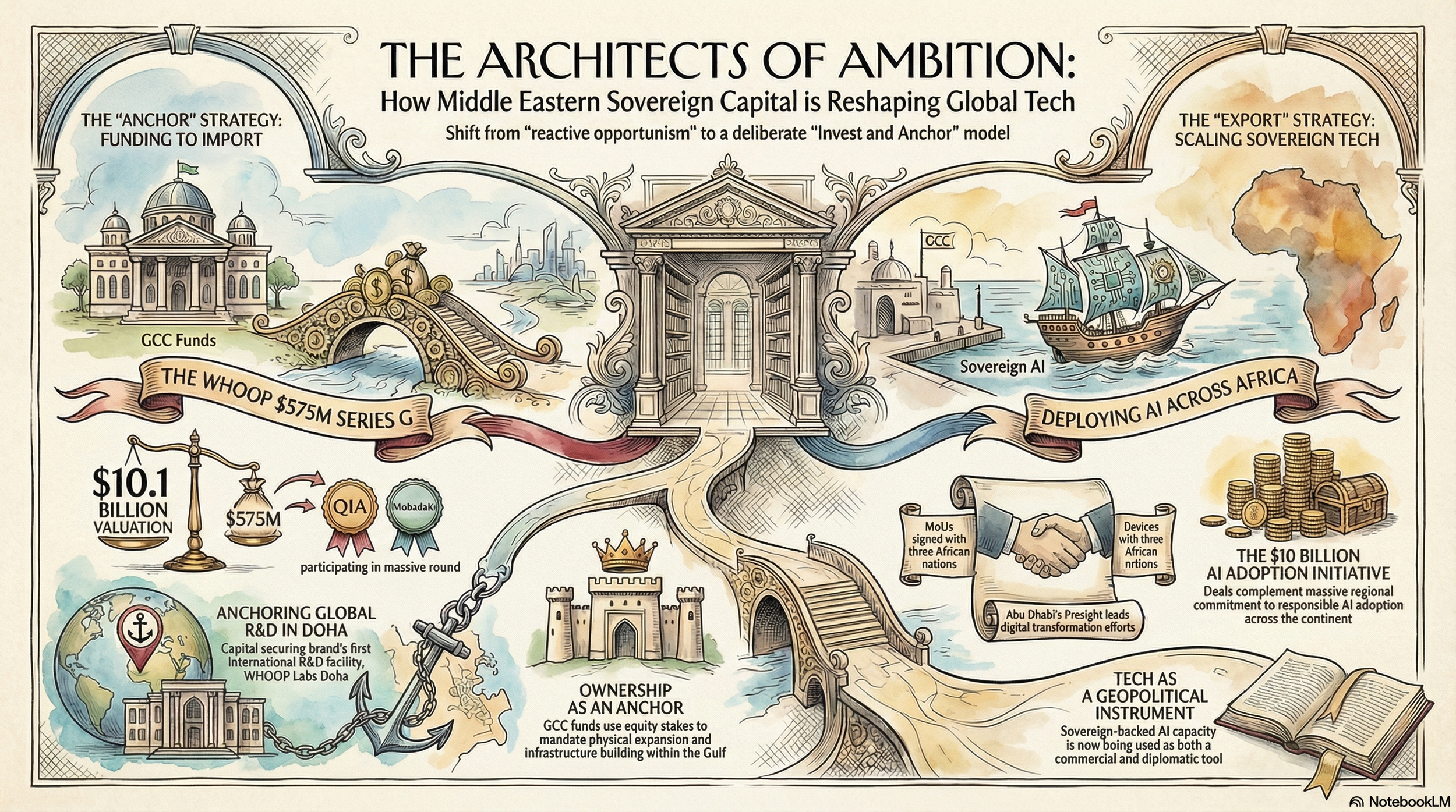
The most significant transaction of the week involving MENA capital was WHOOP's $575 million Series G. Qatar Investment Authority, Mubadala Investment Company, and 2PointZero Group all participated in the round, which was led by Collaborative Fund and valued the Boston-based human performance company at $10.1 billion. WHOOP was founded by Egyptian entrepreneur Will Ahmed and will use the proceeds to open WHOOP Labs Doha, its first international R&D facility, as well as to expand across the UAE and Qatar. The round also attracted Cristiano Ronaldo and Karen Wazen as individual investors, reflecting the GCC's growing alignment between sovereign capital strategy and cultural influence.
At home, the early-stage pipeline held firm. Dubai proptech estaie raised a seven-figure pre-seed led by Plus VC and Orbit Ventures to scale its AI-native extended-stay marketplace from Dubai into Saudi Arabia. Hospitality platform Mezza launched in the UAE on 31 March, backed by the founders of PropertyFinder and Jellysmack, and the chairman of Deel, offering restaurants upfront capital in exchange for future food and beverage credit. Egypt's ITIDA and Plug and Play concluded the Aswan Bootcamp Series, supporting 61 startups across Upper Egypt that collectively secured $3.7 million in investment, with ITIDA stepping in as the sole funder after USAID support was suspended.
Abu Dhabi's Presight, majority-owned by G42 and listed on the Abu Dhabi Securities Exchange, signed MoUs with the governments of Burkina Faso, Cote d'Ivoire, and Gabon on 2 April, extending its AI and digital transformation footprint across Africa. The Cote d'Ivoire agreements covered two ministries, while the Burkina Faso partnership includes plans for an AI Expert Factory and the Ouaga Granit Valley Centre. The deals follow an African Development Bank Group and UNDP initiative committing $10 billion to responsible AI adoption across the continent, complementing the UAE's $1 billion AI for Development fund announced in 2025.
Saudi grocery platform Ninja confirmed IPO preparations, eyeing a listing later in 2026 having generated $1 billion in revenue in 2025 and targeting $1.6 billion this year. UAE-based Phoenix Venture Partners closed the third tranche of its inaugural fund targeting fintech, health tech, edtech, and energy startups across MENA ahead of an October 2026 final close.
What emerges from this set of data points is a region deploying capital with deliberate intent rather than reactive opportunism. QIA, Mubadala, and 2PointZero's joint participation in the WHOOP round is not an isolated transaction. It fits a consistent pattern in which GCC sovereign funds back global technology platforms, then use that ownership stake to anchor those companies' physical expansion into the Gulf. WHOOP Labs Doha is the tangible return on that investment strategy. Presight's Africa MoUs extend the same logic outward: Abu Dhabi-headquartered AI capacity, built with sovereign backing, is now being deployed as a geopolitical and commercial instrument across two continents. The region's most powerful investors are not waiting for international technology to arrive. They are funding it, directing it, and building the infrastructure to host it.
Conclusion: a bifurcated world, a single direction of travel
The week of 31 March to 5 April 2026 captured a global venture market operating at two speeds simultaneously. At the top, AI mega-deals and sovereign capital are moving at a scale and velocity unthinkable five years ago. At the early stage, the picture is more selective, more cautious, and in the case of India, constrained by the continuing absence of deep follow-on capital for science-led companies.
What connects all three regions is a shared recognition that the infrastructure layer, whether that is nuclear power for data centres in California, deeptech policy reform in India, or AI-driven digital government platforms across Africa, is where the next decade of value creation will be concentrated. Capital is not chasing applications anymore. It is chasing the foundations on which those applications will run. The investors writing the largest cheques in Q1 2026 understood that early. The rest of the market is catching up.
