
86% of Indian Startup Founders Are Increasing AI Spend. Here Is What They Are Finding
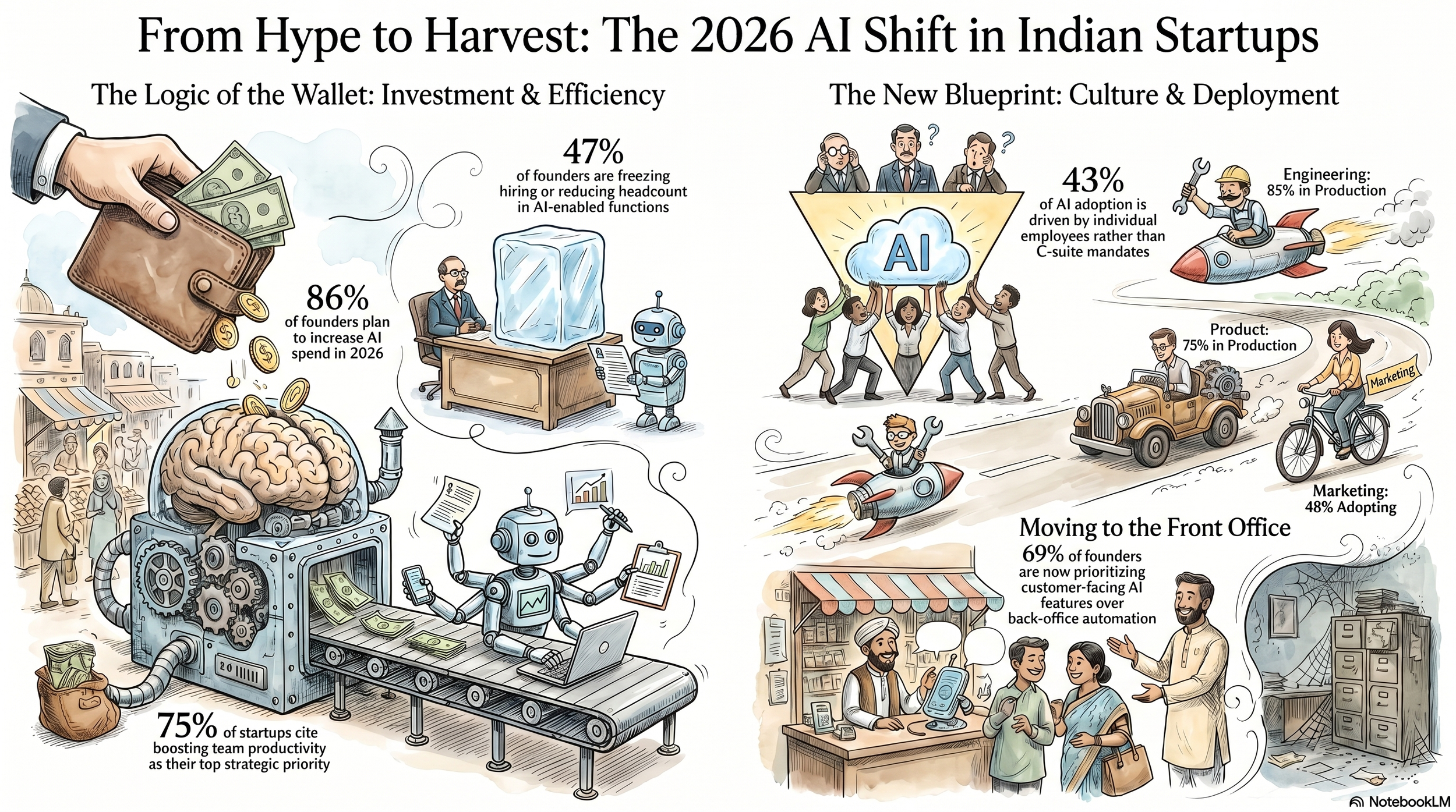
India's startup founders have made their call on AI, and the money is following. Elevation Capital's State of AI Adoption 2026, a survey of more than 200 founders and senior executives, finds 86% planning to increase AI investment over the next 12 months, with productivity already proven and harder questions about strategy, governance, and scale now coming into view.
The report, which covers responses from CEOs, CTOs, CPOs, CMOs, and operations heads across India's startup ecosystem, captures a landscape in the midst of a structural shift. AI tools have moved from experiment to operational infrastructure, investment intent is at its highest point yet, and the cultural resistance that plagued rollouts as recently as 18 months ago has largely disappeared. Of the founders surveyed, 53% plan to increase spending significantly, and only 4% expect to cut back. "What our survey reveals is a landscape that has decisively shifted from experimentation to execution," the report states.
Productivity First, Revenue Later
The clearest value proposition of AI in Indian startups, at least for now, is speed. Productivity gains and faster time-to-market together account for 82% of the measurable business impact founders have seen, according to the report. Only 9% cite increased sales or conversions as their primary win so far. The revenue impact, founders say, is anticipated but has not yet materialised.
Seventy-five percent of founders name boosting internal team productivity as their top AI priority for 2026, well ahead of the second-ranked goal of launching customer-facing AI features, cited by 69%. The logic, as the report frames it, is that productivity is the proving ground: teams that move faster ship better products, which eventually translates into competitive and commercial advantage.
The most unexpected benefit reported by 45% of founders was faster experimentation, specifically the ability to test ten times more ideas than before. One early-stage founder quoted in the report noted that product managers on their team could launch interactive content in a single day without developer involvement, a task that previously required at minimum seven days and one dedicated engineer.
Engineering Leads, HR Lags
AI adoption across business functions is far from uniform. Engineering is the most advanced, with 85% of companies already running AI projects in production. Product teams are close behind at 75%. Marketing sits at 48% and operations at 40%, while customer support, sales, finance, and HR all trail significantly.
The unevenness, according to the report, reflects the maturity of available tooling rather than a lack of willingness. For HR, finance, and legal functions, the AI product ecosystem is still too nascent for scaled deployment. The report treats this as a forward signal: the next wave of AI-native companies will likely be those that build specifically for the still-underserved functions.
The founder and CEO cohort, comprising 90 respondents, 99% of whom are also founders, offers the sharpest window into how startup leaders are thinking about AI at the strategic level. The findings reveal a group that has moved past the hype cycle but has not yet worked out the operational details.
80% of CEOs in the survey disagree with the statement that AI tools are more hype than substance. Sixty-nine per cent believe AI gives startups a structural advantage over larger incumbents. And 88% reject the idea that AI will replace most knowledge workers within five years, suggesting that the people closest to implementation are also the most sceptical of the most dramatic predictions.
Yet 58% of those same founders acknowledge that their company does not have a clear AI strategy. Conviction, in other words, has outpaced codification. The report also finds that 72% of founders consider data quality a bigger bottleneck than AI capability itself. The models may be capable, but feeding them clean, structured, and context-rich data remains an unsolved problem for most early-stage companies.
Regarding what is stopping them from getting started, 53% of founders cite bandwidth as the primary barrier. Teams are too stretched to implement the tools that would make them less stretched. Cultural resistance, by contrast, has fallen sharply as a concern, flagged by only 25% of respondents. The debate about whether to adopt AI has ended. The debate about how is very much ongoing.
Scaling AI presents a different set of obstacles. Fifty-four percent of founders say AI tools require too much manual context to function reliably at scale, while 48% cite both waiting for tools to mature and concerns about output quality. Where the barriers to getting started are largely about internal capacity, the barriers to scaling are largely about the tools' limits.
Inside Engineering: The CTO View
Forty-two CTOs participated in the survey, 83% of them founders, and they represent the cohort that has gone furthest into AI implementation. Ninety-two per cent report greater excitement about AI than a year ago, the highest figure of any group in the study.
Their enthusiasm is grounded in direct experience. CTOs have shipped with these tools and debugged their failures. They have also formed the sharpest view of what is still missing. When asked about barriers to scaling AI, they do not point to bandwidth or budget. They point at the tools: 67% say AI requires too much manual context to work reliably, 58% flag output quality as not yet production-ready, and 46% say models do not learn adequately from feedback.
Across the software development lifecycle, code generation has reached near-universal adoption, with 92% of teams using it and 39% running it at full scale. Documentation and debugging both sit at 72% adoption. Test automation is at 61%. DevOps and infrastructure remain the least-penetrated stage, at 44% adoption and only 11% at scale, reflecting how much that layer demands of AI in terms of reliability and system context.
The economics of AI tooling present a paradox the report highlights directly. Thirty-six percent of CTOs spend between $51 and $100 per developer per month, while 28% already exceed $200. Sixty-one percent report positive return on investment. But cost-effectiveness scores as the lowest-rated dimension of overall satisfaction. CTOs acknowledge that AI is worth the investment while also signalling that the price-to-performance ratio has not yet met their expectations.
On the question of proof-of-concept conversion, 85% of CTOs report that at least 10% of their AI POCs make it to production, and nearly half convert between 30% and 60%. Accuracy and output quality are the most common reasons POCs fail to advance, cited in 44% of cases. Getting from a demo that works 80% of the time to a production system that works 95% of the time is where the bulk of engineering investment concentrates, and where most efforts stall.
The majority of CTOs are neither building custom AI models in-house nor purchasing specialised AI software. They are calling foundational model APIs and orchestrating them through frameworks such as LangChain. Fifty-six percent have built nothing custom, and 67% have bought no specialised tooling. The API-first approach is fast, flexible, and currently the default across the ecosystem.
Governance, however, is largely absent. Fifty-eight percent of CTOs have no observability platform in place and 67% have no guardrail tooling. The AI stack in Indian startups is being built code-first. Monitoring, testing, and safety infrastructure are an afterthought. The report frames this as simultaneously the most significant operational risk in the ecosystem and the clearest product opportunity for tooling companies.
Headcount Is Being Recalibrated, Not Collapsed
Nearly half of all founders, 47%, are freezing hiring in specific functions or actively reducing team sizes. A further 23% are watching and waiting. The report is careful to contextualise this: it is not a wave of mass layoffs. What is happening is more structural. Founders are finding that smaller teams can produce significantly more output, and they are adjusting headcount planning accordingly, one function at a time.
Engineering leads the list of functions seeing the most hiring reductions, followed by marketing, customer support, and operations. Junior and entry-level roles are bearing the greatest impact. CEOs are directing 45% of their AI budgets toward engineering, product, and data, the areas of highest adoption and most mature tooling. Sales and marketing receive 21% of budget. HR, finance, and operations remain in single digits.
CTOs offer a more granular version of the headcount story. They are cutting general engineering roles while simultaneously hiring AI specialists with skills in production deployment, model evaluation, and reliability engineering. Forty-three percent of CTOs identify a talent shortage, but the shortage is not in engineers. It is in engineers who know how to build and maintain AI systems in production. The net result, the report argues, is a talent reshuffle rather than a straightforward reduction.
Adoption Is Now Being Driven From Below
One of the more striking reversals the report documents is in where AI adoption is originating within organisations. Forty-three percent of founders say adoption is now primarily bottom-up, driven by individual employees who are discovering, testing, and advocating for AI tools on their own initiative. Function-level champions account for 33%, and centralised AI teams for 25%.
A year ago, cultural resistance was among the most-cited barriers to AI rollout. The survey data suggests that dynamic has inverted. Employees are now ahead of institutional processes. For founders, the report notes, the internal sales job is over. What remains is building the operational infrastructure to support what employees are already doing.
Elevation Capital asked an open-ended question of 48 founder respondents: what single change would do most to accelerate their AI journey? Three themes emerged clearly from the responses. The most common was lower cost with maintained quality. Founders want frontier model performance at price points that work for startup economics, and specific asks around rate limits, trial credits, and cheaper inference came up repeatedly.
The second theme was better integration of context across tools. Founders describe a fragmented environment where AI systems do not carry institutional knowledge across platforms, and the ability to connect AI seamlessly across a company's CRM, codebase, internal documents, and communications is seen as the next significant unlock. Third was human readiness. The tools, multiple founders indicated, are now good enough. The constraint is whether teams have the skills, training, and leadership support to use them well.
The Gaps That Remain
The picture Elevation Capital's report presents is not one of seamless transformation. The ecosystem has crossed a meaningful threshold, but significant gaps persist. Most companies lack a documented AI strategy. Data infrastructure is not ready for the ambitions being placed on it. Governance tooling is almost entirely absent. And the functions that most need purpose-built AI solutions, namely HR, finance, and legal, remain largely underserved by the current generation of products.
The report's conclusion is measured. Indian startups are firmly committed to AI, and that commitment is now backed by evidence rather than aspiration. The harder work of converting that commitment into scalable, reliable, well-governed systems is what comes next. The companies that do it well, the report suggests, will build advantages that incumbents will find very difficult to match.
