
The Spider on the Lens: How a Product Failure Shaped Axis Communications' Perimeter Security Philosophy
A spider walking across a camera lens looks, to an early AI system, a lot like a threat. The legs move. The shape crosses the frame - an alarm fires. Somewhere, an operator responds to nothing.
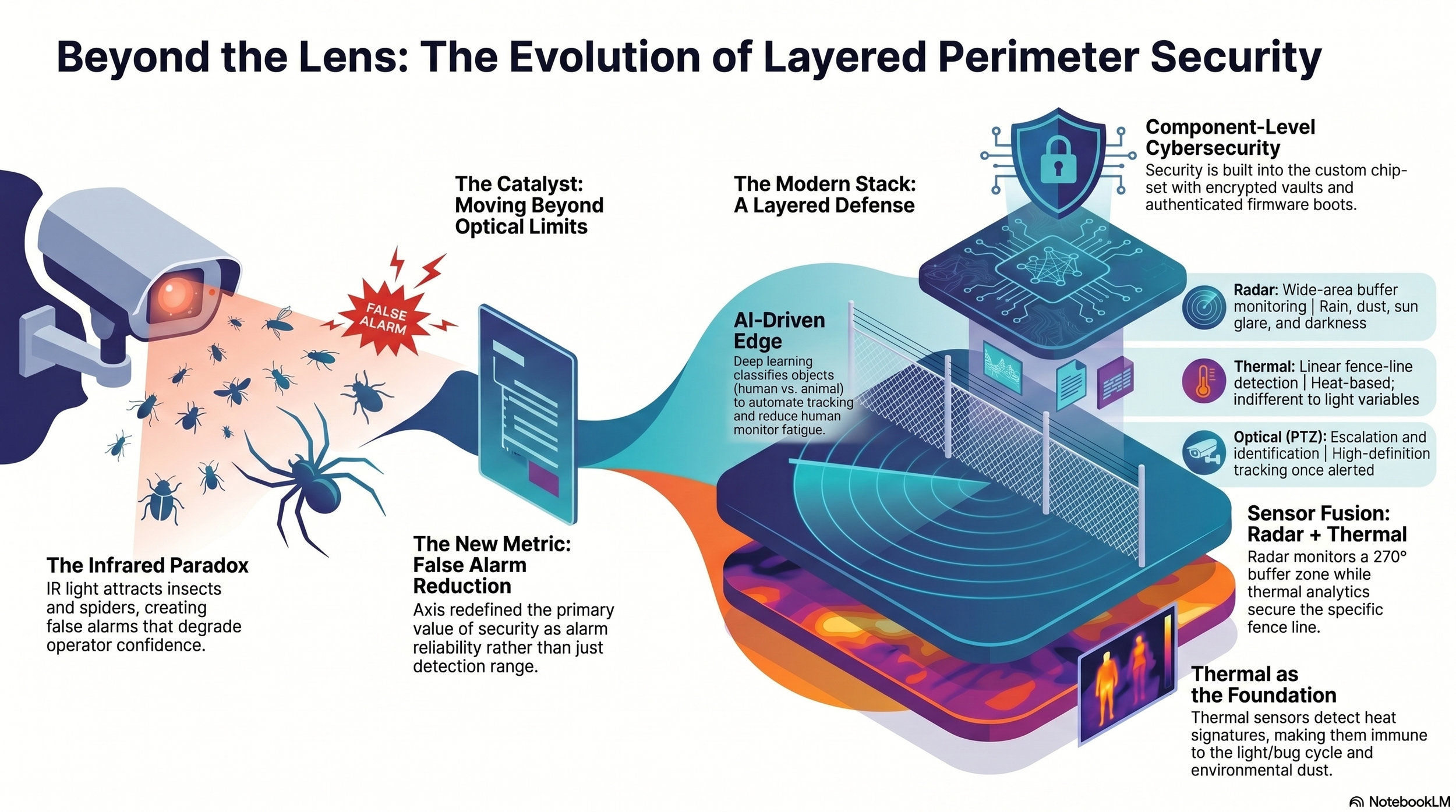
This is not a hypothetical failure mode. It is what happened when the security industry tried to solve the night-vision problem on outdoor perimeters by adding infrared illumination to optical cameras. Infrared light attracts insects. Insects attract spiders. Spiders patrol lenses. The alarm count climbed, operator confidence degraded, and the system designed to protect a site became the thing undermining it.
Rudolph (Rudie) Opperman, Engineering and Training Manager for the Middle East and Africa at Axis Communications, uses this episode not as a cautionary tale but as a design principle. "You're creating the problem by adding the light, but you need the light in the first place," he said. The answer was not to build better insect filtering into the AI. It was to stop attracting insects. Thermal and radar sensors emit no light. The problem disappeared.
That instinct, finding the structural flaw rather than engineering around it, runs through a decade of product development at Axis that has taken the Swedish network video company from single-sensor surveillance to a layered, AI-driven perimeter architecture now deployed across oil and gas facilities, power infrastructure, desalination plants, data centres and smart city projects spanning the Middle East and Africa. Axis, part of the Canon Group and operating across more than 50,000 partners globally, has invested significant product development resources in a proposition that repositions the entire competitive framing of the category: false alarm reduction is not a secondary feature. It is the primary value proposition of any serious perimeter deployment.
The environmental problem that optical cameras could not solve
The foundation of the stack is thermal technology, and the case for it was built on a straightforward problem that conventional cameras kept failing to solve. "The challenges with a perimeter specifically are the environmental challenges," Opperman said. "Dust, fog, mist, and the daylight sequence. A perimeter needs to be protected at night where light is limited." High-definition optical cameras perform well in controlled conditions. Perimeters are not controlled conditions. A sensor that degrades in dust or darkness is a liability precisely when it is most needed.
Thermal cameras detect heat signatures rather than reflected light, making them broadly indifferent to the variables that defeat optical surveillance. Axis began exploring their application in security roughly a decade ago, and early deployments established a signal that would shape everything that followed. The technology was not just detecting better than optical. It was producing a false alarm count that was manageable in a way competitors' systems were not. The product that emerged from that work, initially called digital barriers and later Perimeter Defender, demonstrated that thermal combined with edge-based analytics could hold a fence line with a nuisance alarm rate low enough for operators to act on every alert with confidence. "More important than how far you could detect," Opperman said, "was how many false alarms you were getting."
Radar changed the geometry
Thermal technology covered the fence line. What it could not do was monitor the buffer zone outside the perimeter, the ground between the barrier and the wider environment, where a threat is already moving before it reaches the fence. Radar addressed that gap, and its operational characteristics were complementary rather than overlapping. Where thermal worked along a linear field, radar offered wide-area coverage spanning more than 270 degrees from a single device drawing under 30 watts. Where thermal depended on a relatively unobstructed atmospheric path, radar operated through rain, dust, sun glare and darkness without degradation.
The integration of radar with thermal surveillance produced the first genuinely layered architecture. Radar watched the buffer zone and generated early warning. Thermal, with analytics running at the edge, monitored the fence itself. "That's where the layered approach starts to come in," Opperman said. Two sensors, each performing where the other had constraints, with edge intelligence coordinating between them.
What the spider taught the product team
The infrared episode illustrated a broader pattern in how the product evolved. Theory outran deployment, deployment revealed what theory missed, and the feedback loop shaped the next iteration. Every site that struggled with a new configuration generated data. Every customer conversation produced requirements that were taken back into the development cycle. "Our business is based on relationships with our customers," Opperman said. "You first understand the problem. Every time you do something, you learn from it, you get feedback, you try things, you improve." Engineers matched the emerging wish list from customers against new sensor and AI capabilities, and the cycle repeated.
The MEA region sharpened that feedback loop considerably. Oil and gas facilities, power generation infrastructure and the large-scale smart city developments taking shape across the Gulf all share a common operational characteristic: they are expansive, environmentally hostile sites where perimeter failure is not an inconvenience but a critical risk. The demands coming from those deployments pushed the product harder than a more forgiving environment would have.
AI moved the operator out of the monitor room
As deep learning processors became viable at the edge, the analytics layer changed structurally. Object classification became precise enough to filter birds, windblown dust and animals from genuine alerts without human supervision. Detection range extended. Pan-tilt-zoom cameras were added to the stack, automatically tracking objects across zones in response to AI-generated coordinates without operator instruction.
The practical effect on security operations was significant. Operators who had previously monitored feeds continuously, a task that produces reliable attention failure after roughly 20 minutes by Axis's own observation, were moved up a level. The system handled detection and tracking. Personnel managed escalations, coordinated responses and handled anomalies that required human judgment. One operator could manage a larger site count than before. "The system itself autonomously detects and highlights what is more important," Opperman said. "The operators started dealing with the escalations, the anomalies."
Cybersecurity enters at the component level
Making devices more intelligent expands the attack surface, and that tension is acutely felt across the MEA region where critical national infrastructure faces persistent, sophisticated threat actors. Axis's response is to treat cybersecurity not as a deployment consideration but as a design constraint applied from component selection onwards. The company controls its own application-specific chip, eliminating the risk of hardware backdoors from third-party suppliers. Encryption keys are stored in a dedicated on-device secure vault. Firmware requires authentication at boot, meaning a device running tampered software will not start. Video is encrypted in transmission and at rest. Surveillance networks are segmented under a zero-trust architecture from business IT systems. "It's not an afterthought for us," Opperman said. "We start thinking about cyber from the product development stage."
Managing devices at scale over their operational lifetime raises a different set of challenges. Axis runs a public bug bounty programme, inviting ethical hackers to identify vulnerabilities, and publishes findings when they are confirmed. Firmware management tools allow partners to maintain large device fleets across multiple sites from a centralised location. The company maintains long-term support firmware tracks for customers operating mixed-vendor environments, alongside active tracks for full Axis deployments where security patches can be applied without compatibility risk. Some updates have required disabling protocols that could no longer be considered secure, introducing breaking changes that required active communication with the partner network. "The world is speeding up," Opperman said. "We have to keep up, but we also have to do it responsibly."
What the next architecture looks like
The direction Opperman described for the near term runs along three threads: deeper AI classification that moves from object identification to behavioural inference; expanded sensor fusion incorporating lidar and drone detection alongside thermal and radar; and predictive analytics that draws on historical and pattern data to anticipate threats rather than simply register them. The edge-versus-cloud architecture question is live. Camera-to-cloud deployments are appearing, and the on-premises infrastructure discussion is shifting as enterprise customers increasingly weigh managed cloud against in-house server room commitments.
The throughline from early thermal deployments a decade ago to the current architecture is not a technology story in the conventional sense. It is a feedback story. Every false alarm the product failed to suppress, every insect attracted by an infrared emitter, every operator exhausted by unmanageable alert volumes became a design input. The companies that built systems optimised for detection range found themselves competing on the wrong metric.
