
The 2026 World Cup Is the Most Predictable Cyberattack Window Ever Handed to Adversaries
An active Iranian-affiliated campaign is already targeting the same categories of United States municipal infrastructure that 16 World Cup host cities will operate under tournament load this summer, according to a threat assessment published by Palo Alto Networks ahead of the 2026 tournament, which found that disruptive intrusions, criminal fraud at scale and politically motivated denial-of-service operations against the event are highly likely rather than speculative.
The United States Cybersecurity and Infrastructure Security Agency confirmed the campaign in joint advisory AA26-097A, documenting ongoing Iran-nexus targeting of internet-exposed programmable logic controllers in water, energy and municipal systems, the precise infrastructure on which transit, traffic signalling, wastewater treatment and stadium operations will depend across the 39-day window that opens at Estadio Azteca in Mexico City on 11 June and closes at MetLife Stadium in New Jersey on 19 July.
What makes the 2026 tournament different from any cyber target before it is not its size, though it is the largest sporting event ever staged, but its predictability, and a separate survey of US employees published by Qlik in early June illustrated how thoroughly that predictability has already been internalised on the civilian side, with 90% of workers who plan to follow the tournament saying they were likely to watch matches live during working hours and 68% saying they would delay or reschedule meetings to do so.
The same fixed calendar that allowed those employees to plan their working day around 104 matches in three nations gave adversaries an equally precise map, and the Palo Alto assessment, drawing on cyber operations against mega-events from the 2016 Rio Olympics through the Milano-Cortina 2026 Winter Games, concluded that the only meaningful questions left were who would attack, against which targets and at what severity.
The geopolitical backdrop has rewritten the threat envelope around this tournament
The assessment located the 2026 World Cup inside a geopolitical context materially different from any prior edition, shaped above all by the United States-Israel-Iran kinetic conflict that began on 28 February 2026 and reordered the threat surface for any US-hosted event.
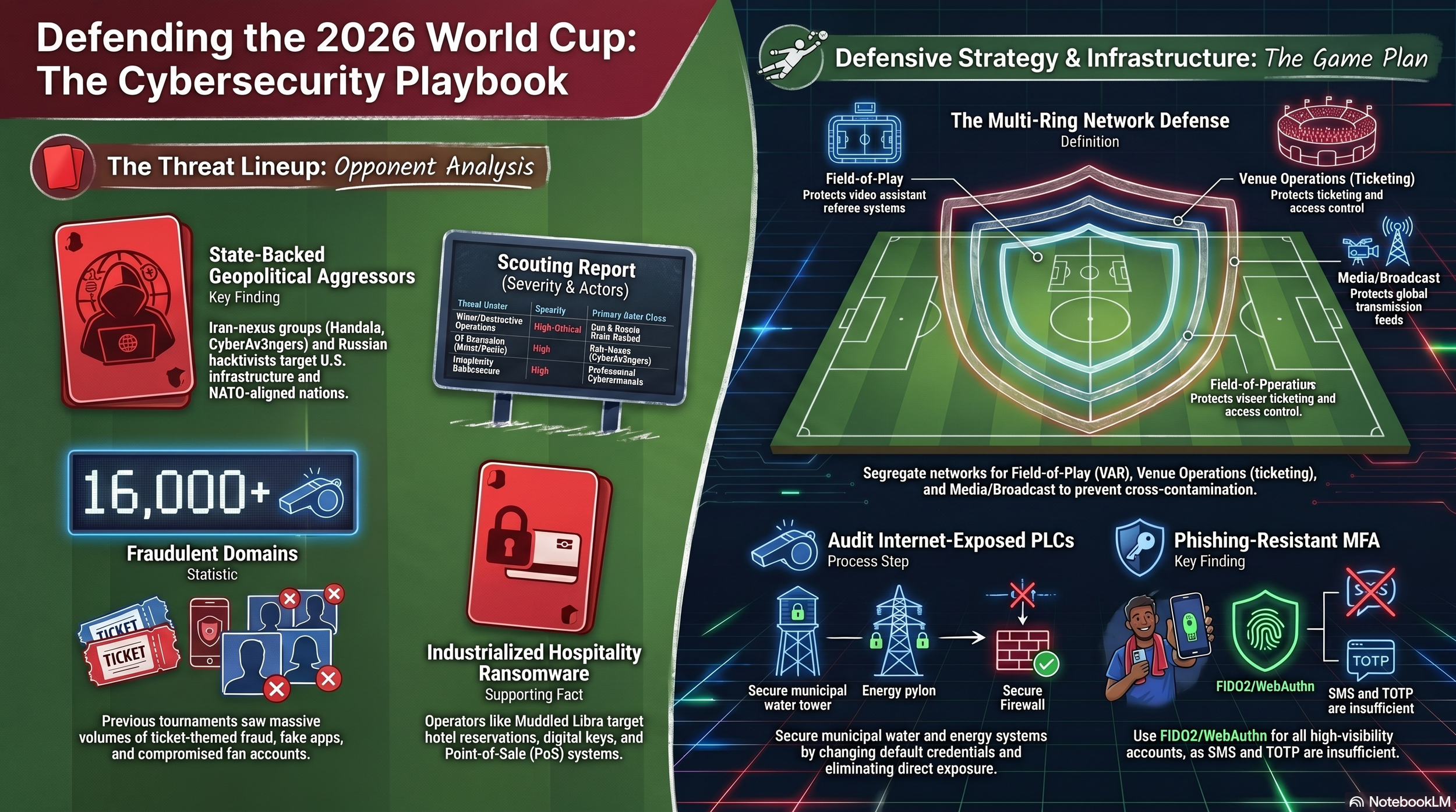
The Handala Hack Team, assessed by the Federal Bureau of Investigation and multiple commercial threat intelligence firms to be a front for Iran's Ministry of Intelligence and Security, executed significant wiper attacks in early 2026, and the CISA advisory confirmed an active campaign against internet-exposed Rockwell Automation and Allen-Bradley controllers in US critical infrastructure, alongside Islamic Revolutionary Guard Corps targeting of Israeli-made Unitronics controllers at water, energy and municipal sites.
These are not adjacent systems, but the operating layer of the host cities themselves, and a 2024 CISA assessment cited in the report found more than 70% non-compliance with existing safety requirements at US water utilities, a baseline of exposure that the tournament does nothing to improve and a great deal to advertise.
Running in parallel is a Russia-nexus hacktivist threat anchored by NoName057(16), which has conducted more than 3,700 verified denial-of-service attacks against governments and critical sectors in NATO member states since 2022 and has repeatedly timed its surges to politically symbolic events, a pattern that places a tournament jointly hosted by the United States, Canada and Mexico squarely in scope. Operation Eastwood disrupted the group in July 2025 without eliminating it.
The UK National Cyber Security Centre confirmed continued operations into 2026, and the assessment noted that pro-Russian hacktivists have moved beyond denial-of-service into operational technology targeting through exposed remote-access services, a shift that collapses the comfortable distinction between a website knocked offline for a few hours and a control system reached by the same actors.
The scale of what will be online simultaneously sharpens every one of those exposures, and Dave Russell, SVP and Head of Product Strategy at Veeam Software, observed that the tournament was about to put billions of people, devices and transactions online at once across ticketing, payments, broadcast, stadium operations and host-city infrastructure, with temporary tournament networks layered onto existing environments, a vast ecosystem of suppliers and partners and countless dependencies that together created real opportunities for disruption.
What distinguished this edition from any before it, in his assessment, was that it would be the first World Cup of the agentic era, where the actor was no longer only human and AI agents could initiate actions, move data, change configurations and trigger workflows at machine speed, a shift that meant trust could no longer rest on intent or assumption and had instead to be grounded continuously in verification, governance and recoverability.
The highest-volume threat is the one aimed directly at arriving fans
For all the weight of the state-aligned threat, the assessment identified financially motivated cybercrime as the highest-volume and highest-likelihood category for the tournament, drawing on the Qatar 2022 precedent in which Group-IB identified more than 16,000 fraudulent domains and 90 compromised fan-portal accounts. Ticket fraud through lookalike resale sites, credential-stuffing against the official fan portal, accommodation fraud routed through off-platform wire transfers and account takeover of FanID-equivalent identities were all flagged as prime targets at scale across the three host nations, and the report singled out QR-code fraud as the single fastest-growing variant, with the geographic spread of the tournament across multiple cities multiplying the openings for fake shuttle passes, parking permits and transport codes that fail only once a traveller has already paid.
The hospitality supply chain forms the other half of this picture, and here the assessment drew on the 2023 Muddled Libra campaign against entertainment organisations, the operators behind ALPHV ransomware, to argue that the reservations, digital-key, point-of-sale and loyalty systems on which host-city hotels run are a proven ransomware target rather than a hypothetical one.
One of two scenarios the report recommended for pre-tournament tabletop exercise involved exactly this: a social-engineering campaign against a major host-city hotel operator that collapses room access, mobile check-in and payment systems for 48 to 72 hours during the run-up to the final, a disruption that would land on tens of thousands of travelling fans with no competition needing to be touched at all.
The historical record shows preparation, not luck, has kept competition running
The assessment's central evidentiary move was to treat prior mega-events as data rather than anecdote, and the pattern it drew out was consistent across a decade. The 2018 Pyeongchang Winter Olympics remain the clearest warning, where the Olympic Destroyer wiper, later attributed by the UK Foreign, Commonwealth and Development Office to a Russian military intelligence unit, disabled Wi-Fi at the opening ceremony along with the Olympics website, ticketing and broadcast systems, compromised more than 300 systems and took 12 hours to restore.
The 2024 Paris Olympics offered the more reassuring counterpoint, where French authorities confirmed at least 140 cyber events, including 22 successful intrusions and a ransomware attack on the Grand Palais, with denial-of-service peaks reaching 190,000 requests per second, none of which disrupted competition.
The reason Paris held, the assessment was careful to record, was not fortune but preparation that began years earlier, including exercises against 500 Games-linked facilities and sustained government-industry coordination, and the 2026 tournament must clear the same bar across more jurisdictions, more regulatory bodies and more languages than any single-nation host has faced.
The temporary tournament network itself compounds the difficulty, since each match runs a layered, ring-based architecture grafted onto pre-existing stadium environments and pulls on municipal services that FIFA does not own, while the Pyeongchang case demonstrated that an IT service provider sits at the centre of the breach path, with Recorded Future finding that Olympic Destroyer samples aimed at the service provider were timestamped five minutes ahead of those aimed at the host.
The defender's only viable posture is to treat the attacks as already scheduled
The accumulation of evidence pointed the assessment toward a single conclusion that doubles as the reader's takeaway: the window for shifting from preparation to live response is closing, and because the threat actors of greatest concern have all demonstrated their capabilities within the preceding 24 months, the defensible assumption is that the attacks will come on a calendar the adversary has already been handed.
The report's recommendations followed from that premise rather than from any single threat category, prioritised by impact, and led with the standing-up of a single multi-jurisdictional cyber operations centre integrating CISA, the Canadian Centre for Cyber Security, Mexico's CERT-MX, the FBI and their federal counterparts, replicating the coordination model that underpinned Paris.
Beneath that headline sat a set of measures that read less as aspiration than as a checklist against known tradecraft: auditing every internet-exposed controller in water, wastewater, energy and transit operations, mandating migration off consumer remote-access tools on production infrastructure, applying phishing-resistant authentication to executive and high-visibility accounts before kickoff rather than during an incident, and pre-positioning denial-of-service scrubbing capacity at an order of magnitude above the Paris peak.
The thread connecting the survey that opened this account to the assessment that filled it is the same predictability cutting in two directions at once, because the fixed calendar that let 90% of surveyed employees plan their viewing around the matches gave adversaries the identical foreknowledge, and the only meaningful difference between the two camps preparing for this tournament is that one is planning around a disruption it expects to enjoy and the other is planning to cause it.
