
Saudi Arabia leads on AI graduate readiness, but access has yet to become applied capability
Saudi Arabia has become the single market in a six-country study where high institutional investment in artificial intelligence, high learner confidence and high employer satisfaction with new graduates all move in the same direction, according to research published on 19 June by Pearson and Amazon Web Services. That alignment, rare across the markets surveyed, positions the Kingdom as a leading example of how a state-coordinated approach to AI in higher education can translate into measurable graduate outcomes, even as a disconnect between tool access and hands-on practice continues to constrain full readiness.
The report, AI Readiness: Building the Bridge from Higher Education to Work, draws on more than 2,700 survey responses from learners, higher education leaders and employers across Saudi Arabia, the US, the UK, Brazil, Vietnam and Malaysia, supplemented by in-depth interviews with higher education leaders. The 402 Saudi responses behind these figures make them a directional read on where the market sits rather than a precise measure of it.
State-led investment is buying alignment that other markets cannot manufacture
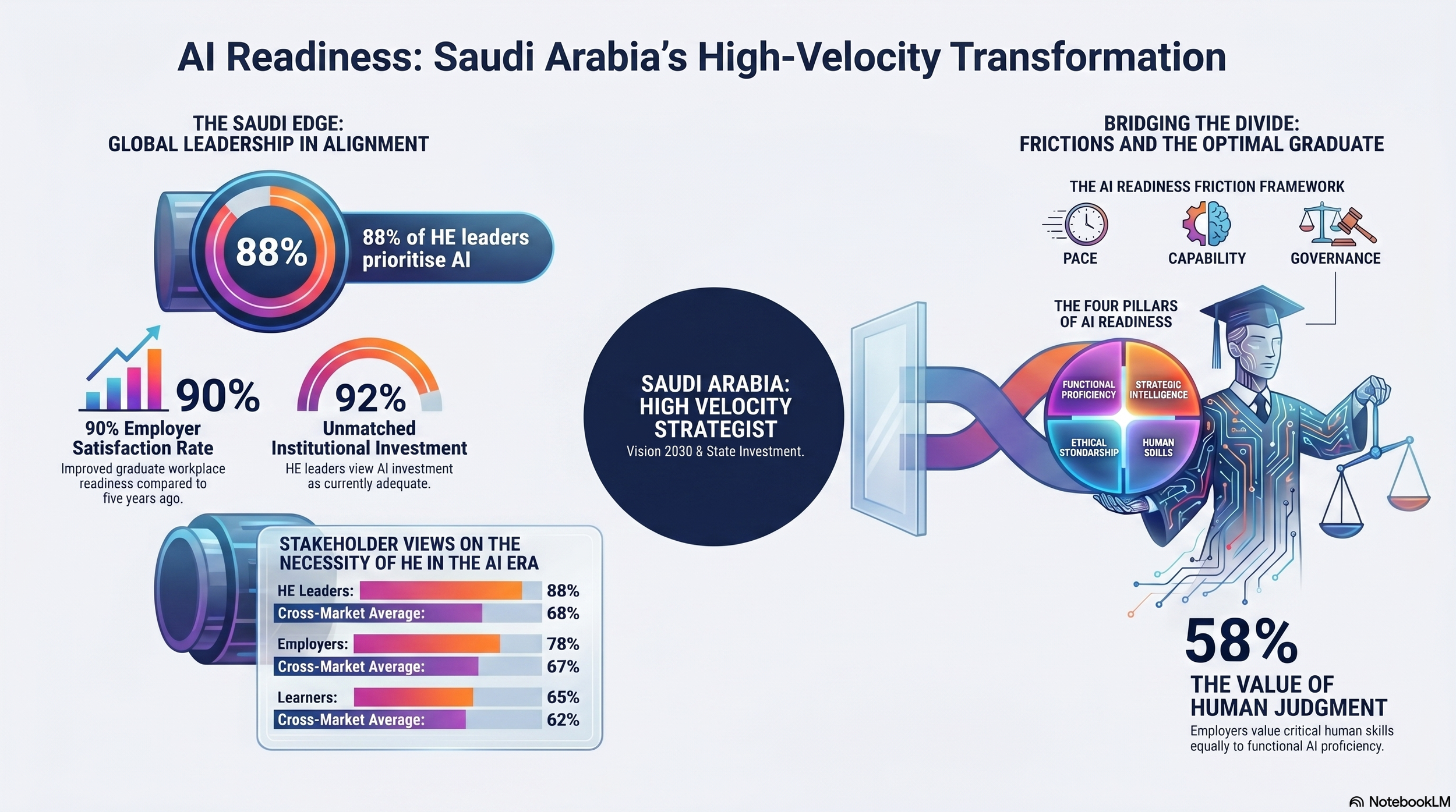
The investment picture in Saudi Arabia is unmatched in the study, and it explains much of why the Kingdom is categorised as a High Velocity Strategist, a market where AI is treated as core to the mission of higher education institutions and backed by substantial, state-led investment designed to synchronise educational programmes with national goals under Vision 2030. Nearly half of Saudi higher education leaders characterise their institution’s AI investment as significant, more than double the cross-market average, with a further 40% describing it as moderate, so that 88% regard AI as either a major or important institutional priority. Only 12% describe investment as limited, a figure that contrasts sharply with the 37% of US higher education leaders who say the same.
What sets the Kingdom apart most is not the scale of the spending but its direction. Investment in industry partnerships runs 20 points ahead of the cross-market average, reflecting a deliberate emphasis on the external connections an AI-enabled workforce demands alongside internal capability. That orientation is what gives Saudi institutions something most markets lack, which is a structural mechanism for keeping curriculum tethered to workplace reality rather than drifting from it.
The investment is translating into outcomes the labour market recognises
The clearest evidence that the model is working sits in the unusual convergence between how institutions, learners and employers each assess readiness. Approximately 90% of Saudi employers say graduate workplace readiness is much or somewhat better than it was five years ago, substantially above the cross-market average of 60%, and half rate recent graduates as excellent, the highest employer satisfaction rate in the study. Saudi learners, in turn, report the second-highest personal AI readiness of any market, with 43% rating themselves as highly ready against a cross-market average of 31%.
The connective tissue running between these groups is employer engagement, where 94% of Saudi higher education leaders report regular interaction with employers, the highest rate in the study, giving institutions access to current and structured workplace intelligence. Tony Lteif, Global Revenue Officer for English Language Learning and Saudi Country Ambassador for Pearson, situated the findings within the national agenda when he said that “Saudi Arabia has created strong momentum for AI readiness by placing skills, education and workforce alignment at the centre of its national agenda.” He added that with large-scale capability-building already underway, the opportunity now is “to translate this ambition into practical, workplace-ready graduate skills,” with the two companies working to bridge the gap between higher education and employers through learning, assessment and credentials.
The frictions that remain are the second-order kind, harder to spend away
The challenges the report surfaces are not the underinvestment that defines other markets, but the more stubborn constraints that emerge once foundational investment has been made. The most acute is experiencing friction. While Saudi learners report strong access to AI tools and instruction, one in three remains dissatisfied with the extent of hands-on, workplace-relevant practice, and employers identify a lack of practical, applied experience among their top three hiring challenges. The report is direct about the remedy, noting that readiness is thwarted when access is not paired with sandboxes, pilot projects and work-integrated learning that turn tool usage into applied competency. This is the friction that exposes the limits of access as a strategy, since a learner can be fluent in a tool without being able to deploy it against a real professional problem.
A capability paradox compounds the picture. Saudi higher education leaders rate their faculty more highly than any other market, with 86% describing them as strong or very strong against a study average of 44%, supported by training that 86% characterise as comprehensive or regular. Yet, the lack of faculty AI expertise remains the single most cited barrier to preparing AI-ready graduates. That apparent contradiction is, in the report’s reading, a feature of operating at velocity, since the standard of what faculty readiness means is continuously reset by the pace of technological change, so even well-trained educators find themselves chasing a moving target.
A governance system that is visible but not yet trusted
The governance challenge in the Kingdom is the inverse of the one most markets face. Rather than absent rules or low awareness, the surface indicators are strong, with 86% of Saudi learners aware of their institution’s AI rules and 84% confident in their own compliance, among the highest rates in the study. The friction lies in the distance between awareness and behaviour. Only 27% of learners would be fully comfortable with teaching staff knowing about their AI usage, and a shadow culture persists in which 46% use self-sourced tools for writing, against just 22% who use institution-provided tools.
High awareness, in other words, has not matured into a culture of open, transparent use, and the report argues that the habits students form during their education will shape how they behave in professional contexts, carrying the risk of shadow AI into the workplace. Professor Tanzila Saba of Prince Sultan University in Riyadh, one of the higher education leaders interviewed for the research, located the underlying point in human readiness rather than technical provision. “You can have sophisticated tools, strong infrastructure, and excellent labs, but if people are not emotionally, mentally, and behaviourally ready, these resources will not achieve their full impact,” she said, describing the first step as bringing people to a stage where they feel at ease and prepared to accept change.
The skills employers signal and the skills institutions teach are not yet aligned
Beneath the headline alignment sits a more specific divergence over which capabilities matter most. Saudi Arabia is the only market where the use of functional AI tools ranks as employers’ top hiring priority, yet higher education leaders underestimate its value, prioritising adaptability and innovative thinking instead, skills that employers rank considerably lower. The mirror image holds for communication and collaboration, which employers rank second among their hiring priorities, while leaders place it much lower, producing a 12-point gap between the two groups.
The consequence is that the greatest distance between current graduate ability and the ideal composite skillset lies in strategic intelligence and critical human skills, the relational, ethical and judgment-based capabilities that sit above pure execution. More than half of Saudi employers, 58%, say critical human skills are equally valuable to functional AI proficiency, and nearly half rank communication and collaboration as their top hiring requirement. Saudi institutions are graduating students who are functionally proficient, the report concludes, but lacking the strategic and relational intelligence employers expect, a gap that curricular reform and deeper workplace connection will be needed to close.
The foundation is built; the remaining work is narrower but no less demanding
For AWS, the through-line across all six frictions is the translation of engagement into capability. Kim Majerus, Vice President of Global Education and US State and Local Government at Amazon Web Services, said the research “reveals that our primary opportunity is to help translate AI tool engagement into real workplace capability,” and committed the company to working with education partners so that every learner develops AI literacy alongside the judgment, adaptability and hands-on experience employers need.
The caution that runs through the report’s conclusion is against mistaking momentum for completion. Professor Saba captured it when she warned that speed alone is insufficient, observing that “it is always good to move quickly, but it is even better to begin with a deep study: to understand whether the initiative is feasible, and whether the required resources are available in terms of infrastructure, software, hardware, and expertise.” Sometimes organisations want to align with national-level strategies, she added, but the realities on the ground may differ, and only an honest reckoning with what is needed against what already exists can turn progress into success.
That is the task the research sets for a market that has already done the hard work of building the foundation. The remaining agenda is narrower but no less demanding: building trust in governance models so that awareness becomes open practice, embedding applied experience in the curriculum so that access becomes capability, and sharpening the skills signals employers send so that institutions teach what the workforce actually values. AI readiness, as the report sets out in its broader lesson, is built or broken in the transition between higher education and work, and is owned by neither alone.
