
Why Poor Data Quality Makes Most Enterprise AI Fail
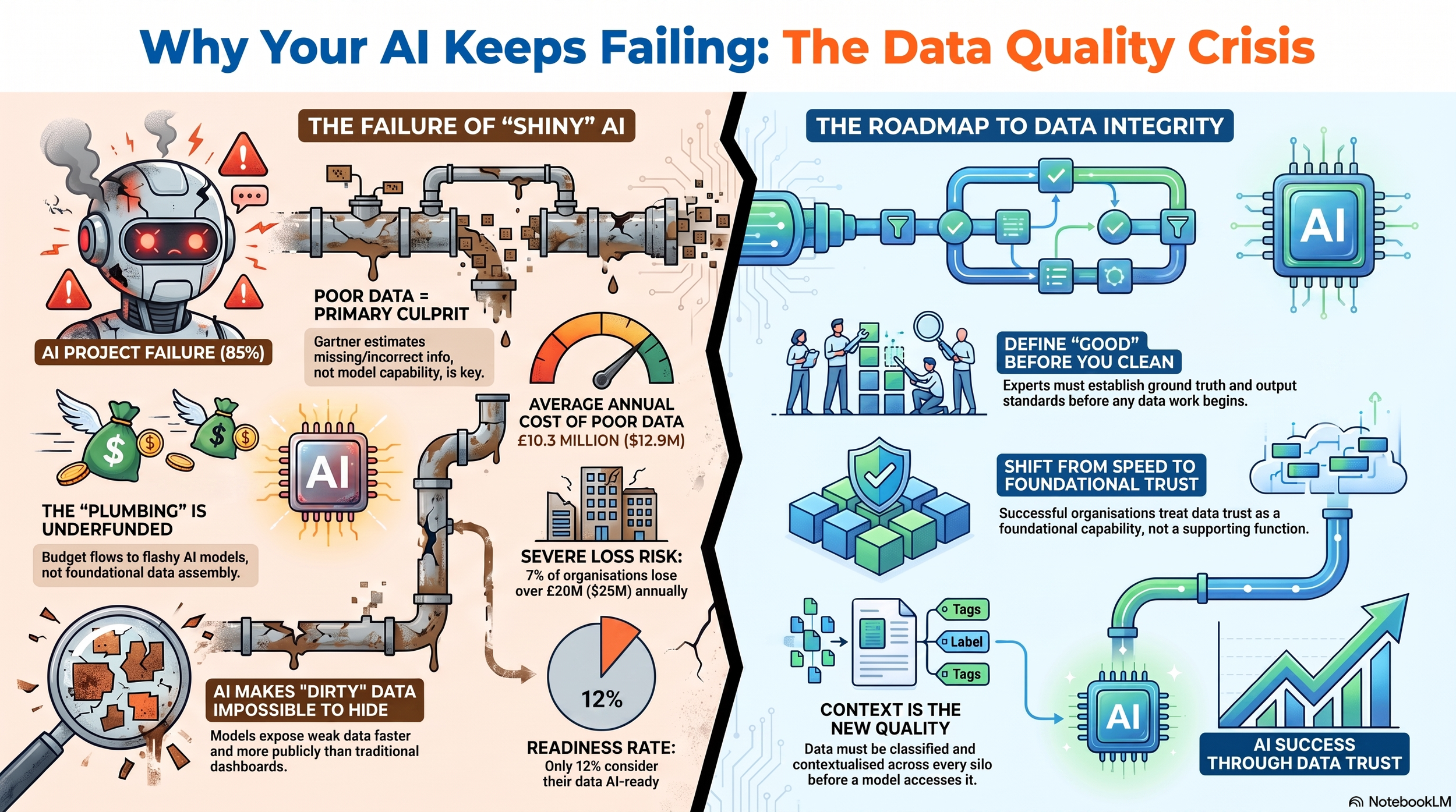
Poor data costs the average company $12.9 million a year, and it is now the reason most enterprise AI never works, according to a Gartner report. Enterprises have spent two decades and untold billions cleaning their data, and it has never been in worse shape. Gartner estimates that 85% of AI projects fail due to missing or wrong data, and the models themselves are rarely the culprit. Capability has arrived. The constraint has moved to the information feeding them, and a growing consensus among the vendors closest to the problem holds that data quality has become the single factor deciding whether AI can be trusted at all.
AI has made the failure impossible to hide because a model exposes weak data faster and far more publicly than any dashboard ever did. The scale of the loss is documented. A 2025 report from the IBM Institute for Business Value found that more than a quarter of organisations lose over $5 million a year to poor data quality, with 7% losing $25 million or more. Informatica's own survey of chief data officers found that only 12% of organisations consider their data of sufficient quality and accessibility for AI.
The problem was never the technology, it was the plumbing nobody funded
Peter Pugh-Jones, EMEA Field CDO at Confluent, has worked with data since the early 1990s and has watched the same difficulty survive every technology cycle since. “The challenge has always been around the data, around assembling the data correctly, making sure you’ve got the right versions of the most current information available for the decisions you need to be able to make,” he said. The reason it persists is unglamorous to the point of being invisible in budget meetings.
“A lot of people don’t think that data is the most exciting thing, but the more boring thing is perhaps the plumbing for making AI better, which is this assembly of the data,” he explained, and money tends to flow toward what is shiny rather than toward what makes the shiny thing useful. He reached for a house built on weak foundations to make the point, warning that no matter how beautiful the structure, “eventually it’s going to start sinking into the ground.”
Much of the damage, in his account, is structural. A large bank kept properly siloed for regulatory reasons ends up rebuilding the same customer record inside corporate, retail, fraud and cyber divisions. “If I am a customer of that bank that is split up into those four or five different departments, there’s going to be four or five different versions of me immediately in their data system,” he said.
Mergers and acquisitions compound the duplication over the years, and the obstacle usually turns out to be organisational rather than technical. “It’s actually legacy decisions that drove the problems that they had,” he noted. Beneath those decisions sits a politics that no architecture dissolves, because a person who alone owns a valuable piece of information has little reason to surrender the control that ownership confers.
Fragmentation is getting worse, and AI is accelerating it
Fred Lherault, Field CTO for EMEA and Emerging Markets at Everpure, formerly Pure Storage, put the operational stakes plainly. “Your AI is only as good as the data that you feed it,” he said. He pointed to a widely reported case in which an AI model wiped a company’s data and backups, and traced the failure to missing context rather than any malicious act. “It was simply that the AI didn’t have the right context. It didn’t understand what was important,” he explained.
His sharper warning is that the fragmentation keeps deepening. “Regardless of how much we as an industry have tried to unify data into one platform, it’s more fragmented than ever,” he said, because AI assistants now let anyone build an application carrying its own fresh data set, worsening the very sprawl the industry has spent years trying to consolidate. His prescription starts with knowing what an organisation actually holds, classifying and contextualising data across every location it lives in before a model is allowed near it.
That question of context runs through the way Levent Ergin, who works on data governance across the Salesforce and Informatica ecosystem, describes acquisition-driven growth turning into unusable insight. Every business a company buys arrives with its own systems, so scale brings duplication as a matter of course. The same customer surfaces across three acquired entities under three different addresses and three different product relationships, and analytics thrown at that mess returns nothing of value.
“It doesn’t matter what insights analytics you throw at it; it’s not going to give you anything meaningful,” he said. His answer is discipline over ambition. “You can’t boil the ocean, so you have to scope what it is that you’re trying to solve, and what you’re trying to solve needs to move the needle for the business, have a P&L impact,” he explained, describing a start-small, test, iterate and scale sequence anchored on the data that matters most.
He also linked poor quality to cost and auditability, noting that data can pass through 20 hops and begin degrading at a single corrupted step that stays invisible without full lineage across every agent and every source.
The real roadblock sits one step before the data
For Avinav Nigam, Founder and CEO of Tern Group, the obstacle sits further back than the data itself. “The biggest roadblock is not that the data is bad. It is that nobody has defined what good looks like,” he said. Most organisations go hunting for data to train or evaluate AI before answering a more basic question, which is what a correct output actually looks like in their domain, and so they end up cleaning toward a standard that does not yet exist. In healthcare, the gap grows acute, with clinical records, HR systems and manual workforce assessments that were never built to be machine-readable.
The definitional work has to come before the data work, and that sequence cannot be rushed. “You have to do the definitional work before the data work,” he said. At Tern, that meant co-designing evaluation frameworks with clinical leadership at Emirates Health Services before any AI layer could be built. “You need domain experts to define ground truth before the machine can learn from it,” he explained, and that process took months with no way to compress it.
These accounts converge on trust, and trust turns out to depend on consistency far more than on raw capability. A system that is mostly right falls short in a regulated setting. “An AI that is right 90% of the time in a healthcare context is not trusted, because the 10% that is wrong could have clinical consequences,” Nigam said. Tern assessed more than 300 nurses through its system before Emirates Health Services relied fully on the output, which he described as the true adoption curve, earned over months of validated consistency rather than through any demo or pilot.
Mena Migally, Regional Vice President for EMEA East at Veeam, described the same tension as a contradiction sitting inside the market, with organisations moving quickly on AI while knowing they lack the controls to govern the data underneath it. “The biggest challenge we are seeing today is not a lack of intent, but a lack of visibility and control at scale,” he said. Once that happens, AI ends up resting on foundations that cannot be trusted. “In practice, the barrier to AI success is not the technology itself, but the reliability and integrity of the data feeding it,” he explained.
Veeam’s own research sharpens the picture, with data used for AI and analytics emerging as the single largest blind spot, cited by more than 40% of organisations, while over a third pointed to third-party environments as a major gap in tracking where data is stored, processed and accessed. Data quality, in his reading, has grown into something wider than accuracy or completeness. “It is increasingly about whether organisations have a clear, real-time understanding of their data across cloud platforms, borders, and partner networks,” he said.
Fixing it means doing the slow work first
The remedies the vendors describe differ in emphasis while pointing in the same direction. Migally would push organisations from awareness to execution, improving visibility across AI pipelines and third-party environments, embedding governance into workflows so that it becomes part of how data is handled, and strengthening resilience so trusted data can be recovered when something breaks. “The organisations that will succeed are those that treat data trust as a foundational capability, not a supporting function,” he said.
Pugh-Jones argues for a different way of working, hooking disparate systems into a governed streaming layer so that decisions draw only from the most current, deduplicated version of the truth, alongside appointing leaders with genuine authority over data across a whole business. Lherault stresses that none of this is ever finished, since platforms, data and use cases keep evolving, and a system built today has to absorb regulations and use cases that do not yet exist. Nigam would have organisations define the output standard first and involve domain experts, alongside data scientists, in building the rubrics that decide whether an output is correct.
The fact is that the enterprise built this problem for itself long before AI arrived. Duplication, fragmentation and absent standards are the residue of how organisations grew, merged and walled themselves off over decades, and no model can compensate for a foundation that was never designed to answer the questions now being put to it. Speed into production has become its own trap. The organisations that will succeed are the ones prepared to do the slow, unglamorous work first, and honest enough with their stakeholders about how long trust actually takes to build.
