
AI is blamed for a quarter of all job cuts this year. The labour data cannot find the effect anywhere
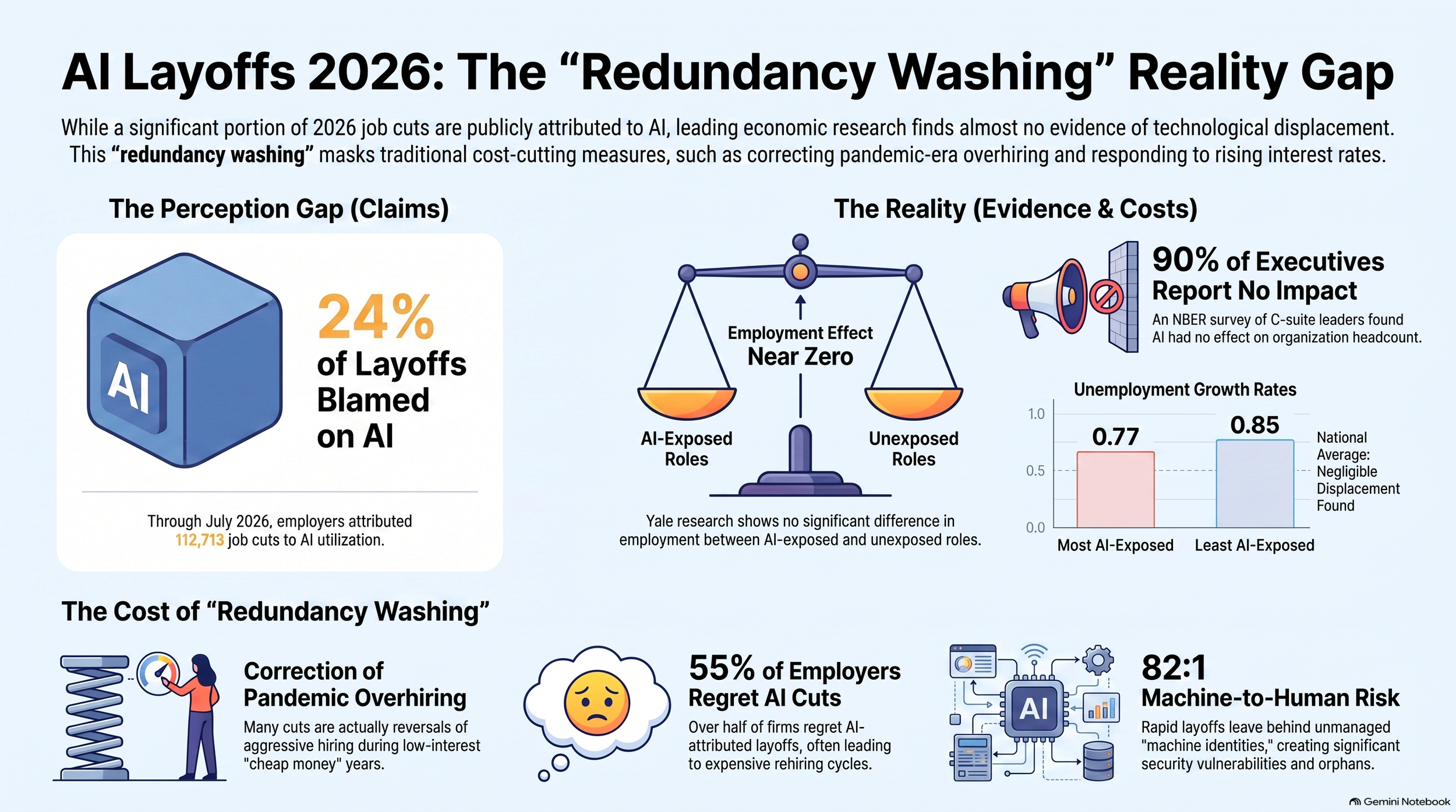
In January 2026, American employers attributed roughly 7% of announced job cuts to AI. By March the share had reached 25%, by May almost 40%, and it has led every monthly tally since, according to Challenger, Gray & Christmas. Through July, AI had been cited in 112,713 job cut announcements, around 24% of all cuts, and in 184,538 announcements since 2023, when the outplacement firm first tracked the category separately. The figure for all of 2025 was 54,836.
The evidence has not moved at anything like that speed. Labour economists studying the same period have found very little to support a story of technological displacement at scale, and the executives making the claim remain the primary source for almost all of it. Sam Altman, Chief Executive Officer of OpenAI, told CNBC-TV18 in February that some companies were engaged in what he called AI washing, blaming AI for layoffs they would have carried out anyway. When the man selling the technology concedes his customers are overstating its effects, the claim deserves harder scrutiny than it has had.
The Budget Lab at Yale ran the microdata behind the monthly employment reports through a synthetic differences-in-differences method in May, comparing AI-exposed occupations against comparable unexposed ones. The estimated effect on employment came out close to zero and statistically indistinguishable from it, and the same held for inflation-adjusted hourly wages. Earlier work by the same team found no unusual rise in occupational churn, the pattern that would appear if large numbers of workers were being automated out of one line of work and into another.
The Stanford Institute for Economic Policy Research reached a similar conclusion by a different route, finding that unemployment among the most AI-exposed quintile of workers rose 0.77 percentage points from 2022, while unemployment among the least exposed rose slightly more, by 0.85 percentage points. A National Bureau of Economic Research study published in February surveyed thousands of C-suite executives across the United States, the United Kingdom, Germany and Australia, and nearly 90% said AI had made no difference to employment at their organisations over the previous three years. Kurt Muehmel, Head of AI Strategy at Dataiku, puts the gap down to several pressures hitting at once. “The truth is somewhere in the middle. Several factors were coming together all at once,” he said.
Two separate cost problems are being sold as one technology story
The first factor predates generative AI. Technology companies hired heavily through the pandemic years, when borrowing was cheap, and carried those employees into the period that followed. The second is what markets now expect from those same companies with money costing more. Neither has anything to do with model capability, and both would have produced workforce reductions on their own.
“During the years of the pandemic, interest rates were very low and technology companies hired a lot of people in response, probably more people than their business required,” Muehmel said. He puts the productivity gains at 30% or more in software development depending on the organisation, and this is where the accounting comes apart. “Are they laying off the developers or are they laying off other roles? I think in many cases they were laying off other roles, roles related to customer support, back office administrative roles, in the effort to be leaner,” he added. The measurable gains sit in one function. The cuts fall on another.
Muehmel is direct about what the combination produces in public. “You have these combining forces of real productivity gains, real overhiring in the past and real pressure to cut the workforce, and altogether it comes together as a convenient narrative that the reason we are cutting this is because we have been so effective at deploying AI,” he said. Asked how much of that survives contact with the numbers, he was equally direct. “Partially, yes, they have been effective at deploying AI. Yes, there are productivity gains. Is it the only reason? No. It is just a convenient story, of course, that is a little bit neater.”
Gartner predicted in February that by 2027, half the companies attributing headcount reduction to AI would rehire staff for similar functions under different job titles. Its October 2025 survey of 321 customer service and support leaders found only 20% had reduced agent staffing because of AI, with the majority reporting headcount had held steady even as they served more customers. Kathy Ross, Senior Director Analyst in the firm’s Customer Service and Support practice, attributed most recent reductions to broader economic conditions.
Klarna is the case everyone reaches for. The Swedish fintech replaced roughly 700 customer service roles with an OpenAI-built assistant, took headcount from about 5,500 towards 3,400, and publicised the results heavily. Satisfaction on complex disputes deteriorated, the projected savings did not fully materialise, and Sebastian Siemiatkowski, Chief Executive Officer, told Bloomberg the company had focused too much on efficiency and cost. Klarna started rehiring. Forrester puts the share of employers who regret AI-attributed layoffs at 55%, and Ford has taken back several hundred engineers after AI-powered inspection missed defects that experienced staff caught. A reduction reversed within eighteen months was a cost decision in a technology cost.
The classification problem means the headline numbers are softer than they look
Challenger, Gray & Christmas, whose monthly report supplies most of the figures quoted on this subject, has been candid about how hard its own categorisation is. In July it tracked twelve utilisation review nursing positions eliminated at a Bronx hospital system after it adopted third-party software. The nurses’ union called it replacement by AI, hospital leaders called that characterisation misleading, and with no clarity on the product, the firm logged the cuts under a separate heading it uses when new technology is named as the cause, and AI is alluded to without being tied to it directly. That holding category accounted for 20,219 cuts in 2025.
Andy Challenger, the firm’s Chief Revenue Officer, has named the incentive, noting that citing AI in a layoff announcement can win over investors while pushing current and prospective employees away, and that company messaging has swung from hedging to aggressive attribution as a result. He expects the picture to get murkier as regulation takes shape and companies grow more careful about what they put in writing. Two other figures from the same July report sit awkwardly beside the displacement story. July’s 33,429 cuts were the lowest monthly total in two years, and announced hiring plans reached 107,500 through July, up 25% year on year and the strongest January-to-July total since 2023.
Profitability is the test the claim cannot talk its way around
Mena Migally, Regional Vice President, EMEA East at Veeam, argues the attribution question distracts from a more basic one about whether any of this produces something a customer would notice. “It would be very difficult to come in and say we replaced the entire marketing team with AI, and the only way that we can quantify it is by saying that we have reduced the human cost element of this,” he said. “The reality is, did you go to market faster, did you release your products in a better way?”
He is unsentimental about the automation argument, and about how little of it is new. “If your job is purely going to be automated, that has nothing to do with AI. That is just how technology has been for the past many, many years, starting from the industrial revolution,” Migally said. On the accounting, he offers a test any board could apply. “You can cut a cake in different ways. The reality of it is the same size.” Anything short of a demonstrable improvement in what reaches the market is, in his words, “just jargon, riding a bandwagon that should not be ridden.”
Muehmel gets to the same place by arguing that separating AI effects from restructuring effects may be impossible from outside the company. “It is actually rather difficult to disentangle the two,” he said, since a general-purpose technology touches processes across an entire organisation and process redesign drives reorganisation of its own. His advice to investors is to stop trying. “What observers should be looking at is what are the investments being made in AI, where are those expenditures, but ultimately how is that hitting the bottom line.” Without that, he said, there is “no proof that this technology is anything other than a fun science project.”
The workforce a company cuts takes its machine estate with it
Redundancy washing carries a cost outside the credibility question, and it falls on the security team. Migally puts the current ratio of machine identities to human identities at 82 to 1, which means a reduction is never only a reduction in people. “When workforce reductions or offboarding happens at scale, these organisations are not simply managing people transitions; they are managing changes to the security posture,” he said.
The identities that worry him are the ones nobody has inventoried. “The risk becomes the service accounts, the scripts, the API connections and ultimately that machine identity that was created, managed and understood by that individual,” Migally said, and organisations without a complete map of those dependencies end up with orphaned, overprivileged assets widening the attack surface long after the employee has gone. The context goes with the person too. Institutional knowledge, in his description, works as an invisible layer of organisational resilience, and its absence surfaces when an audit or an incident requires someone to explain why a process was built the way it was. “The vulnerability is no longer the absence of technology; it is the absence of having the operational understanding,” he said. Companies that cut fast on an untested story tend to find this out the worst way. “The businesses that struggle today are the ones that discovered that they had gaps only after something happens,” Migally added.
Executives who cannot show the working will lose the argument
Redundancy washing persists because it costs nothing to assert and almost nothing to get wrong. Nobody outside the company can falsify a claim about model capability, and by the time the rehiring starts the announcement has done its work on the share price. That will hold until boards and investors treat AI attribution as a claim needing substantiation.
Muehmel notes that companies rarely volunteer the other half of the record, comparing corporate AI disclosure to a social media feed where the failed attempts never make the post. Every organisation wants to look savvy about its deployments, he said, and the reality is not that. Migally’s prescription is to fix the sequencing, setting success metrics before deployment instead of reverse-engineering them from whatever the reduction produced, and to be transparent internally about what is being attempted, since employees who suspect the technology exists to remove them have little reason to help it work. MIT’s finding that 95% of enterprise generative AI pilots delivered little to no measurable impact on the bottom line suggests most companies claiming an AI-driven restructuring have an experiment in progress. Taking the claim as settled fact converts a hiring mistake and a margin decision into a story about being early.
