
Google isn’t just building the Creator Economy, it Also is Writing the Rules That Govern It
Demis Hassabis, the CEO of Google DeepMind and one of the most consequential figures in the history of artificial intelligence, stood on stage at Google I/O on Tuesday and used a meme to make his point. Not a chart, not a technical diagram, not a peer-reviewed finding from one of the most productive research organisations in the world, but a meme, the most disposable unit of internet culture, the format with a half-life measured in hours, the thing that exists precisely because it requires no authentication, no authorship, no provenance. He held it up as an example of what SynthID can now detect, verify and trace back to its origin. The audience laughed. The implication was considerably less funny, because the infrastructure Hassabis was describing in that moment, using the most ephemeral piece of content the internet produces as his illustration, is the most significant consolidation of creative infrastructure in the history of media, and almost nobody in the room appeared to notice.
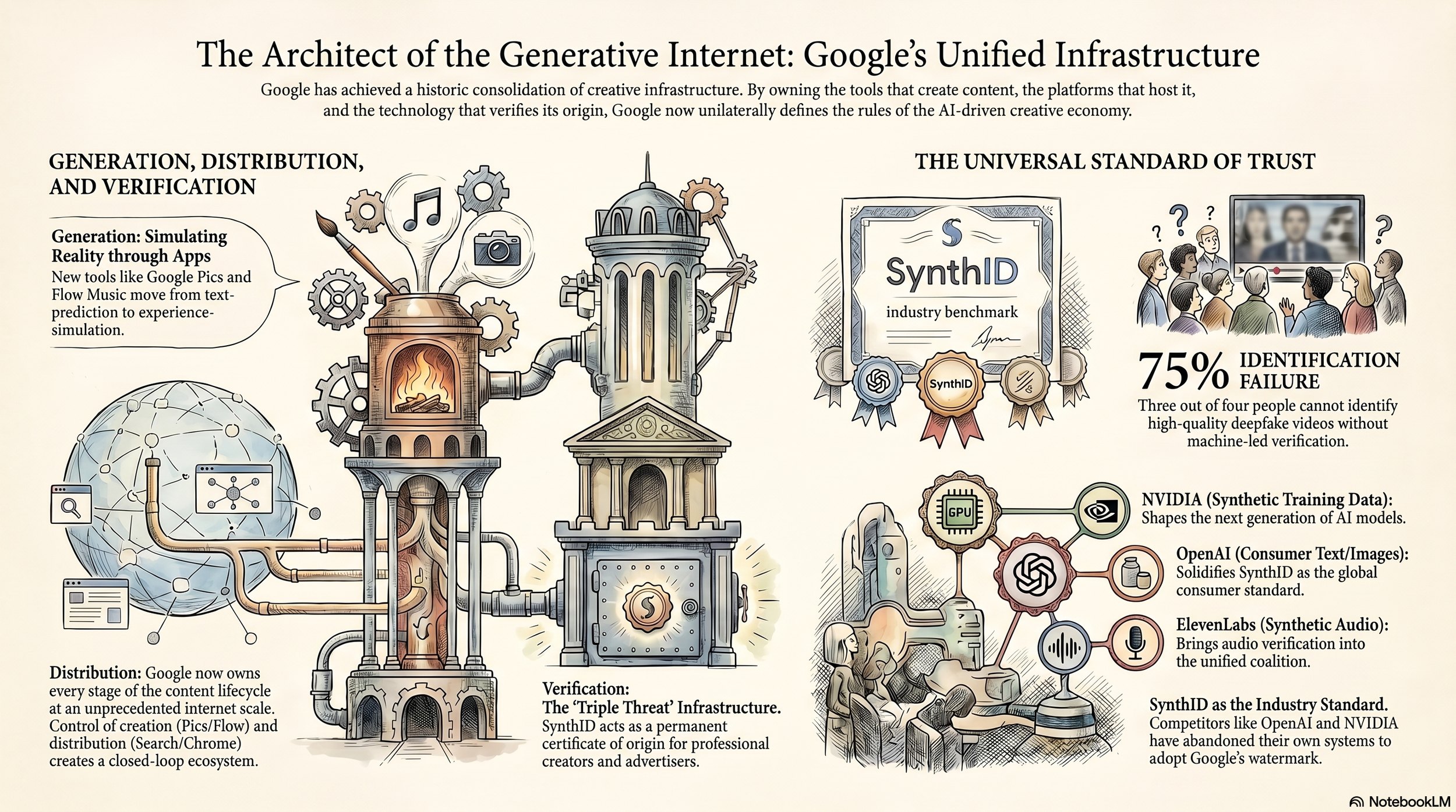
That is the story of Google I/O 2026 that the product announcements, the model releases and the shopping features collectively obscured. Google has spent years building the tools to generate creative content, the platforms to distribute it, and now, with SynthID's expansion into Search, Chrome and Google Lens, the layer to authenticate it. Those 3 things, generation, distribution and verification, have never before been owned by a single company at internet scale.
The moment they are, the rules of the creative economy — who made something, how it was made, whether it can be trusted and what value it carries — are no longer determined by the market or by consensus. They are determined by infrastructure. And on Tuesday, Google announced that its infrastructure had become the industry standard, with the confirmation that OpenAI, NVIDIA, Kakao and ElevenLabs are all adopting SynthID rather than building alternatives of their own.
One hundred billion watermarks and a quarter of a second to fool a human
To understand why Tuesday's announcements matter, it helps to start with what SynthID actually is and what it does, because the name obscures something relatively straightforward. When you use Google to generate an image, record a piece of AI music, or create a video, SynthID invisibly embeds a signal into that content, one that is imperceptible to the human eye and ear but detectable by a machine. That signal survives the kinds of handling that destroy conventional labels and metadata: cropping, compressing, sharing, re-uploading, screenshotting. It is the difference between a label on the outside of a package that falls off in the rain and a serial number stamped into the metal itself. And Google has now applied it to more than 100 billion pieces of content.
Sundar Pichai put the scale of the problem that SynthID is designed to address in plain terms on stage. "As generative AI gets better, so does the need for greater transparency," he told the audience. "Research shows people can correctly identify high-quality deepfake videos only about a quarter of the time." That figure is worth pausing on. Three out of 4 people, when shown a convincingly produced AI-generated video, cannot tell that it is not real.
The tools to produce such videos are now available to anyone with a smartphone and a subscription. The volume of synthetic media circulating online is growing faster than any human moderation system can keep up with. SynthID is Google's answer to that problem, and it is being built into the internet's infrastructure rather than offered as a standalone verification tool that requires a deliberate choice to use.
"We want more people to have easy access to these tools," Pichai said, "so we're expanding both Content Credentials and SynthID verification to Search and Chrome." In practical terms, that means a person browsing the web in Chrome will be able to right-click on any image and immediately see whether it was taken by a camera, generated entirely by AI, or taken by a camera and then altered using AI tools such as the ability to remove unwanted objects from a photo. They do not need to visit a specialist website or download a separate app. The check is built into the browser they already use. Google Lens, the visual search tool available through most Android phones, will extend the same capability into the physical world, so that pointing a camera at a printed image, a billboard or a screen triggers an automatic check of the same kind.
OpenAI's adoption of Google's standard is not a partnership. It is a concession.
For SynthID to work as a trust layer for the internet, it needs to be adopted by the companies whose tools are generating the content people encounter online. A watermark standard applied only to Google's own products would cover a large portion of AI-generated content but would leave significant gaps wherever a competitor's tools were used. Pichai acknowledged this directly on stage. "Of course, this only works at scale if more partners decide to watermark their own AI-generated content," he said. "NVIDIA signed on to SynthID last year. And today, we are thrilled to announce that OpenAI, Kakao and ElevenLabs are adopting SynthID, too. It's great to see the cross-industry collaboration. We're looking forward to expanding to more partners and setting the standard of transparency for the AI era."
The language of standard-setting matters here. Pichai is not describing a partnership programme in the conventional sense of two companies agreeing to work together for mutual benefit. He is describing the point at which a standard achieves the critical mass required for adoption to become self-reinforcing, the point at which other companies join not primarily because they want to but because not joining becomes untenable. OpenAI's presence on that list is the clearest evidence that this point has been reached.
OpenAI is Google's closest and most direct competitor in the AI market. It abandoned its own watermarking plans after internal research found that nearly 30% of users said they would reduce their usage of ChatGPT if watermarks were applied to its outputs. That is a significant finding: nearly a third of the user base of the world's most popular AI application indicated they would use it less if their AI-generated content could be identified as such. OpenAI chose not to implement watermarking on that basis.
What changed is the regulatory environment. The EU AI Act requires that AI-generated content carry machine-readable markers that allow it to be identified as such, and it requires this at scale from August 2026. The cost of building a separate verification system from scratch, one that would need to interoperate with a standard that already covers 100 billion pieces of content and has been adopted by NVIDIA, ElevenLabs and Kakao, became greater than the cost of joining Google's system instead. OpenAI is now building on Google's infrastructure rather than reviving its own, and that decision, made by the company that defined the consumer AI market, effectively closes the debate about which standard will govern AI-generated content on the internet.
NVIDIA's involvement addresses a part of the content chain that most coverage has overlooked. NVIDIA is not primarily a consumer product company. Its Cosmos model pipeline generates synthetic training data for AI companies to train their models. In simple terms, the videos and images that do not exist in the real world but are created to teach AI systems how the world works. Applying SynthID to synthetic training data means that even the raw material used to build future AI models carries a verifiable record of its origin.
ElevenLabs, which produces some of the most convincingly human-sounding synthetic voices available to the public, brings audio verification into a coalition that until now has been weighted toward image and video. Kakao's participation extends SynthID's reach into South Korea's dominant messaging and social media infrastructure. Together, the partner list covers the major ways AI-generated content reaches people: through images, video, voice, and the training data that shapes the next generation of models.
Every piece of content Google Pics creates is verified before it leaves the app
The verification infrastructure announced on Tuesday only tells part of the story. The more revealing part is the set of creative tools Google announced alongside it, because those tools show what kind of creative economy Google is building on top of the verification layer it controls.
Google Pics is a new standalone app for creating and editing images using simple written instructions. A user can highlight a dog in a photograph and ask the app to replace it with a cat, change the colour of a specific piece of clothing without affecting the rest of the image, or translate text written on a sign directly within the photo. These are capabilities that have, until recently, required expensive professional software and significant technical skill. Every image created or edited in Google Pics is watermarked with SynthID at the moment of creation, before it is saved or shared. The verification is not applied after the fact. It is built into the act of making something.
Flow Music is a new standalone mobile app that lets anyone generate and edit music using AI. A user demonstrated on stage how a simple piano melody could be transformed into a complete R&B track in real time, with the musical style, instrumentation, and arrangement all modified through written and spoken instructions rather than technical music-production knowledge.
Google Flow, which the company describes as its AI creative studio, is being upgraded with Gemini Omni, giving it the ability to generate realistic video from text descriptions and edit existing footage by describing the changes rather than making them manually. Project Genie connects nearly 20 years of Google Street View imagery to generative AI, allowing users to create interactive worlds anchored in real places and overlay them onto physical reality through Android XR smart glasses.
Hassabis described the model underpinning all of these tools in terms that are worth taking at face value. "Over time," he said of Gemini Omni, "it will be able to generate any output from any input." What that means in practice is a model that can take a written description and produce a video, take a piece of music and produce a visual, take a photograph and produce a piece of writing, or take a video and produce an interactive world overlaid on physical space. Pichai described the broader ambition as "AI moving from predicting text to simulating reality."
That shift, from a technology that produces words to one that produces experiences across all creative media, is the context in which the SynthID verification layer is most significant. The more convincingly AI can simulate reality, the more important it becomes to have an infrastructure capable of distinguishing simulation from reality at scale.
The Warby Parker signal
The Android XR smart glasses being developed with Samsung, Warby Parker, and Gentle Monster deserve attention that goes beyond the specifications of the devices themselves, because the choice of partners reveals something deliberate about how Google thinks the creative economy it is building will actually reach people. Samsung provides the hardware engineering. Warby Parker and Gentle Monster provide something different and arguably more important: cultural legitimacy. Warby Parker built its brand on making prescription eyewear accessible and desirable to a generation of consumers who had grown up seeing glasses as purely functional. Gentle Monster is a luxury fashion brand that has collaborated with Beyoncé and built flagship stores designed as art installations. Neither company is in the technology business. Both companies are in the business of making people want to wear something on their face.
That is the problem Google Glass failed to solve in 2013, when the product became a symbol of the social awkwardness of wearable technology rather than a mainstream consumer device. The choice to partner with fashion brands rather than technology brands for the first wave of Android XR glasses is a direct acknowledgment that hardware adoption in this category is a cultural question as much as a technical one.
The creative tools built into those glasses, including Project Genie's ability to overlay AI-generated worlds onto physical space, are designed to be used by people who choose to wear the glasses because they look good, not because they run the most advanced AI model. That is a fundamentally different go-to-market logic from any previous attempt at AI-powered wearable hardware, and it suggests that Google's vision for the creative economy extends into the physical world through hardware that people will actually choose to put on.
The watermark is not a warning for legitimate creators. It is a credential.
For the people and organisations that create content professionally, the combination of Google's creative tools and its verification infrastructure changes the practical meaning of what it means to make something with AI. A creator who uses Google Pics to edit a photograph, Flow Music to produce a track, or Gemini Omni to generate a video has, from the moment of creation, a verifiable record of how that work was made. That record survives every form of copying, sharing and repurposing that typically destroys the chain of attribution for digital content. In industries where the origin and ownership of creative work has commercial value, including advertising, music licensing, journalism, film production and publishing, the ability to prove provenance is worth money. The SynthID watermark is not a label warning audiences that content was made with AI. It is a certificate of origin that follows the work wherever it goes.
For brands and advertisers, the rollout of provenance signals in Search and Chrome introduces a previously nonexistent variable into the content and advertising ecosystem. Programmatic advertising, the automated system through which most digital advertising is bought and sold, has struggled with brand safety as AI-generated content has flooded the inventory of websites and social platforms. A brand that pays to advertise alongside what it believes is human-created journalism can currently find its advertisements appearing next to AI-generated content that is indistinguishable from it. SynthID in Search and Chrome creates the technical foundation for distinguishing between the two and, eventually, for making that distinction a factor in how advertising inventory is valued and targeted. The timeline for that capability is unclear, but the infrastructure being built now is the prerequisite for it.
For publishers, the picture is more complicated. If Search begins to surface provenance signals alongside results, distinguishing human-reported and human-written content from AI-generated content as a visible feature of the results page, publishers whose content is verifiably human-produced have a potential differentiator in an environment increasingly crowded with AI-generated alternatives. The value of that differentiator depends entirely on decisions Google makes about how much weight provenance signals carry in its ranking and recommendation systems, and those decisions are made unilaterally. The same company that built the verification standard, developed the creative tools and controls the distribution surface through which most people encounter online content will also decide how much the presence or absence of a SynthID watermark matters for whether that content reaches an audience.
One company now generates, distributes and verifies the creative internet simultaneously
That last observation is where the piece needs to be direct, because the structural position Google has built through Tuesday's announcements is significant enough to warrant saying plainly what it is. Google now creates AI-generated content through Pics, Flow Music, Veo and Lyria. It distributes that content through Search, Chrome and YouTube. It verifies the authenticity of that content through SynthID and C2PA, standards it developed and that its closest competitors have now adopted. It authenticates content in the physical world through Google Lens. No single company has previously occupied all of those positions simultaneously in the same creative economy.
The closest historical parallel is a media company that both produces content and owns the printing press and the distribution network, but even that parallel understates what is new here. A traditional media conglomerate operates in markets subject to competition, regulation, and the constraints of physical infrastructure. What Google is building operates at internet scale, improves automatically with each model release, and is now governed by a verification standard that the rest of the industry has agreed to adopt. The decision about what counts as authentic content, who made it, how it was made and whether it can be trusted, is being embedded in infrastructure that Google controls, deployed through products that billions of people use every day, and enforced through a standard that OpenAI, NVIDIA, ElevenLabs and Kakao have all agreed to uphold.
That is not an argument against any individual product announced on Tuesday. Google Pics, Flow Music and Project Genie each serve genuine creative needs. SynthID addresses a real and growing problem with synthetic media at a moment when the tools to create it are becoming universally accessible. The point is not that these are bad products. The point is that taken together, they describe a concentration of creative infrastructure that the media, advertising and publishing industries have not yet fully reckoned with, and that the conversation about what it means needs to happen with considerably more urgency than the current coverage of Google I/O 2026 suggests.
Hassabis closed the keynote by telling the audience that looking back at this moment, "we'll realise we were standing in the foothills of the singularity." Whether that timeline holds, the more immediate version of the same argument is this: the rules of the creative internet are being written now, in the infrastructure decisions being made now, by the companies with the scale to make those decisions permanent.
On Tuesday, Google demonstrated that it is one of those companies whose verification standards have already been adopted by its closest competitors, and that the creative tools, distribution surfaces, and verification infrastructure it controls collectively describe something the media industry does not yet have a name for. The meme Hassabis held up on stage will be forgotten by the weekend. The infrastructure he was using to illustrate will still be running in a decade, and the rules it encodes will still be shaping what the creative internet looks like long after the products announced on Tuesday have been replaced by whatever comes next.
