
The Consumer-Enterprise Divide in AI Was Always a Fiction. Google Just Proved It
Think about the last 24 hours. At some point, you searched for something personal, a restaurant, a flight, a product, a piece of news that had nothing to do with work; you have also at some point searched for something professional, a competitor, a market, a contact, a document you needed before a meeting. Now try to identify the exact moment those two activities felt like they belonged to different categories of your life, served by different tools, governed by different expectations. If you are honest about it, that moment is increasingly difficult to locate.
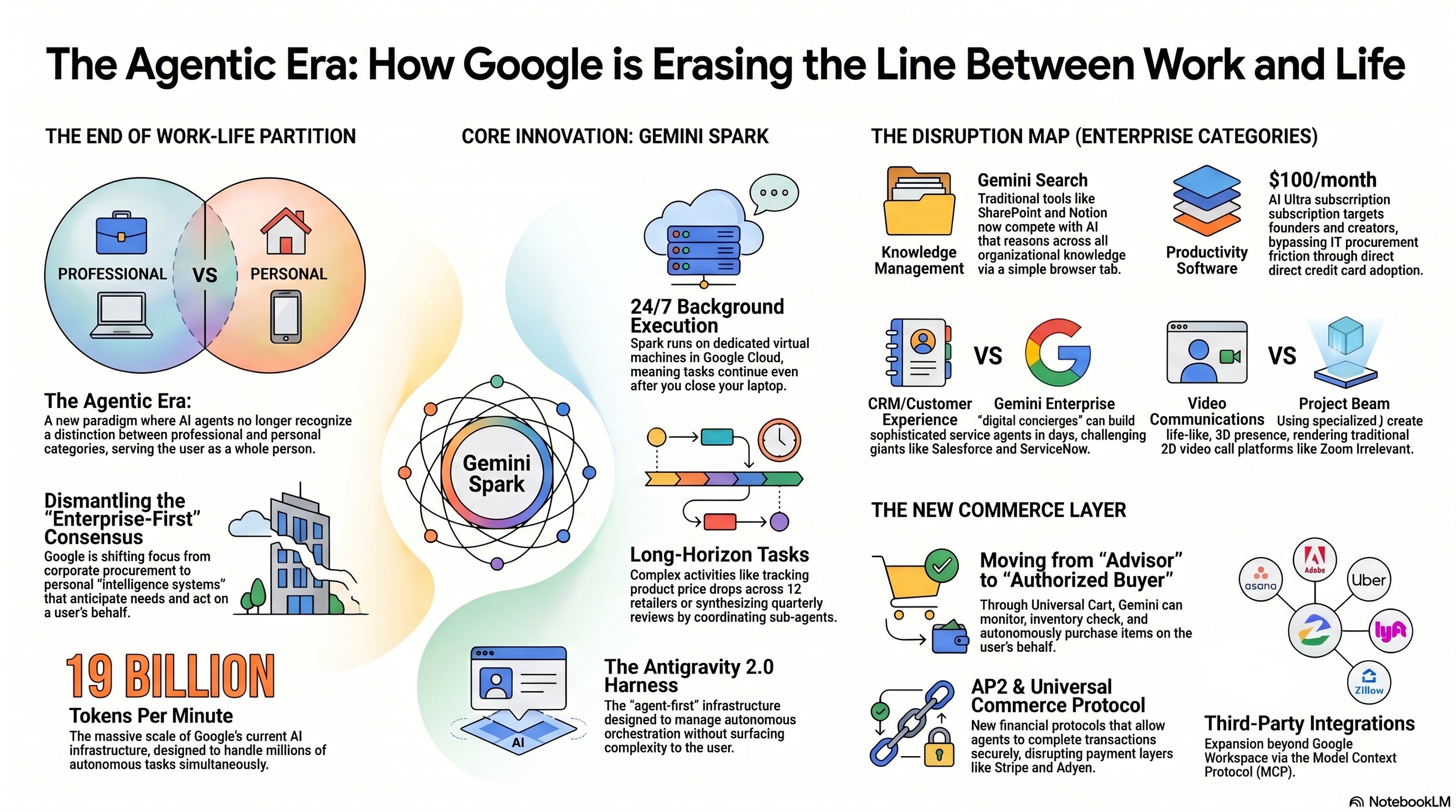
The same device, the same apps, the same browser tab, the same AI interface, and increasingly the same agent running in the background of both, watching, preparing, executing, whether you have asked it to or not. On Tuesday at Google I/O, Sundar Pichai stood on stage in Mountain View and named what that condition has become. "We are now," he told the audience, "firmly in the agentic era of Gemini." The agentic era does not recognise the distinction between your professional and personal lives. It was built, deliberately and at enormous scale, for the person who stopped making that distinction years ago.
The assumption that just broke
Since ChatGPT arrived in late 2022, the prevailing consensus across the technology industry has been that AI's real market is enterprise. The serious use cases and buyers were in corporate procurement, IT departments, and developer platforms. Consumer AI was treated as the demonstration layer, the surface on which you showed the technology before the real business happened somewhere more institutional. The narrative was consistent and, for a time, coherent: AI would transform business first, and consumer applications would follow later, at lower margins, for a different kind of buyer.
Google I/O 2026 permanently dismantles that consensus, and the dismantling is not theoretical. It is structural, priced and already deployed at a scale that makes the enterprise-first framing look like a category error in retrospect. Pichai made the intent clear.
"We've been bringing agents to developers and enterprises for a while," he said. "Now we are super focused on bringing the power of agents, safely and securely, to consumers so that it works for everyone." Not consumers instead of enterprise, not consumers after enterprise, but consumers so that it works for everyone. The architecture is not being adapted for a different market. It is being completed by including the market it has always needed.
Sameer Samat, who oversees Google's Android ecosystem, captured the underlying logic before the keynote. "We're transitioning from an operating system to an intelligence system," he said. "This means deeply understanding your context, anticipating your needs, and getting things done on your behalf." An intelligence system that acts on your behalf does not ask which part of your life it is acting in. It acts in all of it, simultaneously, because your context is your whole context, not the professionally approved subset of it.
The agent that does not clock out
The product that makes this thesis most concrete is Gemini Spark. Pichai introduced it with language that was precise about both the capability and the intent. "I'm particularly excited for Gemini Spark," he said, "your personal AI agent in the Gemini app that helps you navigate your digital life, taking action on your behalf and under your direction. It runs on dedicated virtual machines on Google Cloud. And it's 24/7, so you don't need to keep your laptop open." Please note that closing your laptop at the end of the working day does not end your relationship with Spark. Spark continues running, processing tasks, monitoring workflows, preparing outputs and executing instructions set hours or days earlier.
Pichai described the infrastructure directly. "It's powered by Gemini 3.5 and the Google Antigravity harness," he said, "which allows it to perform long-horizon tasks easily in the background." Long-horizon tasks is the phrase that separates Spark from every previous AI assistant. A long-horizon task unfolds over time, across multiple services, without requiring the user to be present at each step. Preparing a quarterly review by pulling files from Drive, delegating analysis to a sub-agent and synthesising the output into a deliverable is a long-horizon task. So is tracking a product across 12 retailers, monitoring for a price drop and completing the purchase when the target is met. The agent holds both with equal attention and neither with any awareness that one is professional and the other personal.
Varun Mohan, head of Google's Antigravity platform, described the infrastructure's philosophy directly. Antigravity 2.0, the agent harness powering Spark, is, he said, "unabashedly agent-first." The system isn't designed to assist humans; it occasionally automates parts of their work. It was designed to take tasks entirely, run them autonomously and manage sub-agent coordination without surfacing complexity to the user. They see the result, not the orchestration.
Spark integrates with Gmail, Calendar, Docs, Drive, and Sheets, and extends to more than 30 third-party integrations via MCP, including Adobe, Asana, Dropbox, Uber, Lyft, and Zillow. The $100-per-month AI Ultra subscription, which unlocks Spark's full capabilities, is neither a consumer nor an enterprise price point. It is the price a founder, a senior knowledge worker, a creator running a business would pay for a tool that handles the cognitive overhead of both their professional and personal existence simultaneously. Google is pricing for the person who is simultaneously the user and the buyer, which is the person the enterprise-first consensus has been systematically miscounting for 3 years.
Liz Reid extended the agentic logic to Search itself. "You will be able to create, customise, and manage multiple AI agents for your many tasks, right in Search," she said. The world's most widely used information product is no longer just surfacing answers. It is running agents. For everyone. By default.
What this means for every enterprise category
Google I/O announcements have a historical pattern that the enterprise software industry has learned, at considerable cost, to underestimate. In 2019, BERT in Search permanently changed enterprise SEO and content strategy, without most operators noticing until the traffic data told them. In 2023, Duet AI in Workspace looked like a productivity feature. It was the beginning of the end of standalone enterprise productivity software as a distinct market. Each time, the consumer announcement contained the enterprise category redefinition. Tuesday followed the same pattern across multiple categories simultaneously.
Knowledge management and enterprise search are the most immediately disrupted. SharePoint, Confluence, Notion, Guru, and every product built on the premise that organisations need a dedicated system to make internal knowledge findable are now competing with a product that reasons across all of them through a browser tab for $100 a month. The IT buyer who has been renewing a Confluence licence annually now has to answer a harder question: what does this do that Gemini in Search cannot? That question did not have a clean answer on Tuesday.
Productivity software is the second most immediately disrupted category. Microsoft's Copilot strategy has been to embed OpenAI's models across the Office suite and sell the upgrade through procurement cycles measured in months. Spark running on Antigravity 2.0 with 30-plus MCP integrations bypasses that logic entirely. The knowledge worker who pays $100 for AI Ultra does not need approval from the IT department.
They need a credit card. Enterprise software has historically been protected by procurement friction. Spark routes around it, not by being a cheaper version of the same thing, but by being a different kind of thing entirely: a personal agent that handles professional tasks rather than an enterprise tool that happens to be used by a person.
Customer experience and CRM take the most immediate hit from Gemini Enterprise. The ability to build sophisticated shopping and service agents in days rather than months is a direct challenge to Salesforce, ServiceNow and every platform that has spent years layering AI onto legacy infrastructure. Google described the capability on stage as a digital concierge: a prompt like "find me a 4-person waterproof camping tent under $150 and have it delivered by Friday" resolves autonomously, scanning structured catalogues, applying filters, checking inventory and building a cart, with no human operator at any step. The enterprise buyer evaluating customer experience platforms in 2026 is now evaluating against a baseline that did not exist 6 months ago.
Payments infrastructure is the least visible but most structurally significant category Tuesday disrupted. The Agent Payments Protocol (AP2) appears to be a financial infrastructure announcement presented as a shopping feature. Tokenised credentials and irrefutable proof of user authorisation, enabling AI agents to complete transactions without manual input, pose a direct challenge to the payment orchestration layer on which Stripe, Adyen and Braintree have built their businesses.
The Universal Commerce Protocol, developed in partnership with Amazon, Shopify and Walmart as an open standard to unify digital commerce, sits one layer above the payment processor, which is precisely the layer that decides which processor gets used. With UCP and AP2 together, Google is inserting itself between consumer intent and commercial infrastructure at internet scale, across every merchant that wants to participate in the agentic commerce ecosystem.
Video communications is where Project Beam lands with the most concentrated disruptive force on a single incumbent category. Zoom's market cap peaked at over $100 billion in 2020 and has spent 4 years trying to rebuild that valuation on AI features that, fundamentally, remain improvements to 2D video quality.
Project Beam uses an array of specialised cameras to render a person at the other end of a call as a life-like, fully dimensional model, designed to make remote conversations feel as though the other person is sitting directly across from you. It does not compete on 2D quality. It makes the 2D category irrelevant by competing on presence rather than transmission, arriving not through a dedicated enterprise launch campaign but embedded in the same Google ecosystem that 1 billion people opened this morning to check their email.
The commerce layer and what it reveals
The consumer-enterprise dissolution becomes most commercially visible in the agentic commerce announcements that accompanied Spark on Tuesday. Universal Cart is a persistent intelligent shopping hub powered by Gemini that follows a user across Search, Gmail, YouTube and Gemini itself. Items added while watching a product review or reading a promotional email are monitored for price drops, checked for inventory restocks and, depending on permissions granted, purchased autonomously the moment a target price is met. Pichai described Gemini's evolving role plainly: moving from a passive advisor to "an active, authorised buyer."
An active, authorised buyer operating across Search, Gmail, YouTube, and every merchant integrated with UCP does not fall into the consumer technology or enterprise technology category. It sits in a category Tuesday named, but the industry has not yet fully mapped: autonomous commercial infrastructure for the individual, running continuously, executing on their behalf across every dimension of their economic life.
Lo Toney, speaking to CNBC ahead of I/O, identified the stakes precisely: "It's who wins the office copilot market. If the bigger market becomes AI agents and orchestrating them, inference infrastructure, multimodal workflows, enterprise search, that's where we see a big opportunity for Google." What Tuesday demonstrated is that Google is not competing in the office copilot or personal assistant markets. It is competing for both with one product at one price point for one person who has always lived in both simultaneously.
The pattern enterprise buyers cannot afford to ignore
Google is not entering these categories as a specialist vendor competing on feature depth. It is entering them as infrastructure, embedded in products enterprise users already use every day, priced below category incumbents and distributed through a user base that requires no procurement decision to adopt. The defence against a specialist competitor is to build better features. The defence against infrastructure is considerably harder because infrastructure does not compete with the products built on top of it. It makes them optional.
SharePoint does not need to be better than Gemini in Search. It needs to do something Gemini cannot, and the answer to that question is narrowing with every model release. Salesforce does not need to beat Gemini Enterprise for CX. It needs to remain the system of record for customer relationships in a world where the AI handling those relationships runs on Google's infrastructure. That is a different kind of competition, and the enterprise software industry has not yet developed a coherent response to it.
Demis Hassabis closed the keynote with a line delivered with characteristic ambition. Looking back at this moment, he said, "We'll realise we were standing in the foothills of the singularity." Whether that framing holds, the more grounded version of the argument is sufficient. The agentic era Pichai named on Tuesday is not a roadmap item. It is a deployed architecture running on infrastructure that processes 19 billion tokens every single minute, priced for the person who stopped separating their work from their life long before the technology was ready to serve both at once.
The enterprise software industry has built its business model on the assumption that those two things are separate markets. Tuesday's keynote was Google's definitive statement that they are not, have never been, and will not be treated as such again.
