
When AI Risk Reaches the Balance Sheet: Twelve Launches Mapping the Agentic Enterprise
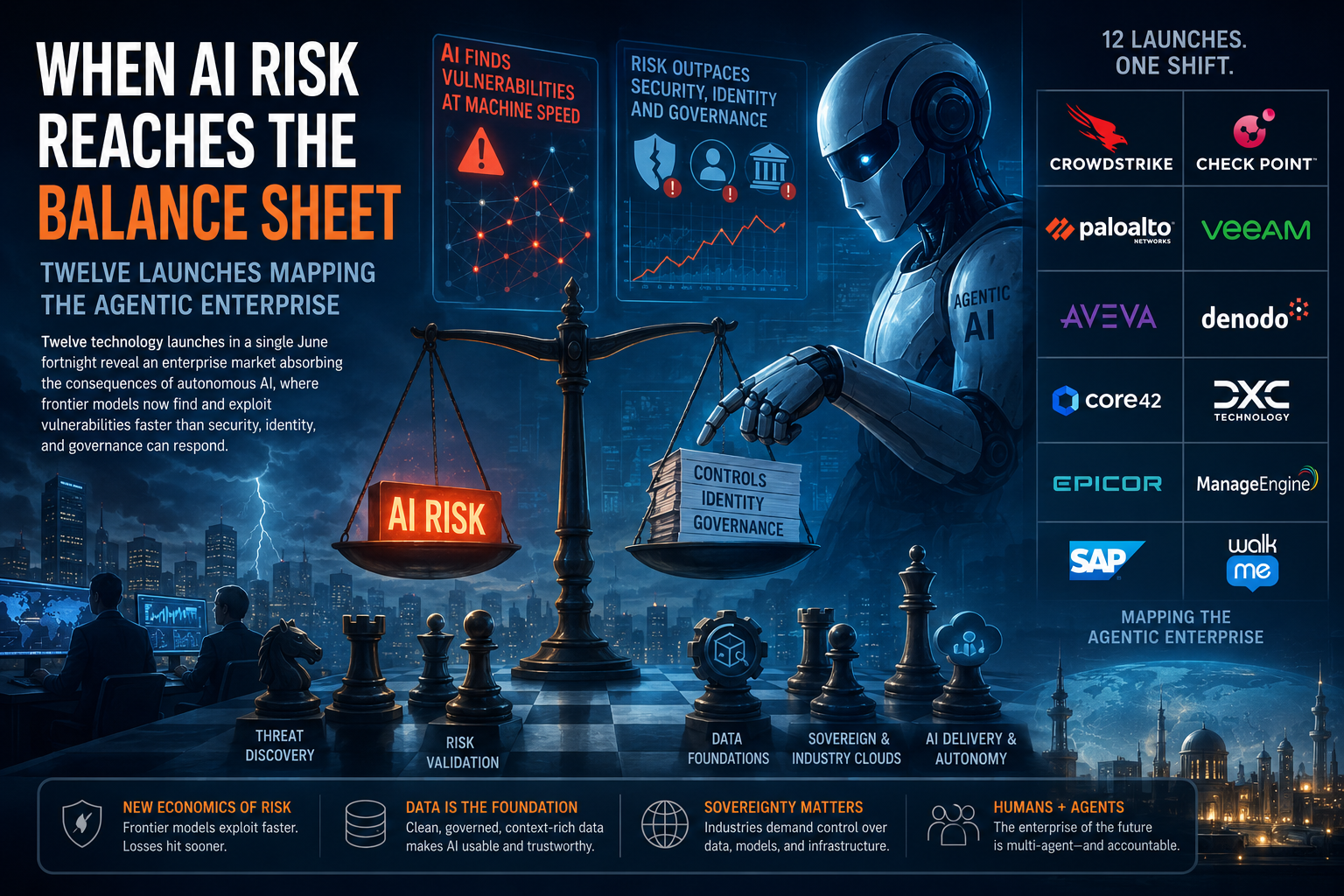
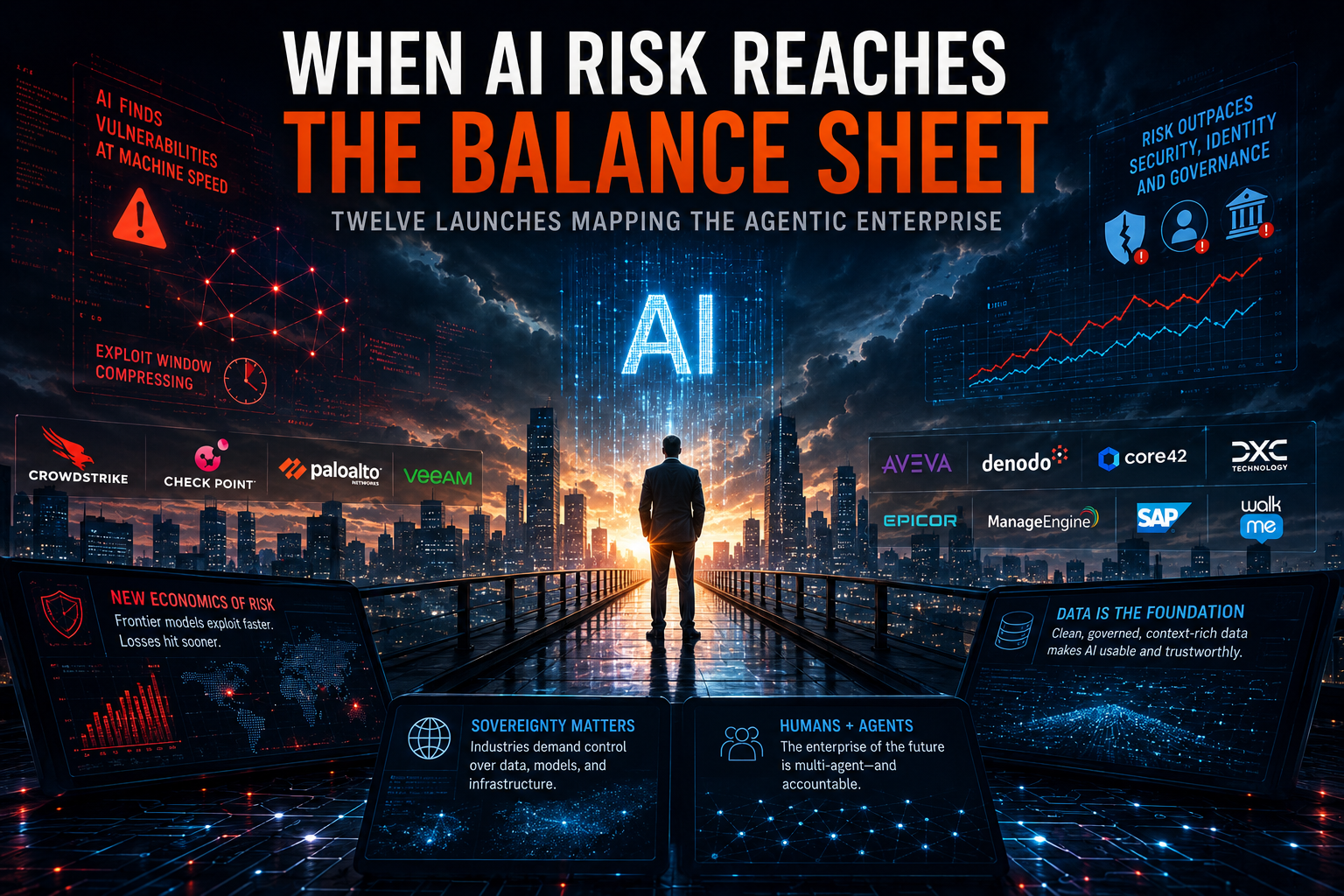
The announcements gathered here arrived within days of one another, and read individually they look like the ordinary churn of a busy quarter, yet placed alongside each other they describe a single shift, which is that agentic AI has stopped being a roadmap item and started generating consequences existing controls were never designed to absorb. Two clusters emerge.
The first concerns the new economics of risk created by frontier models that can find and exploit vulnerabilities at machine speed, which Check Point, CrowdStrike, Palo Alto Networks, and Veeam each address from a different angle. The second concerns the data foundations, sovereign environments, and delivery models that make agentic AI deployable at all, where AVEVA, Denodo, Core42, DXC, Epicor, ManageEngine, and SAP are concentrating their efforts.
1. CrowdStrike extends Project QuiltWorks into the insurance industry, turning frontier-AI risk into something underwriters will price
CrowdStrike took the most consequential step of the fortnight by extending Project QuiltWorks beyond technical discovery and remediation into financial mitigation, bringing cyber insurers and brokers Coalition, Liberty Mutual Insurance, Lockton, Resilience, and Marsh into a framework spanning the full arc from finding an exposure to insuring against the loss it could cause. Daniel Bernard, Chief Business Officer at CrowdStrike, said that frontier AI risk does not stop at technology and instead reaches the balance sheet, and the model combines actuarial intelligence and adversary-informed prioritisation into what the company positions as the industry's first to span technical and financial exposure. The admission underneath it is that frontier AI is compressing the window between a vulnerability being discovered and a loss being realised to the point where, as Resilience framed it through its Risk Operations Center, which exposures actually translate into financial risk becomes the factor determining whether coverage is available at all.
2. Check Point launches Agentic Exposure Validation, deploying AI agents that reason like attackers
Check Point Software went at the same threat from the defensive side, launching Agentic Exposure Validation for its Exposure Management product to answer a question static severity scores cannot, which is not whether an organisation is patched but what an attacker could exploit right now. Yochai Corem, General Manager of Exposure Management at Check Point, was blunt that the era of autonomous, AI-driven exploitation has begun and that frontier models are attacking critical vulnerabilities at scale without human steering, and the product uses AI agents that correlate exposure data, asset context, and live threat intelligence through a safe proving loop mirroring attacker reasoning. The detail that elevates it above a routine release is the disclosure that in early customer engagements the system created novel exploits for dozens of vulnerabilities with no known exploit, the same capability that makes frontier models dangerous in adversary hands now turned toward validation rather than attack.
3. Palo Alto Networks unveils Idira, rebuilding privileged access for a world where machines outnumber humans 109 to 1
Palo Alto Networks unveiled Idira, a next-generation identity security platform built on its CyberArk acquisition, to address the consequence of agentic adoption most organisations have not yet absorbed, which is that privilege is no longer the preserve of a few administrators but a condition shared across every human, machine, and agentic identity with autonomous access. The figures are the argument, with machine and AI identities now outnumbering humans by 109 to 1, with 61% of privileged access requests still fulfilled through standing privilege rather than on demand, and with 9 out of 10 organisations having experienced an identity-related breach in the past year. Peretz Regev, Chief Product and Technology Officer for Idira at Palo Alto Networks, described identity as the new battleground of the AI enterprise where adversaries log in rather than break in, and the platform's pitch is the elimination of standing privilege and the extension of just-in-time controls to every identity.
4. Veeam operationalises privacy and AI governance, conceding that manual compliance has quietly failed
Veeam Software advanced three new AI agents for its DataAI Command Platform under a frank premise, which is that privacy professionals have spent a decade quietly admitting they cannot fully prove compliance with their own policies and are now asked to do the same for AI at a pace no manual programme can sustain. Cassandra Maldini, Head of Product Strategy for Privacy and AI Governance at Veeam, argued that compliance can no longer be a point-in-time exercise and must instead be continuous and evidence-based, a position sharpened by fines under frameworks including GDPR and the EU AI Act now reaching up to 7% of global annual revenue. The three agents, a Consent Agent that propagates user consent signals across every downstream system, a Data Subject Request Agent the company says cuts form launch time by roughly 50%, and an Assessment Agent that generates responses for impact and AI Act conformity reviews, target the spreadsheet-bound work that has left governance unable to keep pace with agents acting at machine speed.
5. AVEVA and AWS sign a multi-year pact to put industrial intelligence and decades of operational data into the cloud
AVEVA and Amazon Web Services announced a multi-year Strategic Collaboration Agreement to bring AVEVA's industrial software portfolio to AWS, expanding its CONNECT platform onto AWS infrastructure using services including Amazon Bedrock and Amazon Bedrock AgentCore as part of a broader multi-cloud strategy. Rob McGreevy, Chief Product Officer at AVEVA, made the case that industrial companies are sitting on decades of operational data holding enormous untapped value, and the collaboration is designed to convert it into intelligence through predictive analytics, digital twin capabilities, and agentic AI workflows previously impractical at scale. The footprint establishes why this matters for industry specifically, with AVEVA software embedded across more than 20,000 enterprises in over 150 countries, the CONNECT platform already managing more than 8 petabytes of trusted industrial data, and the PI System deployed at 65% of Fortune 500 industrial companies.
6. Denodo brings Agora to the Microsoft Marketplace, connecting AI agents to the data that lives outside the cloud platform
Denodo made its Agora cloud service available on the Microsoft Marketplace with a proposition targeting the decisive constraint on agentic AI, which is that agents are only as useful as the data they can reach, and most enterprise data does not live where the agents are built. Agora provides the logical data access layer connecting AI agents to live data across more than 200 source systems spanning on-premises, SaaS, and other cloud platforms, complementing Microsoft Fabric's semantic intelligence by reaching data residing outside Microsoft systems in SAP, Oracle, Salesforce, Snowflake, and hundreds of other sources. Suresh Chandrasekaran, Executive Vice President at Denodo, positioned the launch as giving mutual customers a way to run agentic use cases across their entire data estate while facilitating compliance with data sovereignty requirements, and the integration supports Model Context Protocol access for Microsoft Copilot agents alongside APIs for custom agents built with Microsoft Foundry.
7. Core42 brings Open Innovation AI onto its Compass platform, deepening the sovereign-AI stack for governments and regulated enterprises
Core42, the G42 company specialising in sovereign cloud and AI infrastructure, announced that Open Innovation AI's sovereign AI stack will be available to its customers through the Compass API platform, an integration aimed at organisations for which jurisdictional control over data and models is a requirement rather than a preference. Dr Abed Benaichouche, Co-founder and CEO of Open Innovation AI, argued that sovereign AI has become a strategic requirement rather than a technology choice, and that nations and enterprises increasingly demand full control over their data, models, and operations across multi-silicon environments. Sherif Tawfik, Chief Business Officer at Core42, described Compass as designed to give enterprises secure, scalable access to models and AI applications through a unified platform, with the integration delivered natively on Core42's tenant as a SaaS offering and supplemented by an on-premises stack for organisations needing greater control.
8. DXC formally launches DXC Engineering, betting on the software-defined era with 11,000 engineers
DXC Technology elevated its engineering division into a distinct service offering called DXC Engineering, built on the 20-year digital engineering heritage of Luxoft, which it acquired in 2019, and consisting of more than 11,000 specialised engineers across financial services, automotive, manufacturing, telecommunications, and energy. Ramnath Venkataraman, President of Consulting and Engineering Services at DXC Technology, described the move as a deliberate bet on the company's engineering DNA in the early stages of the software-defined era, bringing together domain expertise, a partner ecosystem spanning silicon and AI compute leaders alongside platform specialists, including Murex and Temenos, and Physical AI capabilities for engineering intelligent systems where software, hardware, and AI converge. The scale claims to anchor the positioning, with software in more than 50 million vehicles, 17 of the world's top 20 banks served, and the proprietary AMBER automotive framework that DXC says reduces vehicle software development cycles by up to 50%.
9. DXC launches CoreIgnite, giving banks a single connection point to fintech ecosystems without replacing the core
DXC Technology also launched CoreIgnite, a cloud-native revenue orchestration platform giving financial institutions a single connection point to fintech ecosystems across payments, digital assets, and embedded finance through a pre-integrated partner network including Ripple, Splitit, Aptys Solutions, and ArcOne. Sandeep Bhanote, Global Head and General Manager of GrowthX at DXC Technology, positioned the platform as fintech infrastructure that lets banks connect new capabilities and orchestrate financial workflows without disrupting the core systems they depend on every day, a philosophy of decoupling innovation from the core that addresses the fragmented integrations constraining many institutions. Built to operate across DXC's Hogan core banking platform and non-Hogan environments, CoreIgnite supports embedded finance, Buy Now Pay Later services, stablecoin-enabled services, and payments orchestration, building on Hogan, which powers more than 300 million deposit accounts and over $5 trillion in deposits worldwide.
10. Epicor compresses cloud ERP go-lives to 90 days by applying AI to the implementation itself
Epicor announced a major expansion of its Ascend programme, introducing a 90-day go-live target for qualified cloud ERP implementations by applying AI to the most time-consuming parts of delivery rather than only to the finished product. Vaibhav Vohra, President and Chief Product and Technology Officer at Epicor, argued that innovation creates value only when customers can put it to work quickly inside their ERP systems, and the programme uses AI to audit a customer's environment, extract and organise data, and generate a migration plan before implementation begins, removing manual discovery work that slows projects and surfacing risks earlier. The programme now supports new customers replacing legacy platforms, existing customers moving to the cloud, and existing customers integrating acquisitions, with the company reporting implementation timelines reduced by up to 40% and the sharpest impact visible in time-sensitive situations such as acquisitions.
11. ManageEngine adds real-time streaming telemetry to OpManager Nexus, retiring the limits of SNMP polling
ManageEngine added native support for gNMI and OpenConfig streaming telemetry to its OpManager Nexus observability platform, addressing the constraint that most enterprise network monitoring still depends on SNMP polling at multi-minute intervals, which leaves teams blind to transient congestion, BGP flaps, and other short-lived events that affect application performance. Gowrisankar Chinnayan, Head of Product Management at ManageEngine, explained that gNMI and OpenConfig are increasingly the preferred way to expose network data because they provide deeper visibility while placing less strain on devices, and the capability delivers sub-second granularity across Cisco, Juniper Networks, Arista, Nokia, and Huawei equipment through a single vendor-neutral integration layer that unifies SNMP, NetFlow, and gNMI collection rather than requiring parallel stacks. The real-time visibility agentic operations cannot be built on a polling model designed for a slower era of networking.
12. EMSTEEL adopts RISE with SAP, laying the cloud foundation a heavy-industry leader needs before it can embed AI
EMSTEEL, one of the region's largest publicly traded integrated steel and building materials manufacturers, adopted RISE with SAP as part of a transformation programme moving the group from an on-premises environment to a cloud-based architecture built on SAP S/4HANA Cloud Private Edition and hosted on Microsoft Azure. Vladimir Arshinov, Group Chief Technology Officer at EMSTEEL, described the move as a landmark that gives the organisation the visibility and control to make faster, better-informed decisions while positioning it to embrace AI and intelligent automation in a meaningful way, and Marwan Zeineddine, Managing Director at SAP UAE, framed it as establishing the foundation for Business AI and agentic capabilities to be embedded across operations. It illustrates the prerequisite the more advanced announcements assume, which is that an industrial organisation operating 14 plants with annual capacity of 3.5 million tonnes of steel cannot embed autonomous AI until it has consolidated fragmented systems into a single standardised environment.
What the dozen launches add up to
Read together, these announcements describe a market that has stopped debating whether agentic AI will reshape operations and started absorbing the consequences of the fact that it already is, and the most telling signal is how often a launch is fundamentally an act of operationalising something that used to be periodic, manual, or assumed to be someone else's problem. The frontier-risk launches share a recognition that autonomous models have collapsed the time between a weakness existing and a loss being realised, forcing security, identity, privacy, and now insurance to operate continuously and with evidence; the foundational launches share the recognition that the binding constraint on enterprise AI is rarely the model and far more often the governed access to distributed data, the sovereignty of the environment, the speed of implementation, and the observability of the infrastructure underneath.
The harder question sits beneath the vendor confidence, because operationalising governance and security at machine speed concentrates consequential decision-making inside automated systems whose own accountability is still being worked out, and the same frontier models being turned toward validation are the ones being turned toward attack. Organisations adopting these tools will need to weigh the operational gains against the human cost of decisions made faster than people can review them, and the practical takeaway from a single fortnight of launches is that the advantage will accrue less to those who adopt the most autonomy and more to those who can prove, continuously and with evidence, that the autonomy they have deployed is under control.
