
Most organisations don't have an AI adoption problem, they have a trust gap: Veeam Report
Most organisations have not failed to adopt AI; they have failed to trust the data that AI runs on, and that distinction sits at the centre of new research from Veeam, which surveyed 600 senior executives worldwide between 16 March and 6 April 2026 and found that 95% of CEOs say data challenges have slowed their AI progress over the past year even as 83% report pressure to accelerate those same capabilities.
The result is a widening gap between what leaders believe AI can deliver and what their organisations are equipped to capture, a gap that the report attributes less to technology or investment than to a failure of executive ownership that no amount of technical capability can substitute for.
The scale of the deployment makes the trust deficit consequential rather than merely awkward, because 88% of organisations are already using or piloting AI agents that act autonomously and make decisions at a speed no human team can match, which means that when the underlying data cannot be trusted, the system does not simply underperform but compounds its errors automatically and at pace.
Autonomous agents turn a data problem into a compounding one
Only 28% of respondents said they were confident they could detect agents operating outside approved parameters, and the proliferation of tools used without security or governance approval, the shadow AI that 95% of organisations know their employees are using and that 44% associate with increased cyber risk, has pushed the exposure further still while leaving 47% to name maintaining audit trails for AI decisions as their top compliance concern.
Veeam set out the problem around four conditions of data trust, namely clear visibility into where data lives and how it flows, enforced controls rather than policy alone, recovery that is tested and validated, and executive alignment around ownership and accountability, arguing that each is necessary and none sufficient on its own. Of the four, executive alignment was identified as the one most often absent and the one on which the others depend, since without leaders willing to own the problem personally, the report found that visibility remains incomplete, controls go unenforced, and recovery plans gather dust, a judgment that the survey data supports through a leadership gap manifesting across perception, activism, and authority.
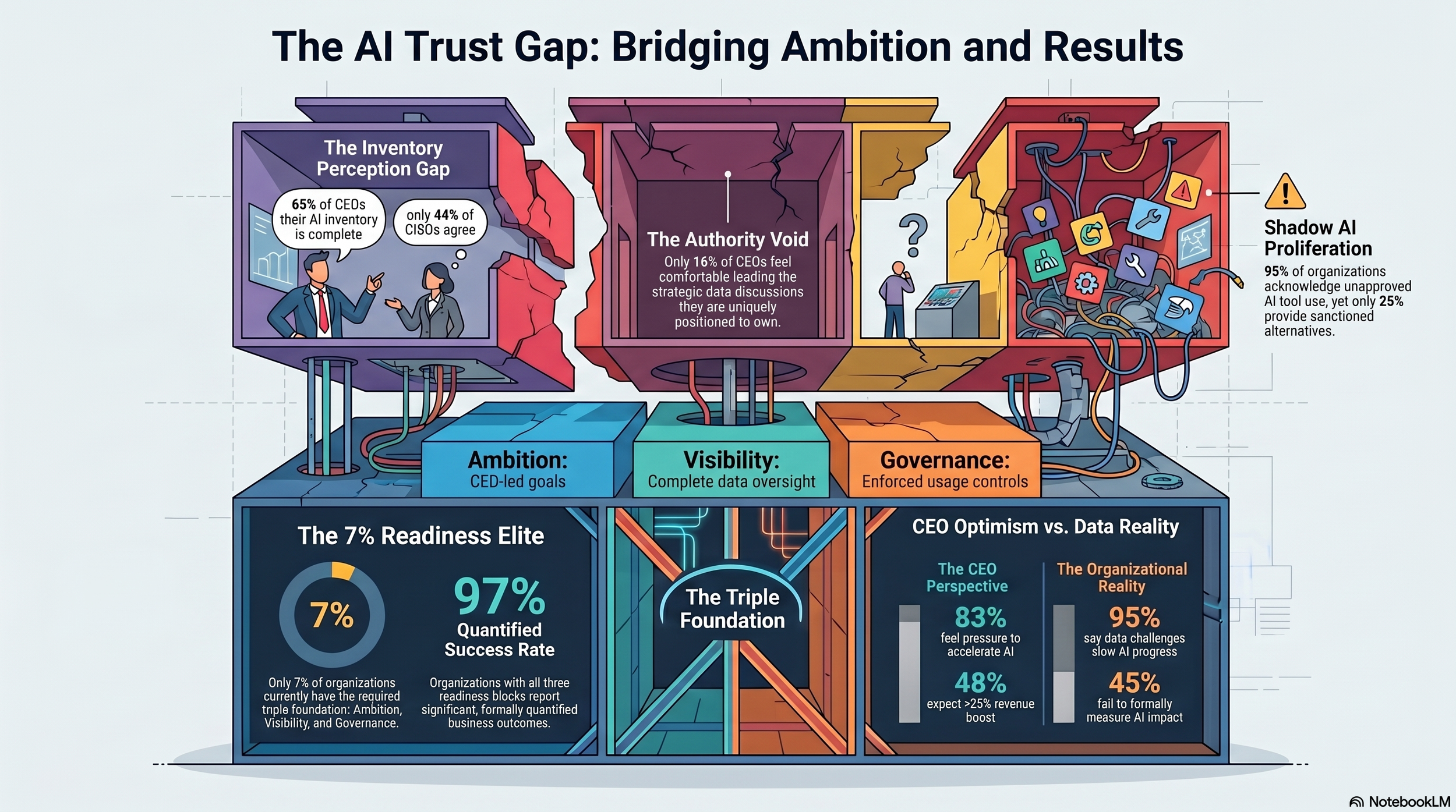
Leaders and their technical teams are not seeing the same organisation
The perception gap is visible in how differently leaders see the same organisation, where 65% of CEOs believe their AI inventory is complete and reliable but only 44% of CISOs and 52% of CIOs agree, a divergence that matters because the CEO is typically the person setting compliance posture and AI strategy, so that if their picture of what is deployed is wrong then the decisions built on it can be wrong too, a risk that grows as the EU AI Act comes into force with penalties for deployers of high-risk systems ranging from €7.5 million to €35 million, or 1% to 7% of global annual turnover. The same divergence appears in language, with more than twice as many CEOs as CTOs and CISOs citing monitoring and auditing as a brake on AI progress, a disconnect the report traces to the word “auditing” meaning organisational and regulatory exposure to one leader and a specific set of technical checks to another.
The activism gap reflects a reactive posture, with senior leaders most commonly discussing data when a strategic opportunity arises (43%) or when a performance problem needs diagnosing (33%), while just 7% schedule data discussions proactively at board level, a pattern that the report argues leaves organisations managing the consequences of absent trust rather than building the conditions that would prevent the crises in the first place. The authority gap proved the most consequential of the three, because while CEOs were willing participants in data discussions, with only 5% finding them too technical, just 16% said they were comfortable leading strategic discussions on data, and what their technical counterparts wanted was not education, which ranked only fourth among their priorities, but involvement in strategic planning, cited by 47% as their top request alongside a desire for the C-suite to set direction and drive accountability from the top down.
Fragmented ownership carries a cost that can be counted
Ownership of agentic AI risk was found to be fragmented to the point where no single function commands a majority, with 35% pointing to an AI or innovation executive, 29% to technology or engineering teams, and just 7% to a structured shared arrangement, a dispersion that carries measurable cost given that detection confidence was 24% higher when CISOs held responsibility for AI agent risk and 47% lower when that responsibility was shared, evidence that diffuse ownership does not merely slow progress but actively worsens outcomes. The measurement picture was similarly uneven, with 85% of respondents claiming significant success from data initiatives over the past year but 45% having made no serious attempt to measure return, and only 29% tracking people metrics such as staff satisfaction or talent retention, the lowest of any category.
Against that backdrop the report identified a small group, just 7% of organisations, that had combined ambition, governance, and visibility, of whom 97% reported significant, formally quantified business outcomes, a return the research insists remains out of reach until the leadership alignment to build it is in place. As Veeam CEO Anand Eswaran put it, the infrastructure to deploy AI exists but the infrastructure to trust it does not, and the report's closing argument held that closing the gap requires nothing extraordinary beyond someone at the top deciding the opportunity is worth owning.
