
The Hidden Figures Problem: Women Are More Exposed to AI Disruption and Less Likely to Use It
In 1958, a group of Black women working as “human computers” at NASA’s Langley Research Centre faced an existential threat. The agency had installed an IBM 7090 electronic computer, a machine that could perform in seconds the orbital trajectory calculations these women had spent hours completing by hand. Their jobs, the very roles that had made them indispensable to America’s space programme, were about to disappear.
What happened next became one of the most celebrated stories of adaptation in the history of technology. Rather than accept obsolescence, women like Dorothy Vaughan taught themselves FORTRAN, the programming language that ran the new machine. They did not wait for permission. They did not wait for a training programme. They walked into the room where the computer sat, studied its manuals, and made themselves the people NASA could not do without. Vaughan became NASA’s first Black supervisor and went on to lead the agency’s programming division. Katherine Johnson, her colleague, performed trajectory calculations for the Mercury and Apollo missions that were so trusted, astronaut John Glenn refused to fly until she had personally verified the electronic computer’s numbers.
The women of Hidden Figures did not merely survive a technological revolution. They seized it. They understood, with piercing clarity, that the machine was not the enemy. Irrelevance was. And so they chose to learn.
Nearly seven decades later, women across the world face a strikingly similar moment. Artificial intelligence is reshaping the global labour market with a speed and scale that dwarfs the arrival of the IBM 7090. And just like that earlier generation of women computers, today’s female workforce is disproportionately concentrated in exactly the roles that AI is poised to transform first.
The question is whether today’s women will respond the way Dorothy Vaughan did.
The Exposure Gap
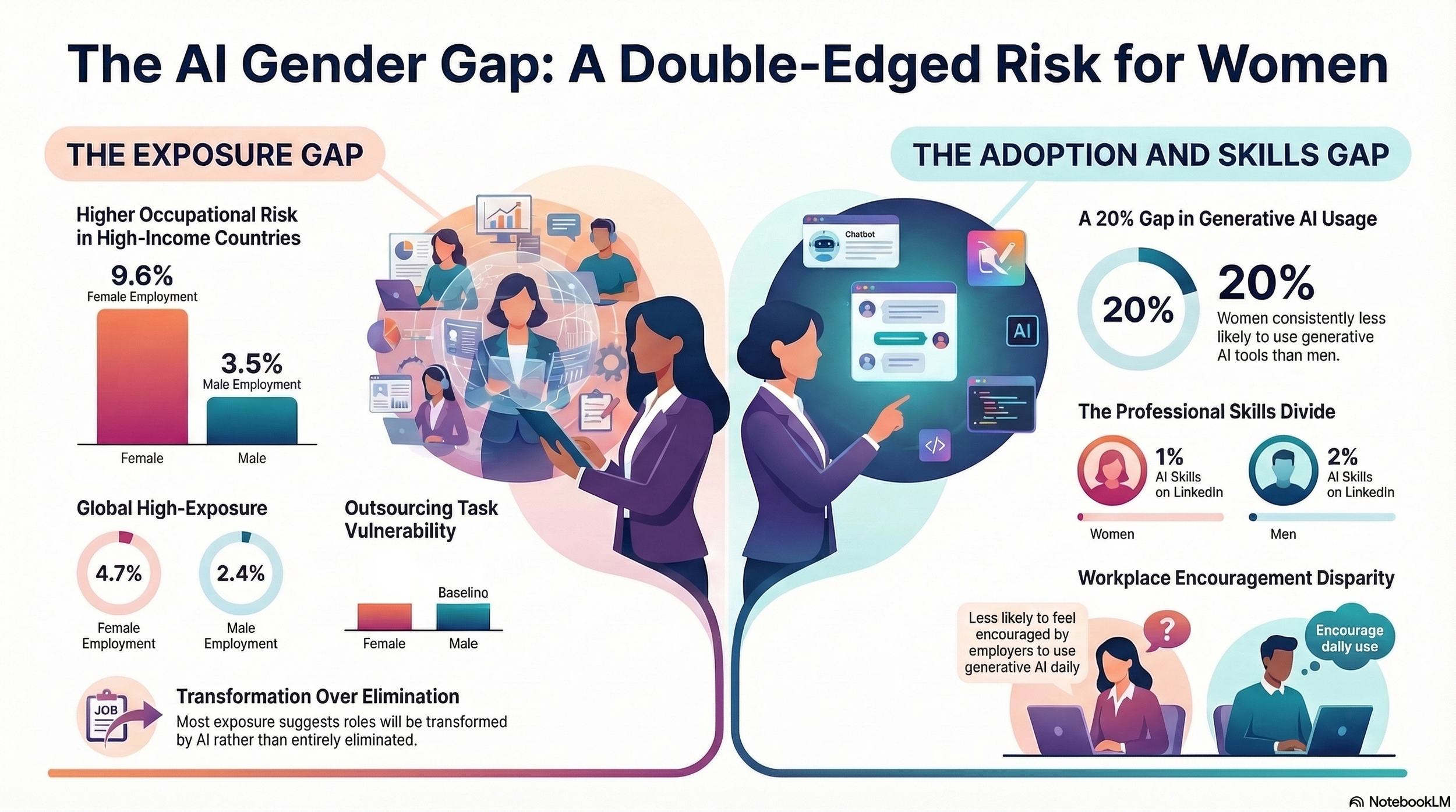
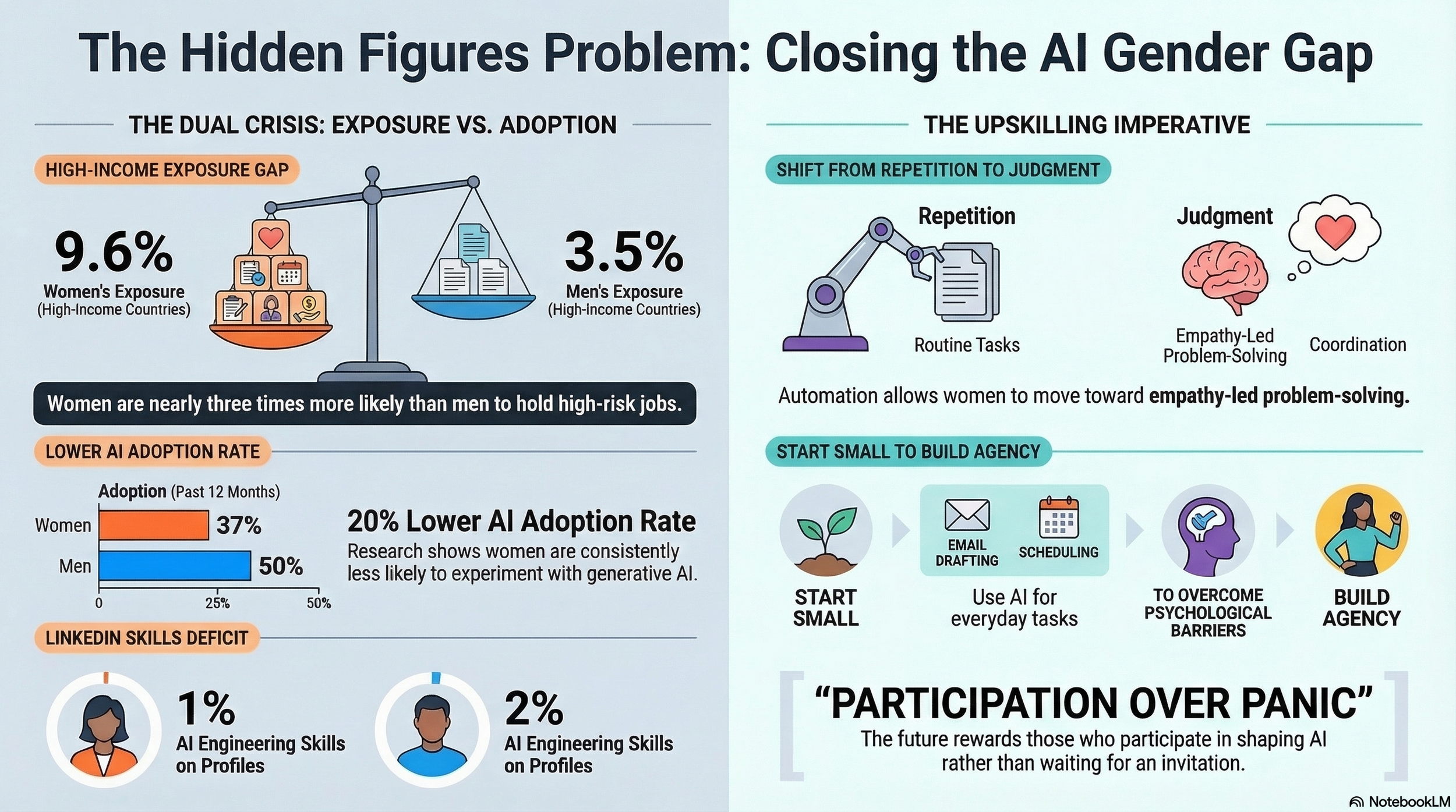
The data is stark. According to the International Labour Organization’s global index of occupational exposure to generative AI, 4.7 % of female employment worldwide falls into the highest-exposure category, compared with just 2.4 % of male employment. In high-income countries, those figures climb sharply: 9.6% for women versus 3.5% for men. That means women in developed economies are nearly three times as likely as men to hold jobs in the most AI-vulnerable tier.
The reason is structural, not conspiratorial. Women are not being singled out by algorithms. They are overrepresented in administrative, clerical, and routine support roles, the very categories where AI’s pattern-recognition and language capabilities bite hardest. When a company introduces an AI tool that can draft correspondence, process invoices, schedule meetings, or triage customer queries, the roles it disrupts first tend to be those staffed predominantly by women.
Alona Geckler, SVP Business Operations and Chief of Staff, Acronis, put it plainly. “I do not believe AI is targeting women as a category,” she said. “What is happening is more structural. Women are overrepresented in the parts of the labour market that are more vulnerable to AI-driven automation. That is an important distinction.”
The LinkedIn and UN Women joint report on women and future jobs reinforces this picture. It found that women are more likely than men to be in occupations disrupted by generative AI and less likely to transition into occupations that reduce their risk of displacement. On top of this, just 1% of women on LinkedIn list AI engineering skills on their profiles, compared with 2% of men. A gap that may look small in percentage terms but represents a significant deficit when multiplied across millions of workers.
The OECD’s report, Algorithm and Eve, goes further. It argues that women are disadvantaged not just in exposure to disruption, but in access to AI tools, AI skills, and AI-related workplace opportunities. The report found that female workers were 20 percentage points less likely than male workers in the same occupation to report using ChatGPT. Even after controlling for the same workplace and detailed task composition, most of that gap persisted, at 17 percentage points. This is not a question of different jobs. This is women and men in the same roles, with the same tools available, and women still using them less.
The Adoption Gap
If the exposure gap tells us who is most at risk, the adoption gap tells us who is least prepared to respond. And the evidence here is equally troubling.
A Harvard Business School working paper, drawing on 18 studies and more than 143,000 participants, found that women are roughly 20% less likely than men to use generative AI. The pattern holds across countries, industries, and settings. A companion summary from HBS Working Knowledge puts the adoption gap at approximately 25% lower for women on average and notes that, even when access and information were provided in a study in Kenya, women were still about 13% less likely to try the tool.
The Bank for International Settlements reported that 50% of men had used generative AI in the preceding 12 months, compared with 37% of women. Deloitte found that in 2023, 20% of men had experimented with or actively used generative AI for tasks beyond experimentation, compared with just 11% of women. Women also reported being less likely to feel encouraged by their employers to use it.
The implications are serious. As Geckler put it: if one group is experimenting more, learning faster, and building familiarity with AI tools earlier, that group builds a compounding advantage over time in hiring, promotions, performance, and resilience.
“Even if AI is not the thing directly removing someone’s role today, the adoption gap itself can become another layer of inequality,” Geckler said. “You are not just more represented in automatable jobs. You are also slower to adopt the tools that could help you protect yourself.”
A Global Picture
The pattern is not confined to the West. In the Middle East, the dynamic takes on a distinctive shape. Countries like the UAE have actively pushed to bring women into leadership, including through policy mandates and public visibility campaigns. The region also benefits from more affordable childcare and domestic support, which can keep women in demanding professional roles during the years when European or American women might step back.
“In the Middle East, especially in places like the UAE, there is a much stronger push to bring women into leadership,” said Jessica Constantinidis, Innovation Officer EMEA at ServiceNow. “There are also mandates in some cases that support this. Then there is the practical side. Childcare and domestic help can be more accessible than in Europe.”
In India, the challenge is magnified by scale. The country’s enormous IT outsourcing sector employs millions of women in back-office, data-processing, and customer-support functions, precisely the categories that AI is beginning to absorb. An AP News report on the outsourcing industry found that women’s tasks were approximately 10% more vulnerable to automation than men’s. Across South Asia, the ILO’s data show that while exposure to automation is lower in absolute terms than in high-income countries, the consequences of displacement can be far more severe because social safety nets are thinner and alternative employment opportunities are fewer.
The World Economic Forum’s 2025 report on gender parity in the intelligent age frames the risk bluntly: if AI skills and adoption gaps persist, the progress women have made in economic participation over the past several decades could stall or reverse.
Why Women Use AI Less
The explanation is not simple, and the women interviewed for this piece were careful to resist reductive answers. Time poverty, the argument that women carry heavier domestic and caregiving loads and therefore have less time to experiment, is part of the story, but only part.
Geckler pushed back on the time argument. “If you are somebody who has very little time, in theory you should be even more motivated to use AI,” she said. “Lack of time may make experimentation harder initially, but once somebody sees the value, the motivation to adopt should actually be higher.”
Helen Lee Kupp, founder of Women Defining AI, a nonprofit that helps women move from zero to building with AI, pointed to a deeper psychological barrier. Many women, she said, look at AI and assume the space belongs to someone else. They see the builders as engineers, machine-learning specialists, and venture-backed founders, predominantly male archetypes, and conclude that unless they fit that mould, they do not belong.
“We have allowed the idea of building to become much narrower than it actually is,” Kupp said. “Women have always built. They have built families, institutions, support systems, communities, operating systems for everyday life. The problem is that the word itself has been culturally recoded to mean something masculine, technical, and formal.”
Kupp, who studied chemical engineering at Caltech and spent years in Bay Area startups, said that when she first started what would become Women Defining AI roughly three years ago, she expected five women to join a small study group. Within days, 50 had signed up. Within months, it was 150. The demand revealed a gap that was not simply about technical education. It was psychological, social, and structural all at once. “Women did not just want information,” Kupp said. “They wanted a space where experimentation felt possible, where questions were welcome, and where they could be surrounded by people who were not dismissing them or making them feel perpetually one step behind.”
Constantinidis was more direct about the cultural dimension. Women who have taken career breaks for motherhood, she argued, often return to workplaces that have moved on without them. Policies have changed, tools have changed, teams have changed. “AI is not going to take your job,” Constantinidis said. “The person using AI will. That is what people need to understand. Today, knowing Outlook or Excel is normal. That is baseline. AI is becoming the new differentiator.”
“She walks back into a workplace where people may give her that look, as if she chose family over seriousness,” Constantinidis said. “That kind of internalised doubt matters just as much as technical knowledge.”
The Upskilling Imperative
Every expert interviewed for this piece converged on the same conclusion: upskilling is not optional, and it cannot wait. But they were also unanimous that upskilling should not be framed as punishment for falling behind.
Geckler argued that the good news is that no job is usually 100% automatable. Almost every role has parts that can be automated and parts that cannot. The opportunity, she said, is to shift people away from the repetitive layer of their work and toward the parts that require judgment, communication, coordination, empathy, and problem-solving, areas where women often bring very strong capabilities. “Reskilling should not be framed as learn AI or disappear,” Geckler said. “A better framing is: use AI to take away the low-value repetitive parts of your work so that you can focus on the higher-value human parts.”
Kupp framed reskilling as something far more expansive than learning a new interface. Real reskilling, she argued, begins at the level of identity and agency. A woman who has spent years in an administrative role is not obsolete. Her workflow is changing. Her toolset is changing. But her contextual intelligence, domain understanding, pattern recognition, and judgment remain valuable, perhaps more valuable than before, because those are the qualities AI cannot replicate.
“If a woman has spent years in a role that is now considered vulnerable to automation, the question should not just be how do we train her to survive,” Kupp said. “It should also be how do we help her understand that the knowledge she has built up is valuable raw material for creating the next solution.”
Andreas Hassellöf, CEO of Ombori, argued that organisations need to move from passive equality to active enablement. “AI should not sit in an innovation lab or IT department,” he said. “It must flow through operations, retail, HR, customer experience, and finance. When AI becomes part of daily work rather than a specialist conversation, the middle of the organisation rises with it, and that includes talented women who may otherwise be overlooked.”
Hassellöf was clear that AI training should be universal, mandatory, and contextual to each role. When AI literacy becomes a baseline skill, as digital literacy once did, the participation gap narrows naturally. But he was equally clear that individuals bear responsibility too. “No organisation can future-proof someone who is not willing to evolve,” he said. “And no individual can scale without an enabling system. This is not about women versus men. It is about future-ready versus future-resistant.”
“The future will not reward those who wait to be invited into the AI conversation,” Hassellöf said. “It will reward those who participate in shaping it.”
He added that the focus should be on removing structural friction rather than creating artificial distinctions. “At Ombori, we don’t create separate tracks based on gender,” Hassellöf said. “We focus on access, exposure, and merit.”
Constantinidis offered perhaps the most practical advice. She described coaching a young mother of twins who was overwhelmed and had not considered that AI could help organise her family life. Within months, the woman had used AI tools to build sleep schedules, coordinate calendars with her husband, and plan activities for her children. “She was learning AI without calling it AI training,” Constantinidis said. “That is the point. AI is a linguistic skill. It is about learning how to frame a question, prompt, refine, and explore. Once you learn that, you are already building AI capability.”
Constantinidis, who has coached professionals, noted that the psychological barriers to AI adoption are often as powerful as the structural ones. She described meeting a young girl who aspired to become an AI engineer but had not yet attended a single hackathon or experimented with a large language model. The aspiration existed, but the action did not. That gap between intention and practice, she argues, applies to women returning to the workforce just as much as it does to teenagers.
The message was consistent across every interview: start small. Start with an email. Start with a meal plan. Start by asking AI to structure a document or summarise meeting notes. The first step matters more than the perfect step. And the barrier to entry has never been lower. Unlike earlier technological shifts that demanded specialist knowledge, today’s AI tools respond to plain language. You do not need to learn FORTRAN. You need to learn to ask.
Celebration and Urgency
International Women’s Day is, rightly, a moment to celebrate progress. Women today hold more leadership positions, earn more advanced degrees, and participate in the global economy at higher rates than at any point in history. In the Middle East, government-backed mandates are pushing women into boardrooms. In India, a generation of women in technology has built careers that would have been unimaginable to their grandmothers. Across the world, the arc has bent, however slowly, toward greater inclusion.
But celebration without candour is flattery, not progress. The data in this piece tells an uncomfortable story: women are more exposed to AI disruption, less likely to be using the tools that could protect them, and in many cases, trapped in structural positions that make the gap self-reinforcing. The BIS warned that unequal adoption could exacerbate existing pay and job opportunity disparities. The OECD cautioned that without intervention, AI risks deepening, rather than narrowing, gender inequality in the workplace.
The window for action is open now, but it will not remain open indefinitely. Kupp warned that the current moment of visibility will not last. “As AI gets embedded into products, software layers, internal tools, and workflows, it will start to disappear from view,” she said. “It will become background infrastructure. Once that happens, most people will stop asking what it is doing underneath. Women need to be in that conversation now, while the architecture is still visible and the assumptions are still contestable.”
The Choice
Dorothy Vaughan did not have a training programme. She did not have a government mandate. She did not have a nonprofit community or a LinkedIn course or an employer-sponsored AI literacy initiative. What she had was clarity: the machine was coming, and she could either learn to speak its language or watch it render her invisible.
The women of 2026 have something Vaughan did not: tools that speak their language back. AI does not require FORTRAN. It requires curiosity, the willingness to experiment, and the understanding that waiting for certainty is itself a form of falling behind.
As Geckler put it: the right response is not panic. It is participation.
As Constantinidis warned: the person who knows AI, even imperfectly, will always be chosen over the person who has never tried.
And as Kupp argued: once women start identifying as builders, the whole conversation changes. It moves from asking why women are excluded to asking what happens when women fully participate in shaping the future.
That is the question that should define this Women’s Day. Not whether we have come far enough to celebrate, we have. But whether we are moving fast enough to keep up.