
Axis Perspectives 2026: Why GCC Organisations Are Betting on Intelligent Video as a Strategic Asset
Intelligent video systems are rapidly outgrowing their origins as passive security tools and are embedding themselves into the operational fabric of organisations across the Gulf Cooperation Council, a landmark new report has found.
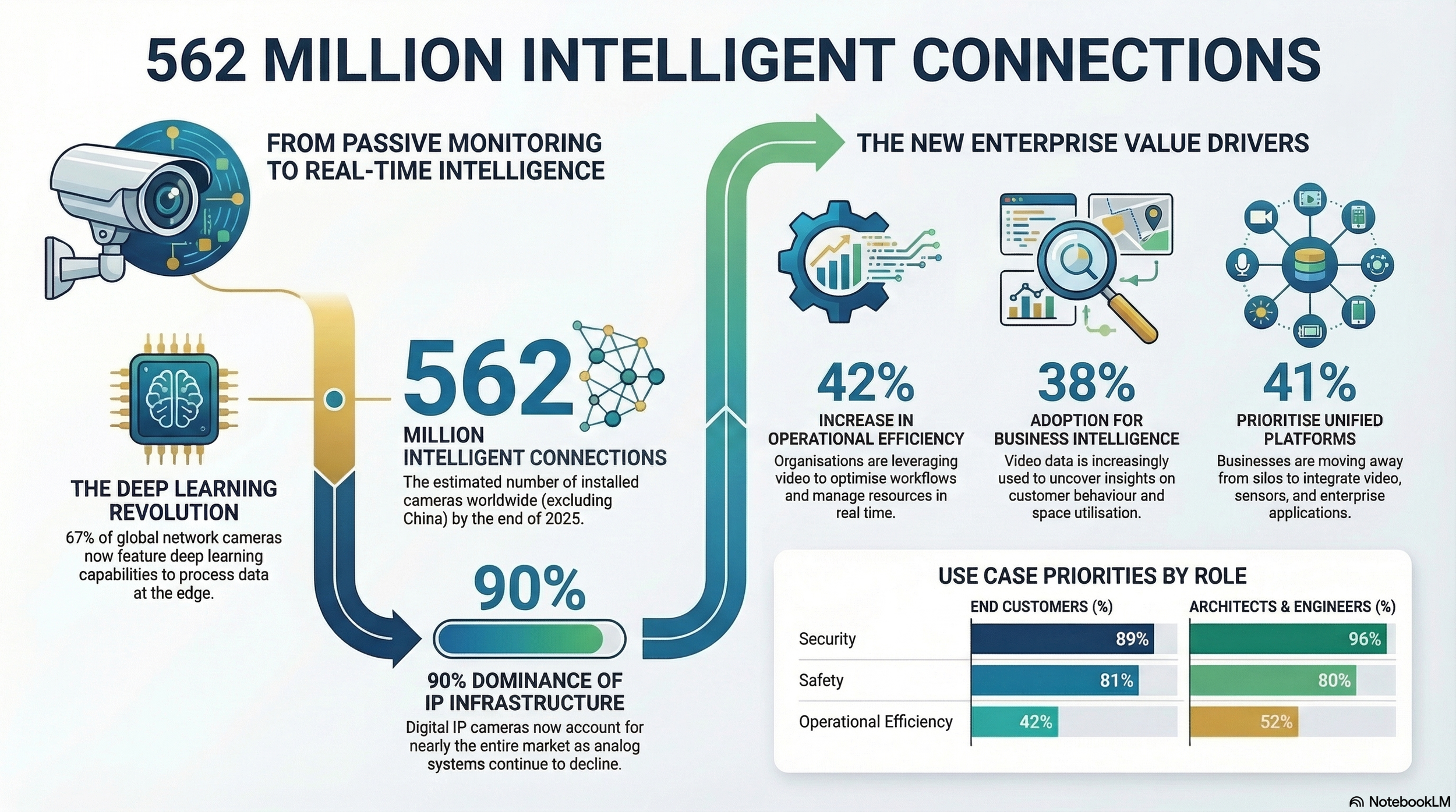
The inaugural Axis Perspectives Report 2026, released by network video pioneer Axis Communications, reveals that the use of video for business intelligence has nearly doubled in a single year — surging from 20% to 38% — while 42% of organisations now deploy video technology to drive operational efficiency. Security remains the dominant use case, cited by 89% of end customers, with safety close behind at 81%. Yet the data makes clear that cameras are increasingly valued for the real-time data they generate, informing decisions well beyond the security operations centre.
The findings carry particular weight across the GCC and the wider Middle East, where large-scale smart city programmes, mega-transport networks and mixed-use urban developments are reshaping the physical landscape. From major public venues to integrated urban infrastructure, organisations are managing complex, high-traffic environments that demand real-time visibility and coordinated response. As these ecosystems grow more connected, there is mounting focus on cybersecurity, unified platforms and cloud-ready architecture to support secure, scalable operations.
Assim Khedr, Engineering and Training Manager for the Middle East at Axis Communications, said the region has been at the forefront of this transformation.
“GCC nations, and the Middle East region overall, have been sites of exciting innovation where video systems are concerned,” he said. “The region has served as the definitive example of not just the shift from analogue to digital, but also how video camera solutions have become powerful tools that deliver real-time insights and added business value.”
Khedr added that the Axis Perspectives Report gives the industry a means to quantify these shifts. “With resources like Axis Perspectives, we’re able to take such examples and quantify them, demonstrating how a brand like Axis, with its established history of innovation, can help businesses and governments extract the most value from investments in new technologies,” he said.
Key findings: cybersecurity, cloud and convergence
As connected environments expand, cybersecurity has emerged as a front-of-mind concern. The report found that 44 % of end customers identify cybersecurity and data protection as a key priority over the next one to three years. The urgency is underscored by the scale of the global threat landscape: cybercrime is now the world’s fastest-growing criminal threat, with annual worldwide losses currently estimated at $9.22 trillion, spanning data theft, ransomware and operational shutdowns.
Cloud adoption in physical security is accelerating in parallel. According to Axis’s research, cloud usage is expected to climb from 27 % to 44 % within two years, driven by use cases including remote device management, live monitoring and video recording. Over 1.5 million Axis cameras are already connected via the company’s cloud services and partner platforms.
Organisations are also seeking simpler, more integrated platforms. Some 41 % of end customers say consolidating disparate security systems into a single unified platform is a top priority, reflecting a strategic move towards resilience, simplified management and enhanced situational awareness. Infrastructure modernisation continues to underpin investment decisions: 64 % of end users cite upgrading legacy systems as a leading reason for investing in new video technology, while 37 % are actively investing in emerging technologies such as AI, IoT and cloud computing to future-proof operations.
AI at the edge: the new standard for intelligent video
The report paints a picture of an industry in which intelligence is fast becoming the default. According to data from Novaira Insights cited in the report, nearly 80 % of cameras shipped in 2024 included analytics capabilities, with two-thirds already featuring deep learning-based functionality. By 2029, an estimated 96 % of cameras will ship with deep learning built in.
The global installed base of cameras outside China is projected to reach 562 million by the end of 2025, climbing to 736 million by 2029. In parallel, the decline of analogue continues: IP cameras accounted for 90 % of total camera revenue in 2024, with analogue HD cameras reduced to just 10 %.
Edge computing is central to this shift. By processing data locally on the camera and transmitting only essential metadata or alerts to the cloud, organisations can reduce bandwidth demands, strengthen privacy and maintain scalable analytics. Gartner projects that by the end of 2025, over 55 % of all deep neural network-based data analysis will occur at the point of capture, reinforcing the case for on-device intelligence.
Ettiene Van Der Watt, Vice-President for the Asia-Pacific region at Axis Communications, emphasised the practical benefits. “For customers, intelligence at the edge means faster, smarter decisions, simplified operations, and stronger security — all delivered through flexible, future-proof platforms,” he said.
From factory floors to city streets: real-world applications
The report spotlights real-world deployments that illustrate the expanding role of intelligent video. Among them is BMW Group’s use of high-resolution Axis cameras to power AI-driven quality inspection across its iFACTORY production facilities. The system captures detailed vehicle images in real time, enabling automated inspections of components — from logos to door handles — that reduce errors and boost manufacturing efficiency, a use case far removed from conventional surveillance.
Across other sectors, the applications are equally varied. In retail, intelligent cameras are being deployed to reduce shrinkage and inform layout and staffing strategies. In transportation and logistics, they increase throughput and reduce errors. In industrial settings, video supports safety, compliance, quality control and predictive maintenance. And in smart cities, camera networks improve traffic flow, emergency response and public safety. The United States alone now operates over 300 real-time crime centres, up from roughly 80 five years ago, each depending on integrated video intelligence for situational awareness.
Verena Rathjen, Vice-President for the EMEA region at Axis Communications, framed the opportunity in strategic terms. “By turning video into actionable insight, enterprises can reduce risk, accelerate response, and make smarter decisions that improve efficiency and customer experiences today, while building a scalable foundation for future growth,” she said.
A five-stage roadmap for organisations
To help organisations chart their own path forward, the report introduces a five-stage maturity model. The framework maps the progression from passive recording systems, where footage is stored and reviewed manually, through reactive setups triggered by predefined rules and motion detection, to proactive systems that use AI-based analytics to identify patterns and alert operators in real time. The final two stages — predictive and autonomous — leverage historical data and machine learning to forecast incidents and operational bottlenecks, ultimately enabling cameras to operate as intelligent agents that make decisions and initiate actions with minimal human input.
The model is designed to give organisations a clear benchmark for assessing their current capabilities and plotting a course towards greater automation, resilience and enterprise value.
Open ecosystems and the push for interoperability
A recurring theme throughout the report is the importance of open, vendor-neutral platforms. Open architectures reduce deployment complexity, lower costs and foster innovation by enabling seamless integration across systems, networks and devices. A recent milestone highlighted in the report is the adoption of the AV1 video codec in surveillance, which improves compression efficiency by 30 to 50 % compared to older standards like H.264, reduces bandwidth and storage costs, and enhances video quality and AI performance — particularly in cloud-connected environments.
Fredrik Nilsson, Vice-President for the Americas at Axis Communications, underscored the strategic value of openness. “By eliminating vendor lock-in and simplifying integration, open, interoperable ecosystems enable organisations to scale intelligent edge solutions efficiently while adapting to changing business demands,” he said.
Body worn cameras: expanding beyond law enforcement
The report also charts the growth of body worn cameras, which are seeing significant adoption beyond policing and corrections. According to Omdia research cited by Axis, the body worn camera market is experiencing steady growth driven by demands for accountability, safety and operational transparency. Use cases now extend into retail, healthcare, transportation and regulatory inspections. Open-platform body worn solutions that can integrate with any video management system are making the technology more accessible within what was previously a closed, subscription-based market. Omdia forecasts 100 % penetration of body worn cameras among frontline police officers in multiple countries by 2028.
Looking ahead: a strategic asset, not just a security tool
The report concludes that what began as a security function is now expanding into broader operational and strategic value, enabling teams to improve safety, streamline processes, optimise resources and make more informed decisions. Success, Axis argues, will depend on how well organisations bring these technologies together and overcome challenges such as legacy integration, data complexity and workforce adoption.
For organisations across the GCC and the wider Middle East, the implications are significant. As video becomes embedded in everyday business systems — from transport management to industrial quality control — the technology decisions made today will shape security postures, operational risk and the efficiency of complex environments for years to come.
The full Axis Perspectives Report 2026 is available at axis.com. Axis Communications, founded in 1984 and headquartered in Lund, Sweden, employs around 5,000 people in more than 50 countries and offers solutions spanning video surveillance, access control, intercoms and audio, enhanced by intelligent analytics applications.