
Microsoft Report Shows 64% of the UAE Uses AI, Representing the World’s Most Advanced AI Adoption System
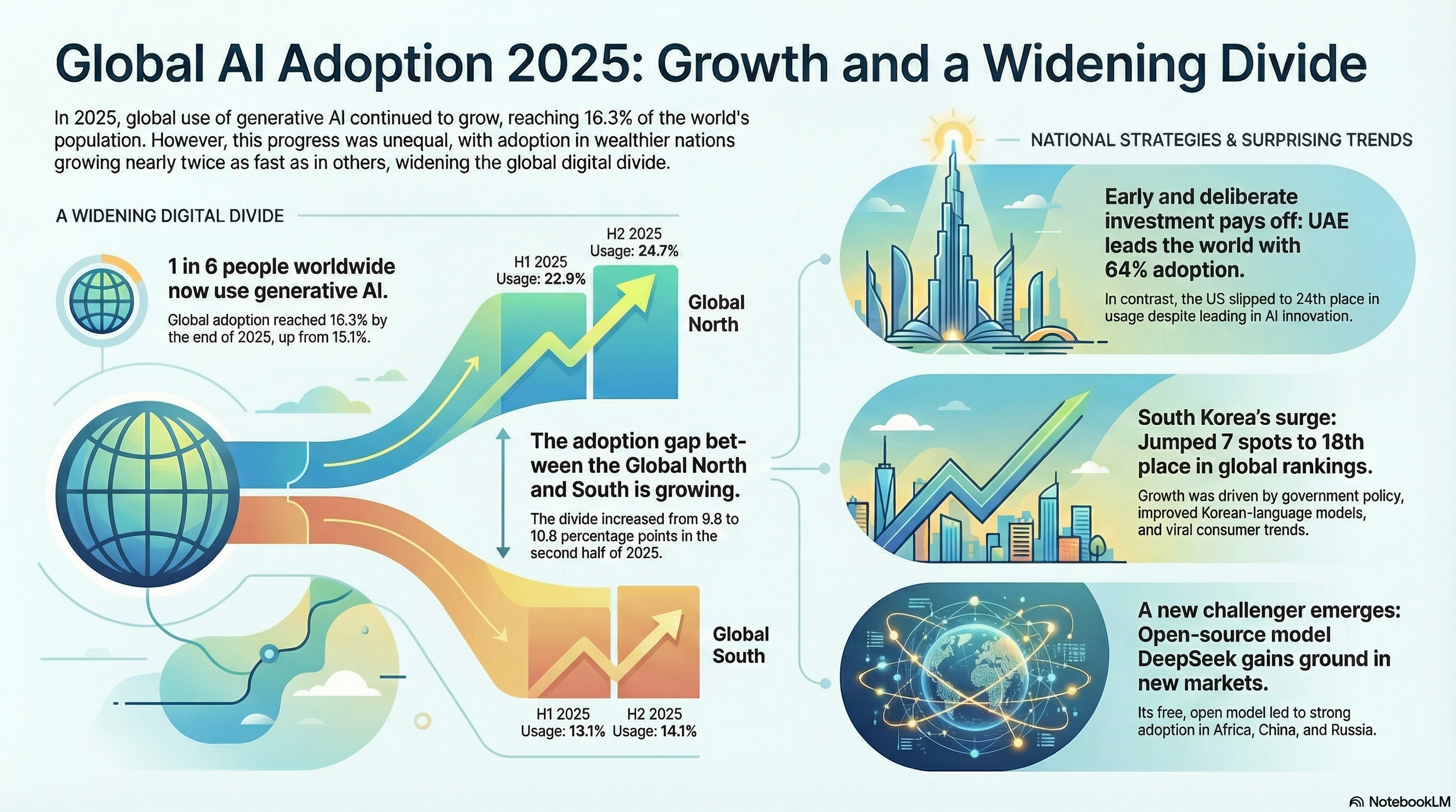
When Microsoft’s AI Economy Institute released its January 2026 report on global AI adoption, one data point stood apart. By the end of 2025, 64% of the UAE’s working-age population was using generative AI tools, the highest share anywhere in the world. Singapore followed at 60.9%. Most advanced economies were far behind.
The United States, despite leading in model development and computing infrastructure, ranked 24th in usage, with just 28.3% adoption.
This gap is not a statistical quirk. It reflects structural differences in how countries approach technology adoption. What looks like sudden leadership is, in reality, the outcome of a long, deliberate national strategy that began years before generative AI entered the public imagination.
A Head Start That Compounded
The UAE’s AI advantage did not come from inventing the most advanced models. It came from starting earlier than almost everyone else, and from treating AI as a governance issue rather than a research problem.
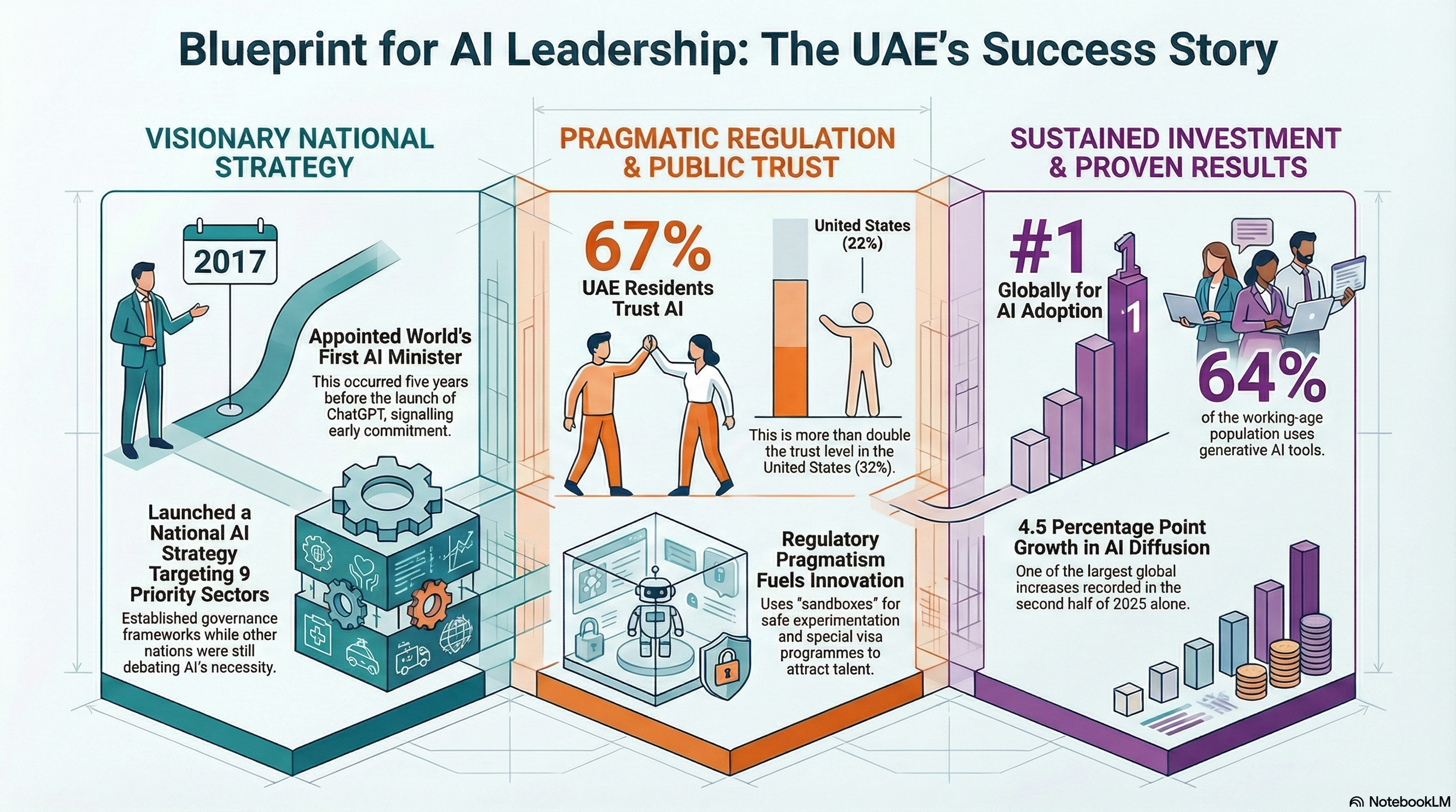
In 2017, the UAE appointed the world’s first Minister of State for Artificial Intelligence. At the time, most governments were still debating whether AI required dedicated policy attention at all. That decision elevated AI from a technical concern to a cabinet-level responsibility, embedding it into national planning rather than leaving it to individual agencies.
That same year, the government launched a national AI strategy spanning nine priority sectors, with defined implementation pathways rather than abstract ambition. As a result, when generative AI tools became widely available years later, the institutional groundwork had already been laid. Procurement processes, legal interpretations, and inter-ministerial coordination mechanisms were not being built in real time under public pressure. They already existed.
Institutions change slowly, but they compound. The UAE benefited from that compounding effect while others were still reacting.
Trust as a Structural Advantage
One of the most overlooked findings in the Microsoft report is the role of public trust. According to the 2025 Edelman Trust Barometer cited in the analysis, 67% of UAE residents say they trust AI, compared with 32% in the United States and similar levels across Western Europe.
This difference is not cultural inevitability. It is the product of sequencing.
For years, residents encountered AI in narrow, practical contexts such as visa processing, transport systems, and government portals before it became a symbolic or political issue. Those systems either worked or they did not. Over time, repeated exposure normalised the technology.
In many Western countries, AI entered public consciousness first as an abstract controversy about jobs, surveillance, or ethics, long before most people used it directly. The UAE followed the opposite path. Familiarity reduced anxiety, not the absence of scrutiny.
Trust, in this sense, functions as infrastructure. Without it, adoption slows regardless of technological capability.
Regulation Designed for Use, Not Optics
The UAE also avoided a regulatory pattern now visible in several advanced economies, where rules are written before usage patterns are understood.
Rather than relying on rigid, prescriptive legislation, the country emphasised regulatory sandboxes and principles-based guidelines. These allowed companies to test AI systems in controlled environments while giving regulators visibility into real-world behaviour before formalising constraints.
This approach reduced uncertainty for innovators while preventing the legal system from becoming outdated as the technology evolved. At the same time, the UAE implemented targeted immigration policies, most notably the Golden Visa, to attract and retain AI talent. In practice, this created a concentrated ecosystem of expertise rather than dispersing it across short-term contracts and temporary visas.
Regulation here functioned less as enforcement and more as coordination. It lowered friction for building and scaling AI systems without removing oversight.
Diffusion Beats Invention
Perhaps the most revealing contrast in the report is between countries that lead in AI development and those that lead in AI usage.
The United States dominates frontier model research and computing infrastructure, yet ranks well outside the top tier for population-level adoption. The UAE shows the opposite pattern. It is not a global centre for model invention, but it leads the world in diffusion.
In the second half of 2025 alone, AI usage in the UAE increased by 4.5 percentage points, one of the largest gains recorded globally. This growth reflects sustained investment not only in digital infrastructure, but also in population-level AI skills and everyday integration.
Many countries are now building increasingly powerful tools that large parts of their societies are not equipped to use. The UAE prioritised absorption. That choice limited internal digital divides and avoided concentrating AI benefits within a narrow professional class.
A Broader Signal in a Fragmenting World
The Microsoft report frames 2025 as a year of widening global AI inequality. Adoption in the Global North is growing nearly twice as fast as in the Global South. Open-source challengers such as DeepSeek are expanding access in Africa and parts of Asia, often aligned with broader geopolitical strategies.
Within this landscape, the UAE represents a distinct model. AI adoption there is not a side effect of market forces or viral consumer behaviour. It is the outcome of coordinated state capacity, long-term planning, and deliberate sequencing.
The uncomfortable implication for other countries is that AI does not diffuse naturally. It spreads where institutions, incentives, trust, and skills align. Where those elements are missing, even the most advanced technology remains underused.
The UAE did not move faster at the last moment. It started earlier, built patiently, and reduced friction at every layer. The numbers now reflect that reality.