
Manufacturing Sector Doubles AI Spending but Struggles to Turn Ambition into Action
Manufacturers around the world have nearly doubled their investment in artificial intelligence over the past year, yet fewer than 4 in 10 say they are truly ready to operationalise it at scale, according to a sweeping new survey that lays bare the distance between boardroom enthusiasm and shop-floor reality.
The Riverbed Global Survey on the Future of IT Operations in the AI Era, conducted by Coleman Parkes Research in July 2025 across seven countries, polled 1,200 business decision-makers, IT leaders, and technical specialists from organisations with average annual revenues of $2.2 billion.
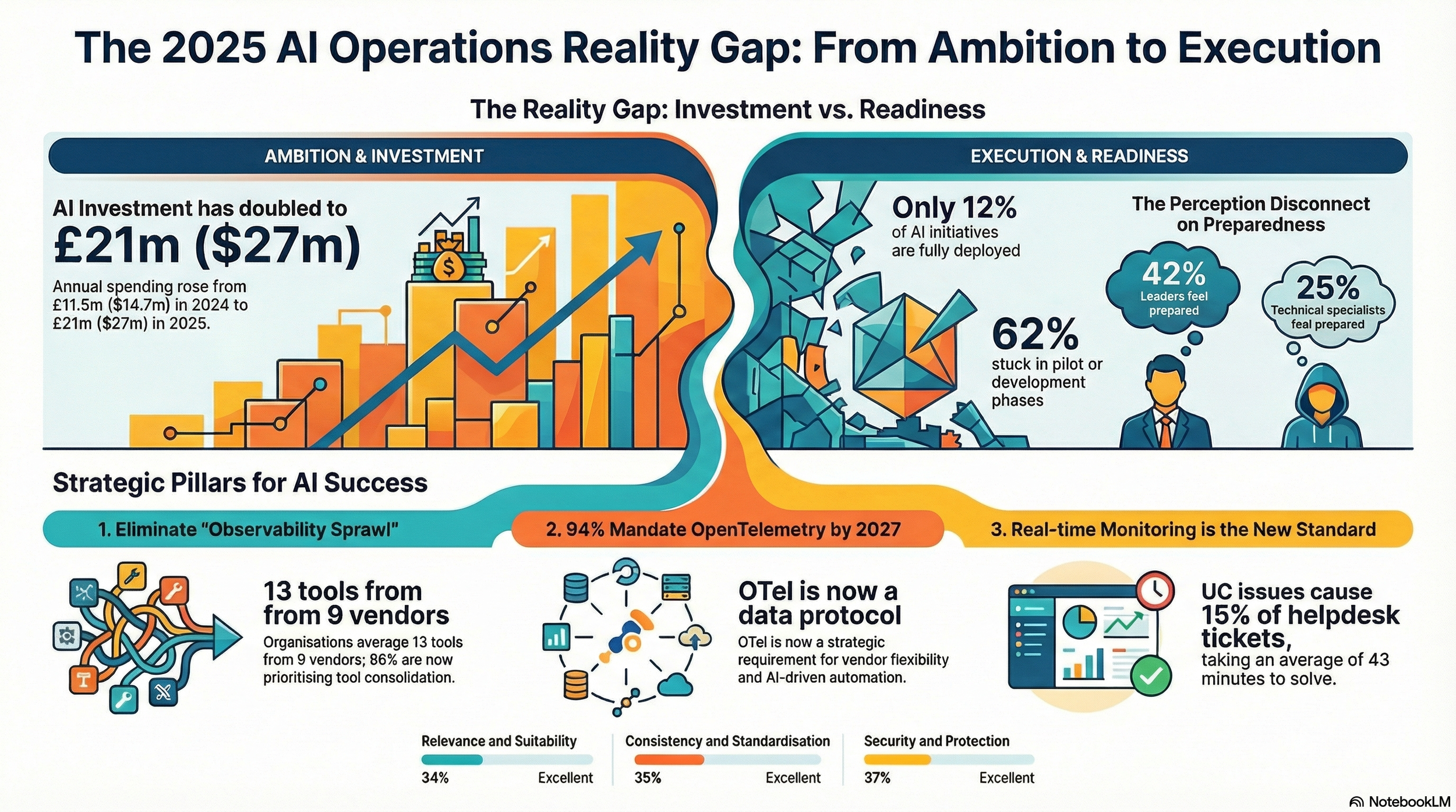
Its findings paint a picture of an industry pouring money into AI (average spending has leapt from $14.7 million in 2024 to $27 million in 2025) while grappling with persistent obstacles in data quality, tool fragmentation, and a troubling disconnect between those setting strategy and those tasked with delivering it.
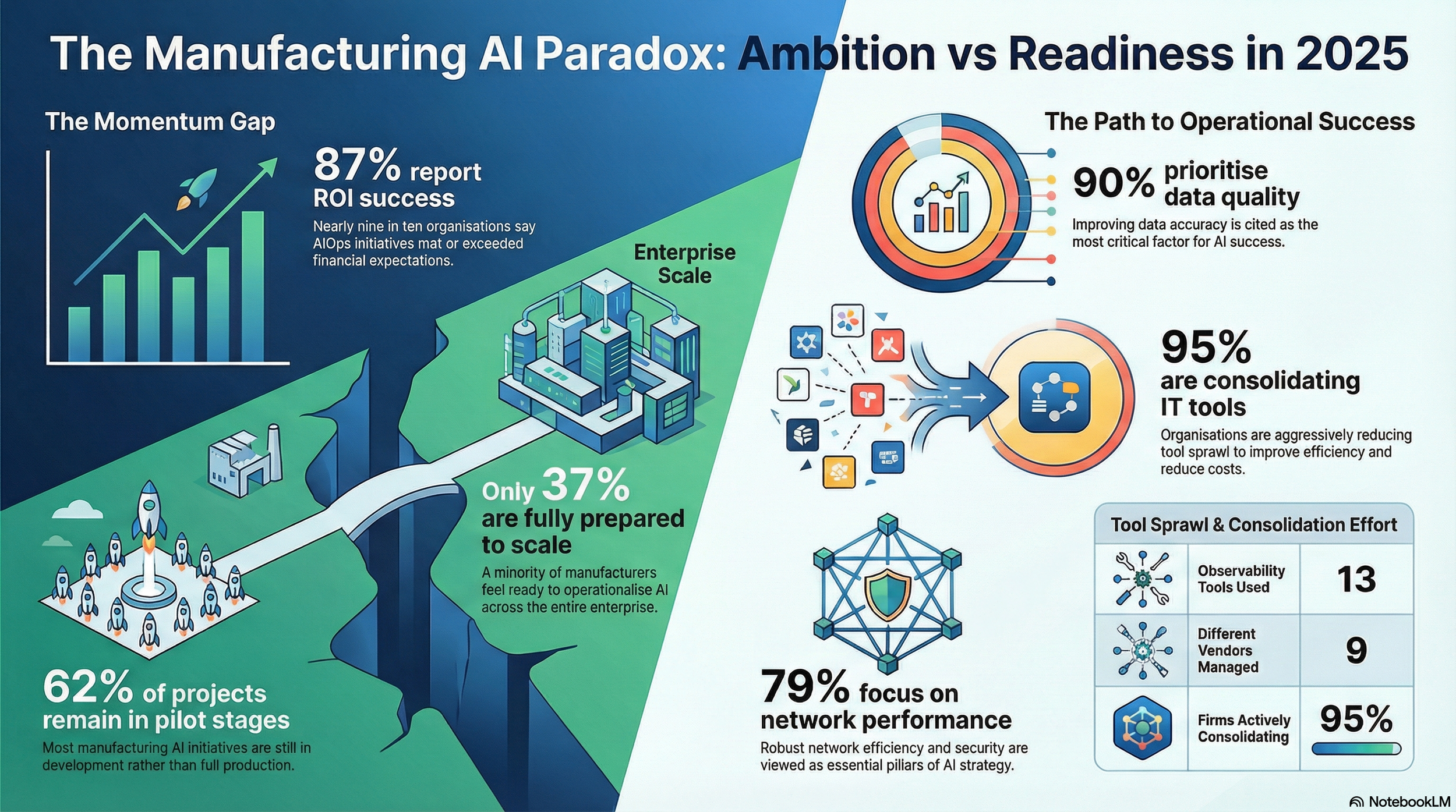
The results are particularly striking in manufacturing, where 87% of respondents report that return on investment from their AIOps initiatives has met or exceeded expectations, yet only 37% consider themselves fully prepared to put AI into operation at enterprise scale. A full 62% of AI projects remain stuck in pilot or development stages, suggesting that the sector’s appetite for transformation is running well ahead of its capacity to execute.
“The manufacturing industry is investing heavily in AI to transform IT operations, and our survey results show that nearly nine in ten companies in this sector are already meeting or exceeding ROI expectations from their AIOps investments,” said Richard Tworek, Chief Technology Officer at Riverbed.
“However, many still face major challenges, including gaps in readiness and preparedness, as well as data quality issues, which are hindering progress. As a data-driven company, we’re helping our manufacturing customers close these gaps with safe, secure and accurate AI built on high-quality real data; delivering practical AI-powered solutions that enable organisations to scale AI across the enterprise.”
The confidence gap: leaders versus the people doing the work
One of the survey’s most revealing findings is the chasm between how business leaders and technical specialists perceive their organisation’s AI readiness. Across all industries surveyed, 42% of business leaders believe their organisation is fully prepared to implement AI projects, compared with just 25% of technical specialists. That 17-point gap raises serious questions about whether executive optimism is grounded in operational reality.
The pattern repeats across nearly every metric. When asked about confidence in their company’s AI strategy for IT operations and digital experience, 64% of business leaders declared themselves very confident, against 48% of technical specialists. On whether AIOps has exceeded expectations, the split was 53% to 42%. Even on data quality, a foundational requirement for any AI initiative, leaders were consistently more sanguine, with 53% rating data accessibility and usability as excellent, compared with 42% among those closer to the technical coalface.
The survey’s authors describe this as a “reality gap,” noting that last year, 82% of organisations believed they were ahead of the curve on AI, which they call a statistical impossibility that hints at widespread overconfidence. While strategic confidence has grown modestly, with 59% now expressing confidence in their AIOps strategy (up seven points year-on-year), the hard numbers suggest a more sobering picture: only 12% of AI initiatives across all sectors have reached full deployment.
Data quality: the Achilles heel
Across the board, data quality remains a stubborn barrier. In the manufacturing sector, 90% of respondents agree that improving data quality is critical to AI success, yet almost half (47%) lack confidence in the accuracy and completeness of their organisation’s data. Only 34% rate their data as excellent for relevance and suitability, and the broader survey tells a similar story: just 35% give top marks for consistency and standardisation, 37% for security and protection, and 43% for quality and completeness.
There has been some progress: perceived accuracy and integrity scores improved by 6 points year-on-year, from 40% to 46%. However, with only 46% of respondents saying they are fully confident in their data quality, even as 88% acknowledge it is essential to AI success, the gap between aspiration and achievement remains wide.
Tool sprawl: 13 tools, 9 vendors, and a growing appetite for consolidation
The survey also reveals the sheer complexity of the IT environments in which AI must operate. Organisations currently use an average of 13 observability tools from nine different vendors, a level of fragmentation that creates integration headaches and operational inefficiencies.
The response has been decisive: 96% of organisations are actively consolidating their tools and vendors, with manufacturers reporting similarly high figures of 95%. The primary drivers go beyond cost. Improving IT productivity topped the list (47% cited this among their top three reasons), followed by better tool integration and interoperability (47%) and alignment with executive strategy (43%). Cost reduction, at 37%, ranked below all three.
Perhaps most consequentially for the vendor landscape, 93% of organisations say they are willing to consider new strategic partners as part of their consolidation efforts. In manufacturing, the figure is 91%. More than half of organisations have already completed their consolidation programmes, and 78% expect to finish within two years. For incumbent technology providers, the message is clear: loyalty cannot be taken for granted.
Unified communications: essential but a persistent headache
The shift to hybrid and remote working has made unified communications tools, including video calls, messaging platforms, and collaborative workspaces, indispensable. Both business leaders and technical specialists report spending 42% of their working week using UC tools, and 65% describe them as essential to effective operations. In manufacturing, that figure rises to 66%.
Yet satisfaction lags well behind reliance. Only 46% of companies are satisfied with UC tool performance, dropping to just 38% among technical specialists. Some 43% report performance issues, and the survey suggests that UC-related problems may be the single largest source of IT help desk tickets, accounting for 15% of all support requests and taking an average of 43 minutes to resolve. One in five UC tickets requires more than an hour.
Compounding the problem, nearly half of organisations can perform only basic or reactive monitoring of UC tools after a call has ended, without real-time alerting or diagnostics during the session itself. In manufacturing, the top three challenges are limited visibility (51%), dropped calls (42%), and integration difficulties with other enterprise systems (38%).
OpenTelemetry emerges as a strategic pillar
Amid the complexity, one technology standard is gaining rapid traction. OpenTelemetry (OTel), the open-source observability framework for standardising data collection across systems, has moved from niche interest to strategic priority. Some 88% of enterprises have begun implementing it, including 41% who have fully rolled it out, and 95% say the ability to correlate OTel data across domains is critical to their observability strategy.
In manufacturing, adoption is even more advanced: 44% have fully implemented OTel, with a further 42% in the process, and 97% agree that cross-domain OTel correlation is critical. Some 93% of manufacturing respondents say the framework will be a foundation for future initiatives such as AI-driven automation.
Looking ahead, 94% of respondents across all sectors state that full OTel support will become a requirement for every vendor in the observability space within two years. Yet the perception gap persists: 49% of business leaders consider OTel very important to their strategy, compared with 36% of technical specialists, while 47% of leaders believe it has been fully implemented, compared with just 30% of those on the technical side.
Preparing the network for AI’s data demands
As AI workloads grow, so does the importance of data movement. Nine in ten organisations view the movement and sharing of AI data as vital to their strategy, and the top concerns are firmly practical: cost of data movement and storage (cited by 95%), security and compliance (94 per cent), and network performance and reliability (94%). Manufacturing respondents placed network performance and reliability even higher, at 96%.
The data landscape is shifting accordingly. Companies expect public cloud usage for AI data to grow from 36% to 39% by 2028, while edge computing environments are forecast to rise from 9% to 13%. On-premises data centres, meanwhile, are set to decline by six points, from 23% to 17%. Three-quarters of organisations plan to establish an AI data repository strategy within the next three years.
What it means
The Riverbed survey captures an industry at an inflexion point. The money is flowing, the returns look promising, and the strategic intent is unmistakable. But the operational foundations are not yet in place. Data quality is patchy, tooling is fragmented, communications infrastructure is underperforming, and the people closest to the technology are markedly less confident than those directing strategy from the top.
For manufacturers navigating increasingly complex global supply chains and seeking to harness AI for everything from predictive maintenance to production optimisation, the message is that investment alone is not enough. Closing the gap between ambition and execution will require better data governance, a more disciplined approach to IT tooling, real-time visibility into the systems employees depend on daily, and, perhaps most critically, a more honest conversation between the boardroom and the technical teams about what is actually ready and what is not.
The organisations that get this right stand to gain a significant competitive edge. Those who do not risk discovering that their AI strategies look far better on a slide deck than they do in practice.