
From Thalapakkati to Skincare: How Deepika Nagasamy Is Building Dipsy Store, One Ingredient at a Time
For Deepika Nagasamy, the foundation for building Dipsy Store was laid long before she ever thought about moisturisers, ingredients, or formulations. It was laid in the rhythms of a family business where repetition mattered, where customers noticed small changes, and where trust was never assumed.
Nagasamy comes from the family behind Thalapakkati Biryani, a brand that grew not by chasing novelty, but by doing the same thing well, every day, across decades. Even today, she continues to support the business on marketing initiatives. Being close to that environment shaped her instincts early.
“When you grow up around a food brand like that, you learn discipline,” she says. “You understand that people trust you with something they consume. If anything changes - the rice, the spice balance, they feel it immediately. That trust is fragile.”
That idea stayed with her as she moved into a completely different category.
A personal shift that had nothing to do with trends
Nagasamy was not someone who grew up immersed in skincare culture. She did not follow elaborate routines or constantly experiment with new products. The shift came later, quietly, as she started hearing more conversations around skin health.
A dermatologist framed it plainly: this phase was not about chasing glow, but about consistency and long-term care.
“That advice stayed with me because it wasn’t about vanity,” she says. “It was about maintenance, the same way you take care of your health.”
When she started looking for products, the experience was overwhelming. The ingredient lists were dense, and claims overlapped. One brand called something clean, another clinical, another natural, without helping her understand what any of it meant in practice.
“I couldn’t tell what to trust,” she says. “The same ingredient would be described in completely different ways. The language felt louder than the product.”
Choosing to learn instead of choosing a brand
Rather than continuing to buy and discard products, Nagasamy chose a different response: she decided to learn how skincare is actually made.
She began reading extensively, then enrolled in formulation courses focused on natural skincare. Her goal was not to launch a company, but to understand ingredients beyond marketing—how they behave, how they interact, and how products are built at a chemical level.
“I’m not someone who can sit with confusion,” she says. “If something keeps bothering me, I need to understand it properly.”
As she learned, a pattern became clear. Many Indian-origin ingredients had quietly disappeared from modern skincare not because they were ineffective, but because they were familiar. Over time, premium had come to mean imported.
“That’s when I realised the things I wanted to see on my shelf didn’t exist in the way I wanted them to,” she says.
Building the first product, slowly and deliberately
Dipsy’s first product, Mali Malai, emerged from that realisation. It is built around coriander and mango butter—ingredients deeply embedded in everyday Indian life, but rarely positioned as high-performance skincare.
From a formulation standpoint, the choices are practical. Mango butter has an absorption profile that works well in hot, humid climates. Coriander has documented soothing and antioxidant properties. The name itself bridges languages and intent: “malli” in Tamil and Telugu.
The emotional connection, however, did not replace rigour. Mali Malai went through close to fifty formulation trials before Nagasamy felt confident enough to take it forward. After that came dermatological testing, stability testing, and regulatory approvals through a lab in Mumbai.
“If you’re putting something on people’s skin, you can’t be casual about it,” she says. “That responsibility matters to me.”
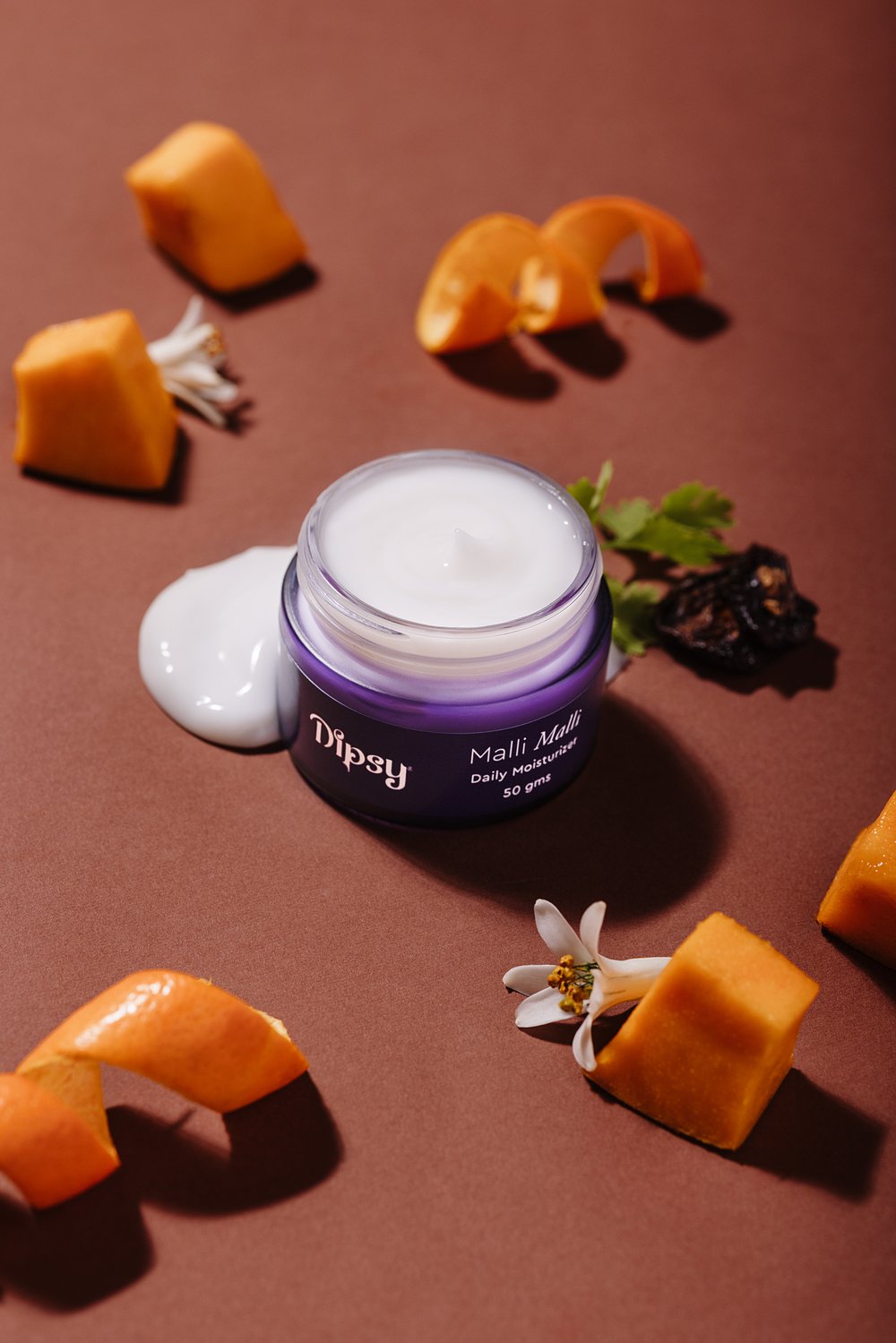
Dipsy Store Product
Pricing as a reflection of process
At Rs. 999 for a 50g tin, Mali Malai is deliberately positioned in the middle of India’s fragmented skincare market. It sits above mass natural products priced at Rs. 200–300, and well below legacy luxury brands that run into several thousand rupees.
“I wanted it to feel premium, but not intimidating,” Nagasamy says. “It should feel like a thoughtful purchase, not something that makes you hesitate before you even try it.”
The price reflects decisions made upstream: ingredient sourcing, certified manufacturing, testing, and packaging. Having seen how shortcuts affect trust in the food business, she was unwilling to compromise to hit a lower price point.
“You can always make things cheaper,” she says. “The question is what you’re willing to give up.”
Entering a market that is growing, and tightening
Dipsy launches into an Indian skincare market already valued at roughly $8–9 billion, with projections placing it above $17 billion over the next decade. Growth is being driven by urbanisation, rising disposable incomes, and a shift toward preventive self-care.
Within that, natural and ingredient-led skincare sold direct to consumers is one of the fastest-growing segments. India’s D2C beauty and personal care market is estimated at around $4 billion in 2025, with skincare forming a significant share. Online-first brands dominate discovery and repeat purchasing, even as physical retail continues to matter for experience.
This growth has also attracted capital. Between 2014 and mid-2024, Indian beauty and personal care startups raised over $1 billion in venture funding. Much of that money flowed during the pandemic, when brands scaled rapidly through digital marketing and influencer-driven distribution.
The result today is a crowded and cautious market. Customer acquisition costs are high. Consumers wait for reviews. Loyalty is harder to buy with discounts alone.
Competing among India’s natural D2C brands
Several Indian natural skincare brands have already built scale and visibility. The Moms Co., founded in 2016, grew rapidly on toxin-free positioning and institutional backing, expanding across thousands of touchpoints. Newer entrants continue to raise capital as well. SkinInspired raised Rs. 24 crore (around $2.7 million) in a Series A round, while Naturals Salon invested Rs. 10 crore (roughly $1.2 million) to launch its own D2C skincare brand.
Globally, the context is just as competitive. The natural cosmetics market worldwide is estimated at around $39 billion in 2024, and projected to approach $70 billion by the early 2030s, as consumers increasingly question ingredient safety and sourcing.
Against this backdrop, Dipsy’s approach is notably narrow. Instead of a wide catalogue or rapid launches, the brand is built around fewer products, slower formulation cycles, and repeat use rather than novelty.
“I don’t want ten products that do one thing each,” Nagasamy says. “I want fewer products that earn their place on someone’s shelf.”
Funding, growth, and choosing pace
Nagasamy is pragmatic about capital, venture funding, she believes, can be useful at the right time, but organic growth is essential in the early stages.
“You need people who come back,” she says. “Without that, money just amplifies noise.”
That view aligns with a broader shift in India’s D2C funding environment. Investors are increasingly focused on unit economics, retention, and defensible positioning, rather than growth at any cost.
For now, Dipsy remains direct-to-consumer, focused on its own website and selective offline experiences such as pop-ups and exhibitions. Marketplaces and global shipping are on the roadmap, but not at the expense of losing control over product feedback and brand direction.
Carrying one discipline into another category
Building Dipsy has meant assembling an ecosystem from scratch: ingredient suppliers, certified manufacturers, testing partners, packaging vendors. It has been slow and occasionally difficult, but deeply intentional.
“At Thalapakkati, I joined something that was already built,” Nagasamy reflected. “With Dipsy, I’m building the system myself.”
The connection between biryani and skincare may not be obvious, but the philosophy is consistent. Respect the consumer. Respect the process. Understand that trust accumulates slowly and disappears quickly.
Dipsy is still early in its journey. But it is being shaped less by trend cycles and more by lived experience - of how brands endure when they are built carefully, and how easily they unravel when shortcuts replace substance.