
74% of CIOs Say Their Jobs Are at Risk as AI's Accountability Era Arrives
For years, enterprise CIOs have been able to shield AI programmes behind the language of innovation: “still early,” “still evolving,” “still being optimised.” In 2026, that defence collapses.
A sweeping new global survey — The 7 Career-Making AI Decisions for CIOs in 2026, conducted by Harris Poll on behalf of Dataiku across 812 CIOs from the United States, United Kingdom, France, Germany, the UAE, Japan, South Korea, and Singapore — paints an unambiguous picture: AI has moved from boardroom ambition to personal accountability. Regulators are tightening, boards are demanding measurable returns, and the CIO’s role is mutating into something sharper and far more exposed: the AI Accountability Officer.
The findings land amid a broader reckoning. PwC’s 29th Global CEO Survey, released at Davos in January 2026 and based on responses from 4,454 CEOs across 95 countries, revealed that 56% of CEOs worldwide have seen neither increased revenue nor reduced costs from AI, despite massive investment. Only 12% reported both cost savings and revenue gains. PwC’s Global Chairman Mohamed Kande acknowledged the disconnect. Speaking at the World Economic Forum in Davos, he told Fortune: “Somehow AI moves so fast that people forgot that the adoption of technology, you have to go to the basics. The companies that are seeing benefits from AI are putting the foundations in place. It’s about execution, not technology.”
Taken together, these reports tell a single story: AI’s experimental phase is over. The accountability phase has begun. And nowhere is this transition more consequential than for CIOs across the UAE, Europe, and high-growth markets like India.
Career Stakes: AI Becomes the Executive Scoreboard
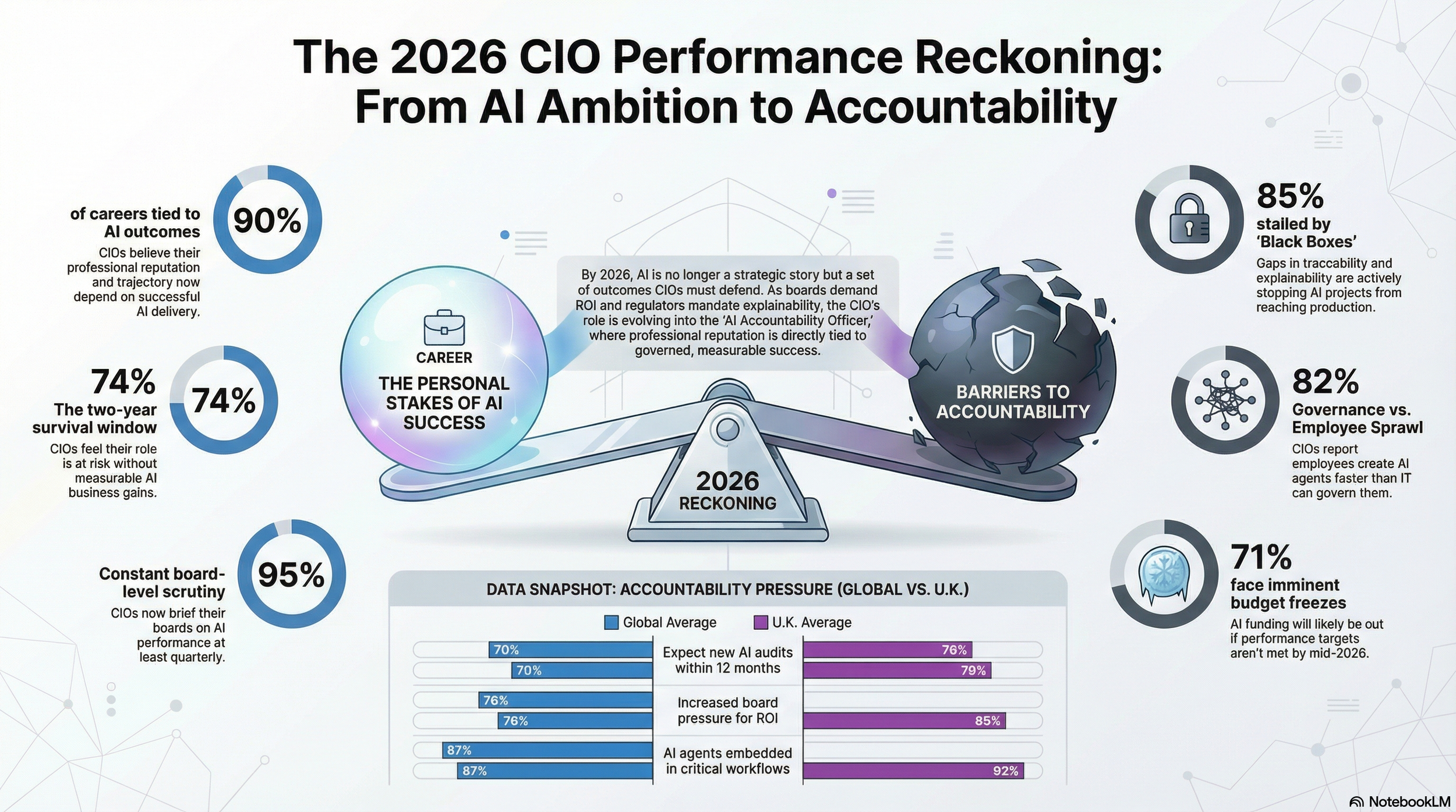
The most striking finding in the Dataiku research is how deeply personal the AI stakes have become. Globally, 90% of CIOs say their professional reputation or career trajectory will be shaped by their success with AI. Nearly three-quarters (74%) agree their role will be at risk if their company does not deliver measurable business gains from AI within the next two years. And the funding consequences are immediate: 71% say it is likely their AI budget will be cut or frozen if performance targets are not met by mid-2026.
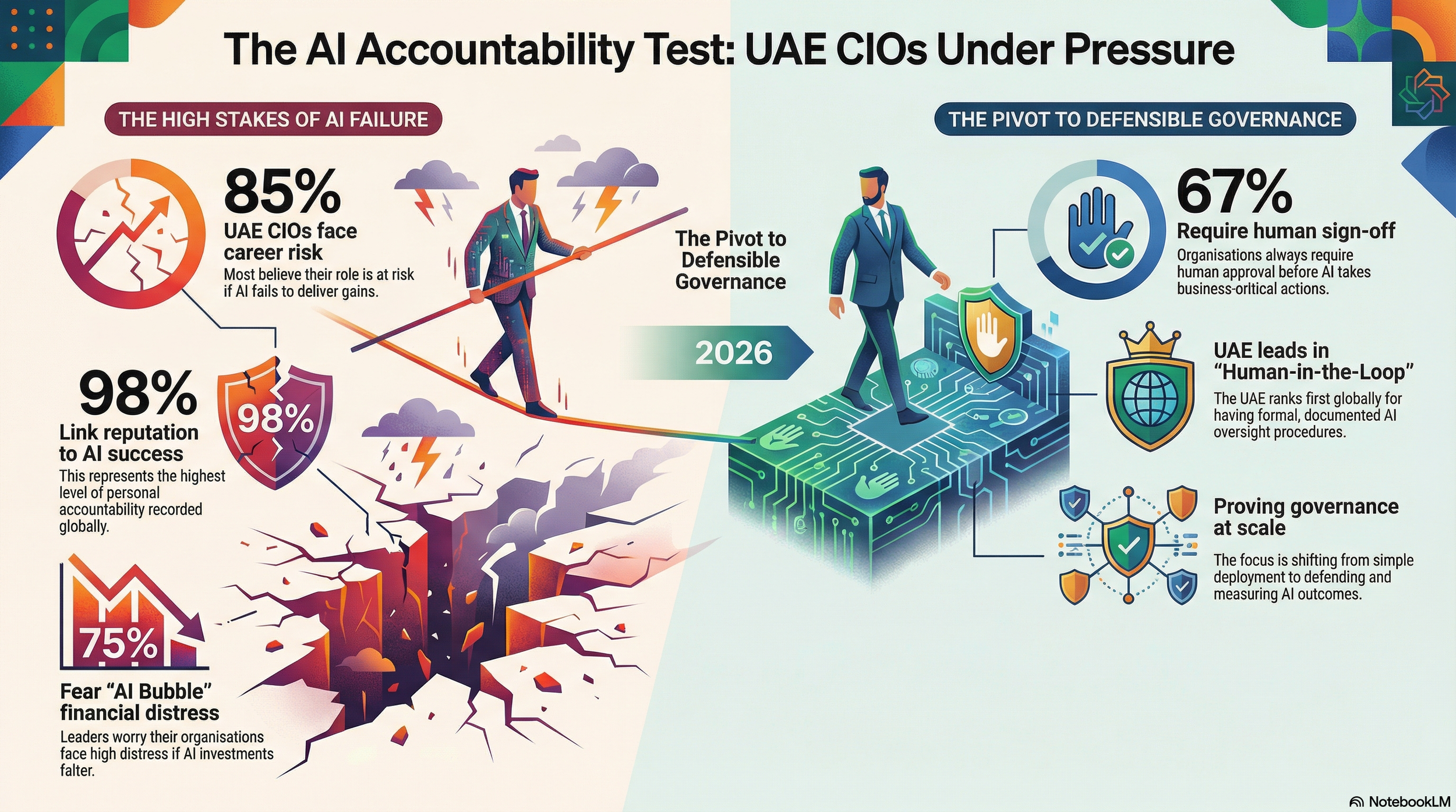
In the UAE, that pressure is even more acute. A remarkable 98% of UAE CIOs — the highest figure globally — say their professional reputation will be shaped by AI outcomes, while 85% believe their role could be at risk if their organisation fails to deliver. The UAE also leads globally in linking CEO compensation to AI outcomes: 92% expect it, signalling that accountability is cascading from the boardroom down through the entire leadership chain. Three-quarters (75%) of UAE CIOs say their organisation would face high financial distress if the so-called “AI bubble” were to burst, underscoring how mission-critical AI has become to enterprise strategy in the country.
Boards are already acting accordingly. Globally, 95% of CIOs brief the board on AI performance at least quarterly, with 46% doing so monthly or more. PwC’s CEO Survey reinforces this pressure from the other side of the table: CEO confidence in short-term revenue growth has dropped to a five-year low of just 30%, and the number-one question on executives’ minds is whether they are transforming fast enough to keep up with technology. Kande, in PwC’s official survey release, called 2026 “a decisive year for AI,” noting that “a small group of companies are already turning AI into measurable financial returns, while many others are still struggling to move beyond pilots. That gap is starting to show up in confidence and competitiveness, and it will widen quickly for those that don’t act.”
For enterprises across Europe, the timeline is equally compressed. In the UK, 85% of CIOs report that board pressure to demonstrate measurable AI ROI has increased since 2024, nine percentage points above the global average. In France, 64% say budgets could be cut or frozen if targets are missed — one of the lower figures globally, but still a clear majority under financial pressure to prove outcomes fast.
The Explainability Crisis: When “Black Box” Becomes Executive Liability
If career risk is the headline, explainability is the mechanism through which that risk materialises. Globally, 85% of CIOs say gaps in traceability or explainability have delayed or stopped AI projects from reaching production. Three in ten (29%) say they have been asked repeatedly over the past year to justify an AI outcome they could not fully explain. And 70% believe new AI audit or explainability requirements are very likely within the next 12 months. In other words, the bottleneck is no longer building models — it’s being able to defend them.
This finding aligns with Cisco’s 2026 Data and Privacy Benchmark Study, which found that while 75% of organisations report having a dedicated AI governance process, only 12% describe their efforts as mature. Ninety-three percent plan further governance investment — an acknowledgment that governance structures are struggling to keep pace with deployment. Jen Yokoyama, Cisco’s senior vice president for legal innovation and strategy, told CIO.com that the gap reflects “the complexity that is facing these companies.”
The regional picture is revealing. In France, CIOs are the most likely globally to expect new audit requirements within 12 months (81%, versus 70% globally), and they are twice as likely as the global average to say explainability gaps cause delays “all the time” (20% vs. 10%). The result is a systemic production constraint, not an occasional blocker. In the UK, 79% expect imminent audit requirements, and 84% say explainability gaps have already delayed or stopped projects. Germany shows more nuance: while 16% report constant delays, the country has the highest scepticism (9% vs. 3% globally) that formal requirements will arrive imminently — suggesting German CIOs see the pressure as complex and uneven rather than a simple countdown.
The UAE presents a distinctive pattern. Day-to-day explainability friction is lower than in Europe — only 8% say it causes delays all the time, and just 22% report being frequently asked to justify outcomes they could not fully explain, the lowest figure globally. But when asked whether insufficient explainability could trigger a customer trust crisis, the UAE ranks highest in the world at 63%, well above the 52% global average. Sid Bhatia, Dataiku’s Area Vice President and General Manager for the Middle East, Turkey, and Africa, captured this tension: “For CIOs in the UAE, the conversation is shifting from ‘how fast can we deploy AI?’ to ‘how confidently can we stand behind it,’” he said. “If 2024 was the year enterprises proved they could build with AI, and 2025 was the year they proved they could deploy it, then 2026 is the year they must prove they can govern, defend, and measure it — and do so at scale, under scrutiny, and with consequences attached.”
Encouragingly, the UAE shows structural advantages that could serve as a model. Two-thirds (67%) of CIOs say their organisations always require human sign-off before AI systems act in business-critical workflows, and the UAE ranks first globally for having formal, documented human-in-the-loop procedures. This aligns with the country’s broader national AI governance framework under the UAE Strategy for Artificial Intelligence 2031, and with Abu Dhabi’s stated ambition to become the world’s first fully AI-native government across all digital services by 2027. Recent developments — such as e&’s collaboration with IBM on enterprise-grade agentic AI for governance and compliance, unveiled at Davos in January — signal that leading UAE organisations are already investing in governed, accountable AI infrastructure.
Shadow AI and the Sprawl Problem: Scaling Without Control
Perhaps the most operationally dangerous finding is how rapidly AI creation is outpacing governance. Globally, 82% of CIOs agree that employees are creating AI agents and apps faster than IT can govern them. More than half (54%) have already discovered unsanctioned AI use for work tasks. Shadow AI is not a future risk — it is active sprawl.
The concern is highest in the US at 86%, but the problem is essentially universal. In the UK, 84% agree AI creation is outpacing governance, and 83% worry about data exposure from citizen-built AI. In France and Germany, the figures are 80% and 83% respectively. In the UAE, 78% say employees are creating AI faster than IT can govern it — slightly below the global average, which may reflect the region’s stronger instinct for centralised oversight.
IDC’s research supports this anxiety. The analyst firm predicts that in 2026, over one-third of organisations will remain stuck in the experimental phase of AI, requiring a decisive shift to enterprise-scale deployment to deliver ROI. Meanwhile, Info-Tech Research Group’s CIO Priorities 2026 report identifies data governance as the single largest capability gap in enterprise IT, with a 2.8-point gap between importance and effectiveness — a fragile foundation on which to scale AI responsibly. As Premkumar Balasubramanian, CTO of Hitachi Digital Services, noted in an interview with CIO&Leader magazine: “Teams must integrate modern platforms with legacy systems, close critical talent gaps in AI and cybersecurity, and balance innovation with compliance.”
AI agents, meanwhile, are already deeply embedded in enterprise operations. Globally, 87% of CIOs report agents are contributing to business-critical workflows — yet only 25% say they can monitor all production agents in real time. In the UAE, the figure is 23%. In Japan, it drops to just 15%, even as 87% of Japanese CIOs report agents embedded in critical work. The combination of widespread deployment with incomplete oversight is exactly where accountability risk concentrates most dangerously. Over two-thirds of CIOs globally (66%) expect formal agent accountability frameworks to be mandated by regulators within two years.
Vendor Regret and the Multi-Model Reality
CIOs are also contending with significant vendor regret that is compounding the governance challenge. Globally, 74% say they regret at least one major AI vendor or platform decision made in the past 18 months. In France, that figure rises to 80%, with French CIOs three times more likely than the global average to regret five or more decisions (12% vs. 4%). Forty percent of CIOs globally say vendor lock-in or LLM pricing changes are having a major impact on their AI budget, and 62% report that their CEO has directly questioned or challenged AI platform decisions at least once in the past year.
The multi-model future is now the present. Eighty-one percent of CIOs expect to rely on two or more LLM providers in 2026, 93% agree that different models perform better for different use cases, and more than half (55%) have already switched LLMs primarily to reduce costs. The CIOs who get ahead, the Dataiku research argues, will treat multi-model as an architectural truth — standardising governance across providers and making switching a controlled capability rather than a panicked reaction.
What This Means for the UAE, Europe, and India
The research draws a clear line between regions deploying AI fast and those deploying AI defensibly. For CIOs across the UAE, Europe, and emerging enterprise AI markets such as India, the implications are material and immediate.
In the UAE, the combination of extreme career stakes, strong adoption momentum, and lower day-to-day explainability friction creates a position that is enviable but deceptively comfortable. The real risk lies in the gap between current confidence and the reputational fallout CIOs themselves expect when — not if — explainability is tested publicly. The region’s structural advantages, from human-in-the-loop policies to national AI governance frameworks, are genuine differentiators, but they must scale alongside the rapid decentralisation of AI creation across the workforce. Despite the rising pressures, UAE CIOs remain cautiously optimistic: they are the most confident globally that their current AI strategies will remain valid over the next year.
In Europe, the explainability challenge is more immediately operational. France faces the most chronic production drag in the global dataset. The UK and Germany are bracing for audit requirements to formalise within months. The EU’s regulatory trajectory means European CIOs will likely face the accountability test first, and the lessons will ripple outward to every market operating under or trading with European jurisdictions.
For India, while not directly surveyed in the Dataiku study, the findings carry direct relevance. PwC’s CEO Survey noted that India has doubled its share of planned international CEO investment year-on-year, breaking into the top tier of global investment destinations. Indian enterprises are scaling AI at extraordinary pace, often with leaner governance frameworks than their Western or Gulf counterparts. The global data on shadow AI, vendor regret, and the monitoring gap should serve as an early-warning system.
The Bottom Line
The convergence of findings across the Dataiku/Harris Poll survey, PwC’s CEO Survey, Cisco’s governance research, and IDC’s predictions points to a single conclusion: 2026 is the year AI stops being evaluated on ambition and starts being evaluated on outcomes. Boards are asking for proof. Regulators are formalising requirements. Budgets are tied to measurable returns. And CIO careers are on the line.
Dataiku’s CEO Florian Douetteau framed the path forward in terms that apply equally to Dubai, London, Frankfurt, and Mumbai: “The pressure is real, and the timeline is tight, but there is a path to success,” he said. “It favours CIOs who act decisively now, building AI systems they can explain, govern, and stand behind — before accountability is imposed rather than chosen.”
The difference in 2026 will not be who experimented with AI. It will be who can prove, govern, and defend AI success at scale. For CIOs across the UAE, Europe, and every high-growth market, the clock is already running.