
AI sovereignty is pushing countries into regional tech lock-in, Gartner report states
Governments worldwide are beginning to redraw the boundaries of artificial intelligence, driven less by technical ambition than by politics, regulation, and control.
By 2027, 35% of countries are expected to be locked into region-specific AI platforms built on proprietary data and infrastructure, according to new forecasts from Gartner. That would be a sharp increase from today, where about 5% of countries operate within tightly regionalised AI systems.
The shift reflects a growing push for what policymakers describe as AI sovereignty — the ability to develop, deploy, and govern AI systems within national or regional boundaries, without dependence on foreign platforms.
“Countries with digital sovereignty goals are increasing investment in domestic AI stacks,” said Gaurav Gupta, Vice President and Analyst at Gartner. According to Gupta, trust and cultural alignment are now shaping AI procurement decisions as much as performance benchmarks or model size.
For many governments, particularly outside the United States and Europe, reliance on Western AI models and cloud infrastructure is increasingly viewed as a strategic risk. Concerns include data jurisdiction, regulatory exposure, and the influence of cultural and legal assumptions embedded in globally trained models.
These concerns are already influencing how AI is deployed in public systems. Gartner argues that regional large language models often perform better than global ones in areas such as education, legal compliance, and government services, especially in non-English languages, because they are trained on more locally relevant data and reflect country-specific legal and administrative norms.
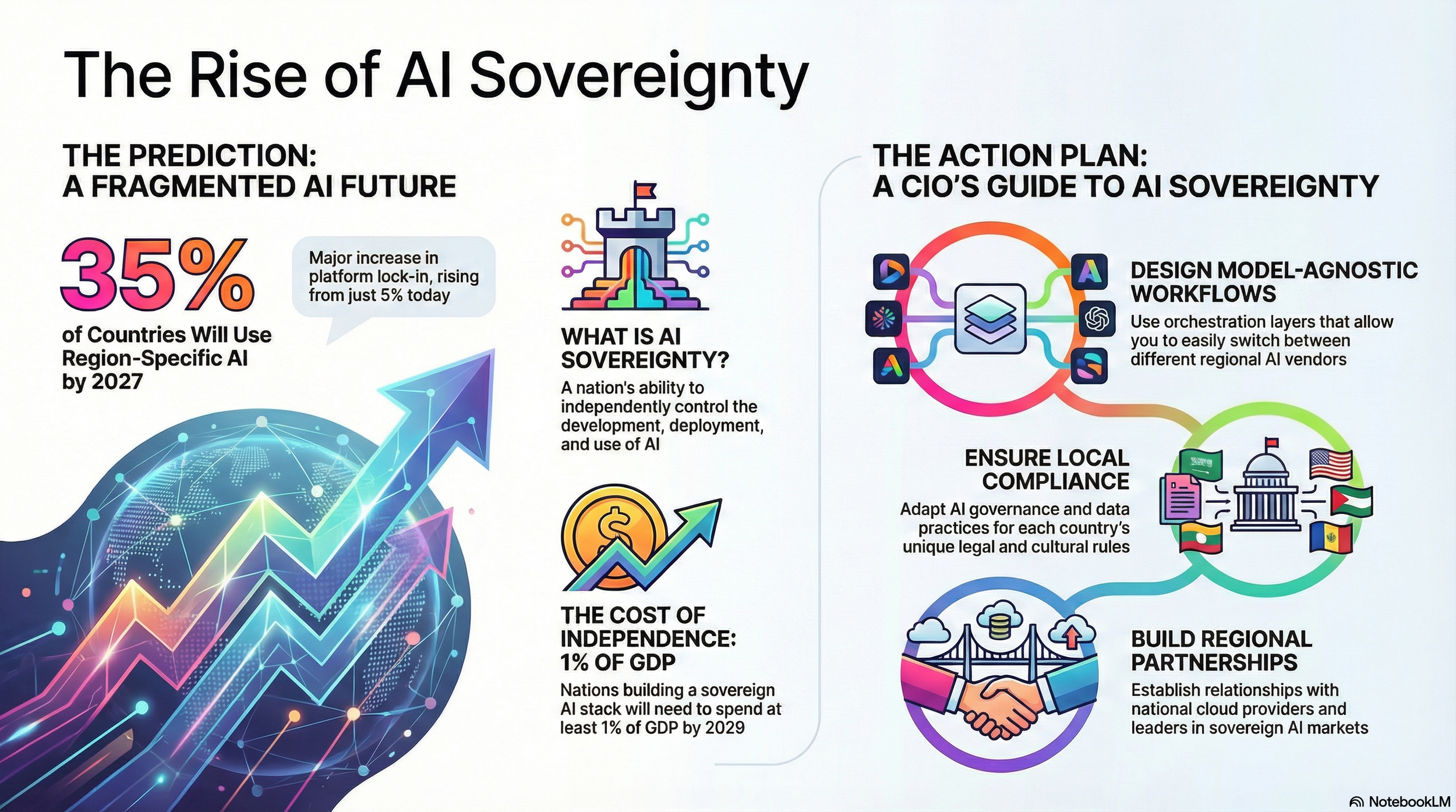
The move toward sovereignty carries significant costs. Gartner estimates that countries seeking to establish an independent AI stack - spanning data centres, cloud infrastructure, compute capacity, and locally aligned models, will need to invest at least 1% of GDP by 2029.
That level of spending would represent a major fiscal commitment, particularly for emerging economies. It also risks reducing international collaboration, as countries duplicate infrastructure and capabilities rather than sharing them across borders. Instead of a global AI ecosystem, the result may be a patchwork of regional systems, each optimised for compliance and control rather than efficiency.
Regulatory pressure is accelerating the trend. Data localisation rules, national AI missions, and security concerns are pushing governments to keep AI infrastructure closer to home. At the same time, fear of falling behind in the AI race is encouraging rapid investment, even where long-term economic returns remain uncertain.
The physical consequences are already visible. Data centres and so-called AI factories are becoming the backbone of sovereign AI strategies, and Gartner expects investment in this infrastructure to rise sharply. Control over these layers of the AI stack is likely to concentrate power among a small group of infrastructure providers, even as governments seek independence from global platforms.
For multinational enterprises, the emerging fragmentation creates new operational risks. Gartner advises CIOs to build model-agnostic systems that can switch between AI platforms across regions and comply with country-specific data governance rules, rather than relying on a single global provider.
What remains unresolved is whether sovereignty delivers what policymakers expect. While localised models may better reflect language, law, and culture, building parallel AI systems is expensive and technically demanding. Many “sovereign” platforms will still depend on imported chips, foreign capital, and upstream software controlled elsewhere.
The push for AI sovereignty may therefore reshape who controls AI,s without necessarily reducing dependence. As governments assert autonomy over technology, they may be trading global integration for regional lock-in, at a cost that will only become clear over the next decade.