
Dubai's property boom outpaced the humans selling it. Rechitta is betting AI can close the gap
Dubai's real estate market closed 2025 as the largest and busiest it has ever been, with property sales reaching AED682.5 billion across 214,912 transactions, a 30.6% surge in value that marked a fifth consecutive record year, according to Dubai Land Department data. Counting mortgages and gifts, the total value of all real estate operations rose to AED919 billion. The numbers describe a market running hotter than its own infrastructure was built to handle, and it is precisely that mismatch that Rechitta, a Dubai-based proptech company, has set out to solve.
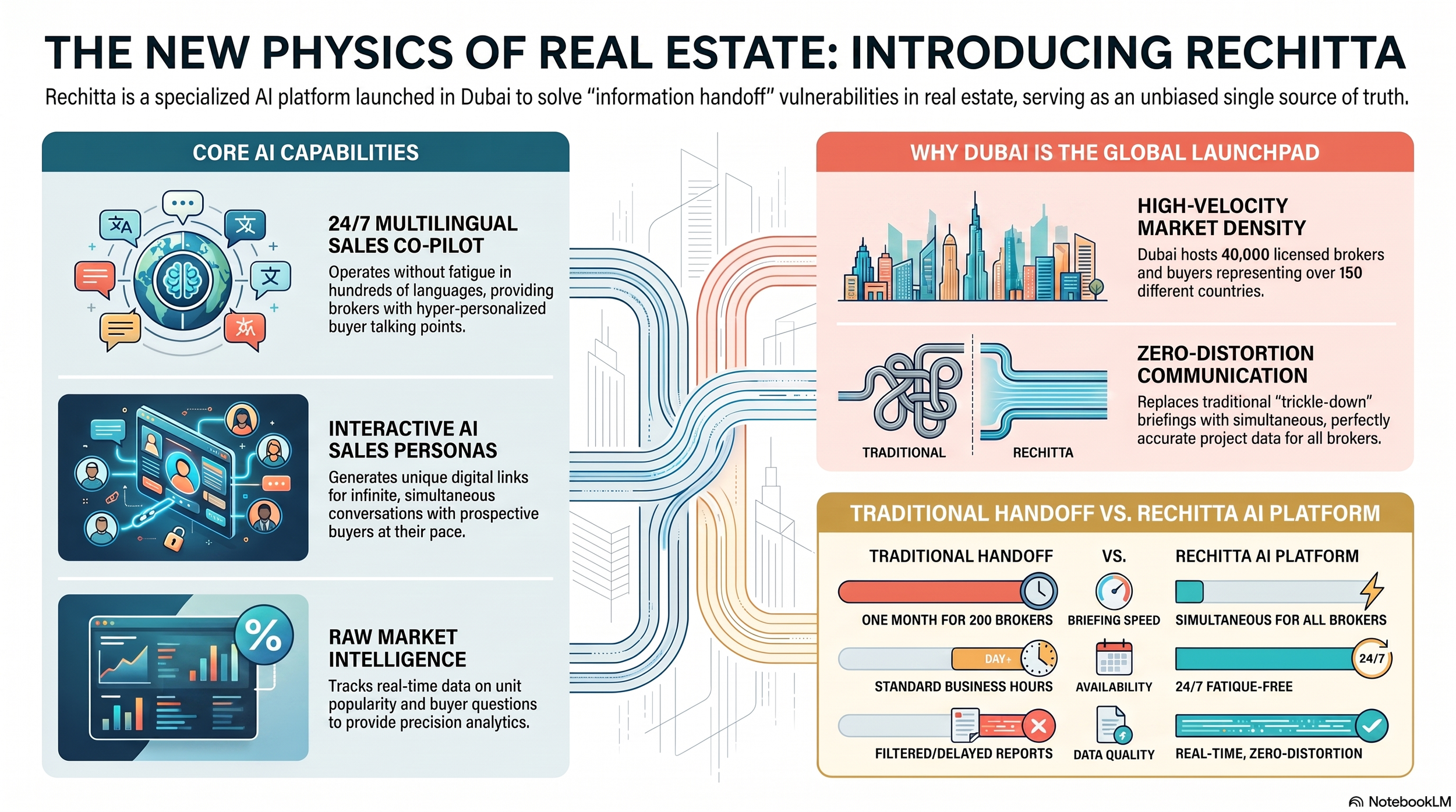
The company, founded by Ashirwad Somani, Aryaman Maheshwari and Atiksh Mittal, has built what it calls an AI-native communication layer for developers, brokers and buyers. Rather than another listings portal or customer relationship management system, Rechitta is designed to sit between the developer who holds complete knowledge of a project and the thousands of brokers who need that knowledge to sell it. The company introduced itself at an event on 19 May at Salvaje Dubai, which it staged as both its first and its last in-person press briefing, a decision meant to signal that the platform itself would handle all future engagement continuously across markets and time zones.
The problem Rechitta describes is structural rather than cyclical. Dubai has roughly 40,000 licensed brokers, hundreds of new project launches each year and buyers drawn from more than 150 countries. A developer's sales team, however dedicated, has a finite number of working hours, which forces it to reach the brokers it already knows and leave a far larger population outside the briefing. Brokers, in turn, carry two jobs at odds with each other, learning new projects deeply enough to speak about them with authority while remaining in front of clients to close deals. The buyer sits at the end of a chain in which information has passed through several hands, each adding a small distortion, and is left to make one of the largest financial decisions of their life inside a fog of inconsistent numbers.
Somani, who has spent close to two decades in real estate, sees the gap as one that no amount of additional human effort can close, because the constraint is the physics of moving information through people one handover at a time. He is candid that long experience can become its own limitation. “Having spent two decades in the profession is not always a good thing, because you get boxed into a particular way of thinking and operating, and you get too attached to it,” he said. That view shaped how the company approached the build. He described bringing in two younger technologists deliberately, handing them the psychology of the market as raw material and letting them work outside the assumptions that two decades in a profession tend to harden into habit.
Ashirwad Somani, Co-Founder of Rechitta, said the market's supporting systems had failed to keep pace with its growth. “Dubai's real estate market continues to grow at a rapid pace, but the systems supporting developer and broker engagement have remained largely fragmented and manual. We saw how AI can build infrastructure that supports global demand more efficiently while improving transparency, responsiveness and consistency across markets. Rechitta was created to support that next phase of growth for the sector. We expect developers using Rechitta to reach up to 20 times more brokers and respond to global market demand far more effectively, without compromising accuracy or consistency,” he said.
Turning every conversation into a market signal
Rechitta's second claim is that the same layer built to distribute information can read it back. The platform is designed to give developers visibility into which brokers engaged with a project, which units generated the most questions, which aspects excited buyers and which fell flat, and which queries recurred often enough to reveal a genuine gap in the original briefing. For brokers, it tracks which parts of a personalised buyer link held attention, what a prospective buyer returned to and what they skipped, so that a follow-up call begins with intelligence rather than cold. The company frames this as giving the market a way to be heard. “The market has always been trying to speak with clarity. It has never had a language that delivered it,” the platform told the room during its own presentation.
Aryaman Maheshwari, Co-Founder of Rechitta, who built the platform's architecture, said the intelligence function is what separates it from existing tools. “What makes Rechitta different is that it transforms communication into actionable market intelligence. Every interaction helps developers and brokers better understand what the market is looking for in real time, from pricing expectations to investment preferences and emerging demand trends. The ability to combine instant response capability with highly accurate verified data creates a more transparent, responsive and scalable sales ecosystem,” he said.
That verified-data foundation is central to the company's argument about trust. In a market where a buyer may hear different figures on the same project from different brokers, Rechitta positions itself as a single source drawing directly on developer-authorised information, delivered in the buyer's own language at any hour. The company argues the trust gap closes not because people become more honest but because the information chain itself becomes harder to break. Atiksh Mittal, Co-Founder of Rechitta, a self-taught AI engineer, said the value for developers lies in control at scale.
“For developers, the challenge today is not demand, it's managing demand accurately and efficiently across markets. Rechitta is designed as a controlled, intelligent communication layer where verified information can be distributed instantly and consistently through broker networks worldwide. One of the biggest advantages is the removal of human error, inconsistency and subjective interpretation from the information chain, allowing developers to maintain complete accuracy and message control at scale,” he said.
A crowded, fast-maturing proptech field
Rechitta enters a sector that has expanded sharply around it. The number of proptech companies in the UAE has nearly tripled in two years to reach 189 firms as of 2025, and the domestic proptech market, valued at around AED2.24 billion in 2024, is projected to nearly triple to AED5.69 billion by 2030 at a compound annual growth rate of roughly 17.5%, according to research cited across the sector. Government backing has sharpened that trajectory. The Dubai PropTech Hub, launched in July 2025 in partnership with the DIFC Innovation Hub and Dubai Land Department, aims to incubate more than 200 startups and attract over AED1 billion in investment by 2030. The Dubai Future District Fund, meanwhile, expanded its portfolio to 30 investments during 2025 and named proptech and artificial intelligence among its priority sectors.
Capital has begun to follow the agentic-AI thesis that Rechitta is built on. In June 2025, UAE-based Prop-AI secured $1.5 million in pre-seed funding to build advanced agentic AI tools for real estate, one signal among several that investors see the category of AI systems acting on behalf of developers and brokers as the sector's next contested ground. Rechitta's differentiator, on its own account, is the depth of its integration with verified developer data rather than a general-purpose assistant layered over public listings, though the company has not disclosed funding, client numbers or the developers currently piloting the platform. On its own telling, it is already inside the ecosystem. “This is not a launch. This is a declaration. The technology is built, the relationships exist, the pilots are live,” the platform said during the briefing.
What it means for the wider market
The significance of Rechitta's wager extends beyond a single company. Dubai's real estate strategy targets AED1 trillion in annual transaction volume by 2033, a goal that assumes the market can keep absorbing rising global demand. If the constraint on that growth is increasingly the cost of moving accurate information through a broker population expanding faster than any sales team can brief, then communication infrastructure becomes a growth lever rather than back-office plumbing. The company has said its immediate focus is achieving trusted integration and operational depth within Dubai before expanding across the GCC and, eventually, internationally.
Whether an AI layer can earn the trust of an industry built on relationships remains the open question, and one the company will answer through adoption rather than assertion. What is clear is that the gap Rechitta describes, between a market setting records and the human systems straining to keep pace, is real and widening. The founders have chosen to treat that gap as an engineering problem. The market's verdict will arrive, fittingly, in the data.
