
How these UAE Startups Turned Their Businesses Into Community Support Tools During the 2026 Conflict
Dubai has always been a city that meets difficulty on its own terms. When regional tensions escalated sharply in late February 2026, a consequence of the US-Israel military campaign against Iran, life in the Emirates did not stop. The Burj Khalifa rose above a clear sky. The malls stayed open. Delivery riders moved through the streets as they always had.
The disruption was real: more than 80,000 short-term rental bookings were cancelled in a single week, airspace across the Gulf was adjusted, and the World Travel and Tourism Council estimated daily losses to the regional tourism sector at up to $600 million.
However, the UAE has navigated difficult chapters before, and what emerged in the weeks that followed was a reminder of why: when pressure arrived, the people who had built their businesses here chose not to retreat. They chose, instead, to reach out.
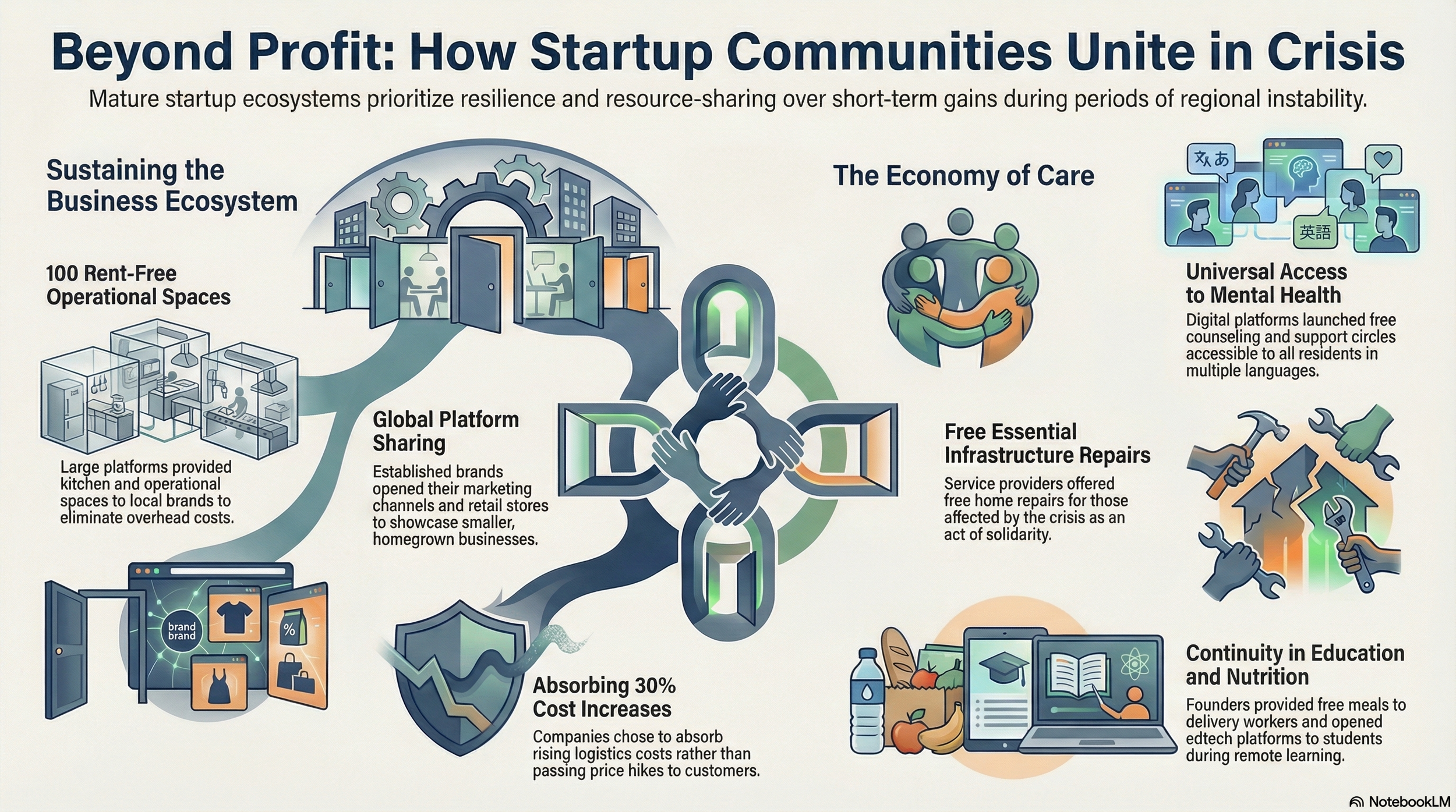
What followed was not a coordinated campaign. It was something rarer: individual founders converting their own platforms, products and resources into tools of community support. Cloud kitchens were offered rent-free to struggling restaurateurs. Retail platforms opened to smaller homegrown brands. Counselling sessions were made available to all. Meals were delivered to stranded delivery riders. Homes were repaired without charge. An ecosystem, those founders told news media, truly matures not when it produces its first unicorn, but when those who have risen begin to carry others with them.
The infrastructure of generosity
Talabat
The gesture that drew the earliest attention came from Talabat, the region’s leading on-demand delivery platform. Founded in Kuwait in 2004 and publicly listed on the Dubai Financial Market in December 2024, Talabat announced on 23 March that it would offer 100 cloud kitchen spaces to UAE-founded restaurant brands, rent-free, until September 2026. The eligibility criteria were specific: brands must have been operating for at least 24 months, maintained 12 months of delivery activity, and operated at least one physical location in the UAE, ensuring the initiative reached established businesses with the capacity to scale rather than functioning as a symbolic gesture.
"Homegrown restaurants are at the heart of the UAE’s food scene, and supporting their growth is a priority for us," said Simonida Subotic, Managing Director of Talabat UAE in news reports. "With this initiative, we’re removing key barriers and giving our partners the space and visibility they need to scale, while continuing to strengthen the wider ecosystem."
Rental expenses in premium urban locations are among the most significant cost pressures for food entrepreneurs in the region. Absorbing that cost entirely for up to six months for 100 separate businesses is not a marketing exercise. It is a structural intervention.
SQUATWOLF
A different kind of infrastructure was being offered on the other side of the city. SQUATWOLF, the Dubai-born premium gymwear brand founded in 2016 by husband-and-wife duo Anam Khalid and Wajdan Gul, announced on 19 March that it would open its entire platform, website, app, flagship stores and social media channels to showcase smaller homegrown brands. Selected businesses would be promoted across every touchpoint of a brand that sells in over 120 countries and recently recorded its best-ever monthly e-commerce revenue, up 98% year-on-year. Founders of featured brands would be invited into SQUATWOLF stores for interviews to run across its social channels.
"As a homegrown brand, we understand the struggle, especially in times like this," said co-founder and co-CEO Anam Khalid. "We have seen firsthand how much a supportive community can lift you. Now it’s our turn to give back."
That phrase, our turn, contains an entire theory of ecosystem development: that support is not charity but reciprocity, not weakness but memory. SQUATWOLF was itself built from personal savings in a Jumeirah Beach Residence apartment in 2016, with its first warehouse a bedroom and its first order worth AED 800. What it is offering smaller brands today is access to the platform it once wished it had.
The economy of care
Not every form of solidarity can be measured in kitchen spaces or platform reach. Some of the most significant responses during this period came from the UAE’s growing wellness and mental health sector, a community uniquely placed to understand what the moment demanded.
Takalam
The Abu Dhabi-founded digital mental health platform acted immediately. Founded in 2020 by Khawla Hammad and Inas Abu Shashieh to democratise access to counselling in the Arab world, Takalam had already demonstrated its crisis instincts during the Covid-19 pandemic. In March 2026, Hammad launched the “Together We Hold” campaign, offering free one-off counselling sessions and group support circles, open to all UAE residents regardless of nationality or status, accessible through the platform’s app in both Arabic and English.
"When the situation escalated, the decision was immediate," Hammad said. "Takalam is a proudly Emirati social enterprise built for this community. The strength of the UAE is not just in its systems, but in how people choose to show up, for themselves and for each other."
Sage Clinics, Keyani Wellness, Medico Arabia, Seva Wellbeing, Achievher and The Sixth House Dubai
Takalam was not alone. Across Dubai and Abu Dhabi, a cluster of founder-led wellness businesses moved in the same direction within days of each other. Sage Clinics organised free online support sessions in English and Arabic for adults, parents, educators and students. Keyani Wellness launched free community meditation sessions. Medico Arabia offered trauma-informed mental health support. Seva Wellbeing opened its Jumeirah studio without charge. Achievher and The Sixth House Dubai each ran free somatic and breathwork sessions for individuals and families navigating acute stress.
What is notable about this cluster is not just its speed but its character. These are not large platforms with marketing budgets. They are small, founder-led businesses, many of them operating on thin margins in a sector still working to normalise mental health conversations in the region. To give away their core product at the moment their community needed it most was, for each of them, a genuine economic sacrifice.
The ones who showed up quietly
Renovo
Renovo, a Dubai-based property maintenance company founded by Scottish expat Samiul Khan, posted a simple message on Instagram: "This land stood for us. Now we stand for it. Renovo will repair every home affected during this conflict free of charge." Khan, who has spent 16 of his 19 years in Dubai running renovation works across the city, described the gesture as an extension of a long-standing ethos. The company had previously completed free renovations for an autism centre in Satwa and undertaken work for mosques in partnership with the Ministry of Islamic Affairs. The conflict, for him, was simply another moment in a pattern of commitment.
Petite Gourmet Dubai
This homegrown F&B brand launched a food initiative providing freshly prepared meals to stranded and vulnerable individuals across the UAE, with a particular focus on service industry workers and delivery riders. "Riders who worked tirelessly through it all, they deserve comfort too," said founder Karishma Samtani. "And food is the ultimate comfort attached to any form of normality during these trying times." The brand extended an open invitation to hotels and other organisations to partner in widening its reach.
LivJaza
UAE-born curated vacation rental marketplace LivJaza waived its platform fees entirely to ease costs for both residents and stranded tourists. When a user posted publicly that her landlord had refused to lower the price for a stranded family of four including a three-year-old granddaughter, LivJaza’s team replied directly: "Please reach out to us via DM. We’d love to help you with a stay." Founder and CEO Ramneek Dhir put the decision simply: "In light of the current crisis, this is not a time to focus on profits."
House of Pops
The UAE plant-based ice cream company made no announcement at all. It simply absorbed logistics costs running 30% higher than normal due to air freight disruptions, choosing not to pass the pressure on to customers. "Now it’s about survival, not really about maximising profitability," said co-founder and CEO Mazen Kanaan. That quiet decision, made without fanfare, is in many ways the most instructive of all.
Peekapak
The edtech platform opened free access to its full K–12 wellbeing education programme for schools and educators across the GCC for the remainder of the academic year, as tens of thousands of children navigated weeks of remote learning and disrupted exams. Peekapak had done something similar during Covid-19, reaching over 438,000 students across 2,800 schools globally. The instinct, when pressure arrived, was already formed.
The Entertainer
Founded by Donna Benton in Dubai in 2001 and still founder-led a quarter of a century later, The Entertainer expanded its “Our Home. Our Heart.” campaign to 100,000 free memberships, giving residents access to buy-one-get-one-free offers across dining, leisure and wellness until September 2026. Benton described the intent plainly: "Supporting local businesses ultimately means supporting the people behind them, the entrepreneurs, hospitality professionals, and the teams who make this country come alive every day. In moments like these, community matters more than ever."
What maturity looks like
There is a question that tends to follow every surge of startup activity in the UAE: whether the ecosystem is real, whether the companies are built to last, whether the culture of entrepreneurship here runs deep enough to survive adversity. The events of March 2026 have not settled that question definitively, but they have contributed something important to the answer. Ecosystems are not made by funding rounds or unicorn valuations. They are made by the choices founders make when the incentives are against them: by giving away a kitchen when you could be filling it, opening your platform to a smaller brand when you could be protecting your own reach, and offering a free session when every session you give away is revenue you do not collect.
Wes Schwalje, co-founder of Tahseen Consulting and himself launching a new venture during the conflict period, told Rest of World that he was building specifically because history shows the UAE does not just survive regional disruption, it wins. "The best companies are not built when the sun is shining," he said in news reports. "They are built by founders comfortable in the trenches."
The UAE has, for decades, been extraordinarily effective at building the structural conditions for entrepreneurship: the regulatory frameworks, the free zones, the access to capital, the infrastructure. What the March 2026 period demonstrated is that something equally important has taken root, a culture of mutual obligation among the people who have built their businesses within those structures. A sense, as Anam Khalid put it, that it is our turn now.
Observers of the UAE’s startup scene noted in media coverage that what distinguished this period was not the scale of the gestures but their nature. These were not campaigns engineered for visibility. They were acts of conviction taken by founders who had decided, long before any crisis arrived, what kind of businesses they wanted to build.
The longer arc
The founders who acted in March 2026 did not discover something new about themselves. They acted in ways consistent with who they had already decided to be, and in doing so modelled something for every founder who came after them: that a platform, a kitchen, an app, or a studio is not just a commercial asset. They are community infrastructure. That signal was not lost on investors.
Steve Khayat, Founder and CEO of Abu Dhabi-based Phoenix Venture Partners, announced the third closing of his inaugural fund during the conflict period, telling Arab News: "Now more than ever, we reaffirm our commitment, with a steady hand and a firm vision, to our investors, to the founders we invest in, and to the wider ecosystem."
There is a plant in the Emirates called the ‘handhal’. It thrives in the harshest desert conditions through what one long-standing UAE founder described in Entrepreneur Middle East as “hardened defiance" -a cultural symbol of the toughness required to build here.
