
The AI Skills Crunch Has a Gender Problem, and Veeam Is Betting 50 Women Can Help Close Both
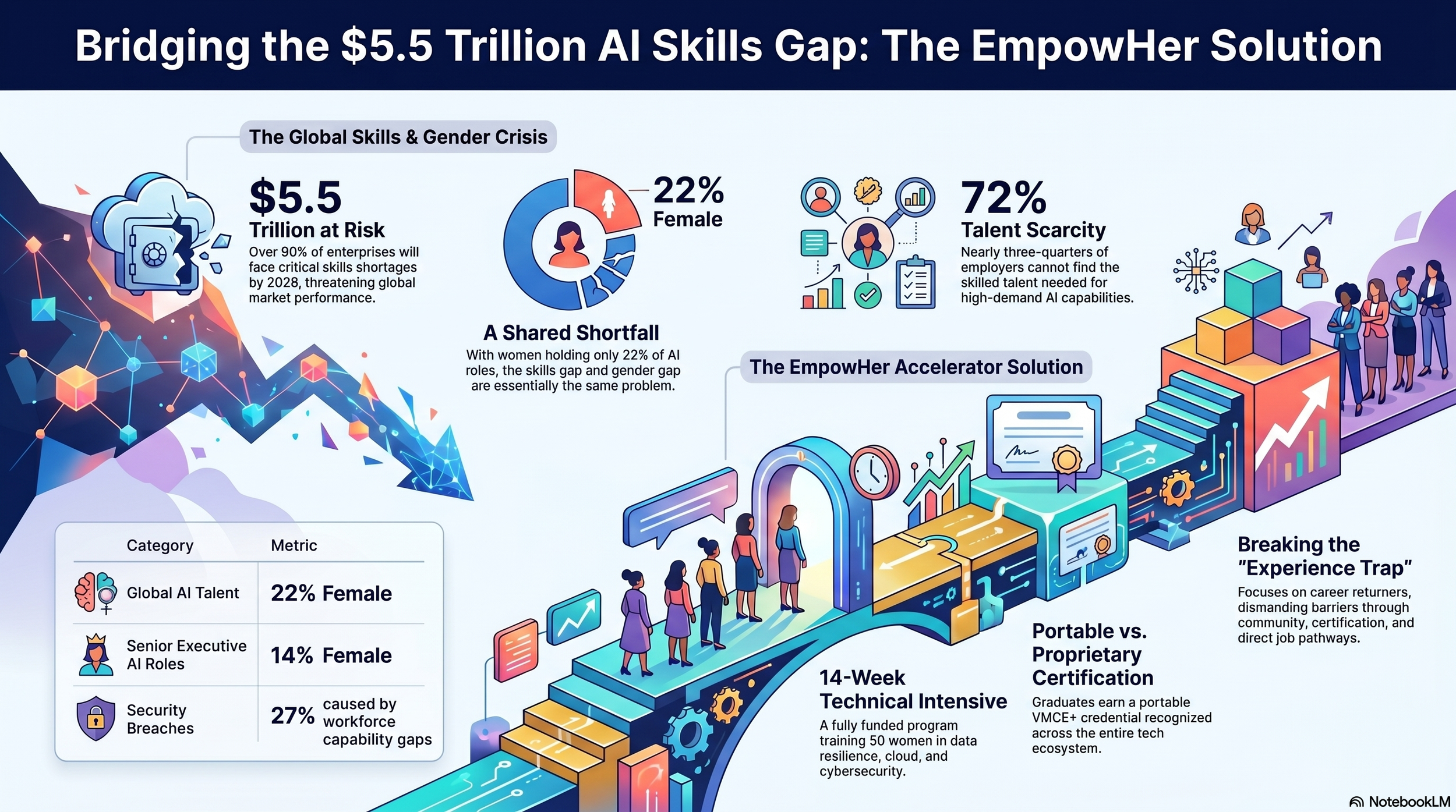
The technology sector is short of skilled people at a scale that now carries a price tag in the trillions, and the shortfall is most acute precisely in the technical territory where women remain scarcest. IDC has projected that more than 90% of global enterprises will face critical skills shortages by 2026, with sustained gaps risking $5.5 trillion in lost global market performance.
ManpowerGroup’s 2026 data found that 72% of employers still cannot find the skilled talent they need, with AI capabilities now topping the hardest-to-fill list and traditional IT and data skills pushed down to seventh place. The World Economic Forum has estimated that 59% of the global workforce, roughly 120 million workers, will need reskilling or upskilling by 2030. Into that gap, Veeam Software has reopened applications for the second cohort of its EmpowHer VMCE+ Accelerator, a 14-week, fully funded programme that trains 50 early to mid-career women toward the company’s VMCE+ technical certification and routes qualifying candidates toward open technical roles.
What has changed is the nature of the shortfall. The market is not short on degrees; it is short on people who can apply technical depth to live systems. The SANS/GIAC 2026 workforce report recorded skills gaps overtaking headcount shortages as the top workforce challenge for the first time, with 27% of organisations reporting security breaches caused directly by workforce capability gaps. AI adoption has widened the chasm faster than training pipelines can fill it, and employers have discovered that access to the technology is no longer the constraint. Securing the people who can deploy, manage and protect it is.
That distinction shapes how the gap can be closed, because a theoretical workforce does not solve a practical shortage. Tellez put the same point from the supply side when she explained the programme’s timing, describing a market where demand has outrun the pipeline. “We are seeing rapid growth in areas such as data resilience, cloud and AI, but the talent pipeline is not keeping pace, particularly when it comes to women in technical roles,” said Emilee Tellez, Field CTO at Veeam. Organisations were now looking for professionals with practical, applied skills rather than theoretical knowledge, she added, which is the demand a certification-led accelerator is built to meet.
A shortage this acute exposes how much talent the sector has been leaving untouched
If the constraint is applied to skill, then a pipeline that excludes half the population is operating well below capacity, and the numbers make the waste visible. Women make up only 22% of AI talent globally and hold less than 14% of senior executive roles in the field, according to an analysis of nearly 1.6 million AI professionals worldwide. In data resilience and cybersecurity, the technical ground the shortage has hit hardest, and that underrepresentation is more pronounced still. The skills gap and the gender gap are not two problems sitting side by side. They are the same shortfall measured twice.
Tellez located the programme squarely on that overlap, presenting it as a deliberate attempt to build a pipeline where representation has stayed lowest. The accelerator is pitched across a broad range of career stages, with a particular focus on early to mid-career professionals, and aimed at the technical fields where the imbalance is starkest. “The goal is to create a strong pipeline of women entering and progressing within technical roles, especially in areas like data resilience and cybersecurity, where representation remains low,” she said. The programme also serves women already in the field who want to deepen their technical skills and take the next step, Tellez added, so the cohort spans entrants and progressors at once.
The most overlooked group within that pool is the one Veeam has gone furthest to reach. Nearly 90% of career re-entry candidates are women, and they take career breaks far more often than men, usually for caregiving, with one LinkedIn and Censuswide survey finding the average break runs to around two years. The barrier is rarely capability. It is the experience-versus-opportunity trap, in which returners cannot secure roles without recent experience and cannot rebuild experience without a role. For an industry openly admitting it cannot find enough skilled people, leaving that constituency stranded is a strategic failure as much as an equity one.
Tellez was unequivocal that the programme was designed with returners in mind, and specific about why their barriers cluster together rather than appearing one at a time. “Women returning to the workforce often face a combination of barriers, from limited access to structured learning and certification, to a lack of community and clear pathways into technical roles,” she said. EmpowHer is built to dismantle all three at once, equipping participants with the skills, credentials and peer network “they need to re-enter tech with purpose and relevant, future-ready capabilities.” A programme that ends in eligibility for live technical positions attacks the experience-versus-opportunity loop directly rather than offering encouragement around its edges, which is what separates an accelerator from a course.
Opening the programme beyond Veeam is the design choice that matters most
That ambition only works if the programme reaches beyond a single employer’s walls, and this is where EmpowHer departs sharpest from convention. It is open to external candidates across the wider ecosystem, including partners, customers, recent graduates and those new to the industry, rather than functioning as an internal hiring funnel. Tellez presented that as a matter of principle rather than logistics. “This is an important part of the initiative, as it reflects our belief that driving meaningful change requires collaboration across the entire technology community, not just within one organisation,” she said.
The choice carries weight because most corporate re-entry schemes are proprietary by design, built to feed the sponsoring employer’s own vacancies. By recruiting from across the ecosystem and ending in a portable, recognised credential, Veeam has built something that benefits the wider talent pool even where a participant is eventually hired elsewhere. The programme concentrates on the first of four courses in the VMCE+ bundle, equipping participants to install, configure and manage the Veeam Data Platform through self-paced learning on Veeam University PRO, cohort sessions led by certified leaders of the company’s Women in Green employee resource group, and a structured pathway to the certification exam. Veeam describes the design as one that shortens time to hire and onboarding ramp time, an argument aimed as much at the employers facing the 72% talent shortfall as at the applicants. Announced from Dubai on 11 June, the programme closes applications on 19 June and runs from the week of 3 August to the week of 30 October 2026.
Why another women-in-tech programme still earns its place
None of which means the field is empty, and Veeam does not pretend otherwise. Infosys runs Restart With Infosys, Tata Technologies launched Reignite 2025, and HCLTech, Persistent Systems, Cisco, IBM, and others operate returnship and re-entry schemes of their own. The reasonable question, which The Source Code put to Tellez directly, is what a further programme adds when so many already exist. Her answer rested on outcomes rather than novelty, and on the difference between teaching a skill and placing a person. “What makes EmpowHer different is its focus on employability and real outcomes,” she said. “This is not just a training program. It is designed as an accelerator that combines certification, hands-on learning and direct pathways into jobs within the ecosystem. It is closely aligned to the skills that are in demand today.”
Two structural features carry that claim. The first is that EmpowHer is open beyond Veeam’s own headcount, where most corporate returnships function primarily as proprietary hiring funnels. The second is that it terminates in a recognised, portable credential, the VMCE+, that holds its value regardless of where a participant is eventually hired. The combination is what separates a pipeline contribution from a recruitment exercise dressed as one, and it is the reason a crowded field still has room for another entrant that is built differently.
The case for treating this as pipeline infrastructure, not philanthropy
The strategic logic becomes clearest when the diversity argument and the scarcity argument are read together rather than apart. Dave Russell, Senior Vice President and Head of Strategy at Veeam, connected the two explicitly. “As organizations accelerate AI adoption, the need for skilled talent who understand how to manage, protect and unlock data has never been more critical,” he said. “Programs like EmpowHer VMCE+ are essential to building the next generation of technical expertise while broadening access to opportunity.” He positioned the investment as foundational rather than charitable, arguing that skills, certification and community together help organisations build “the foundation for trusted data and responsible AI.”
That distinction matters because programmes justified purely on representation grounds tend to be the first cut when budgets tighten, whereas programmes that demonstrably feed a starved pipeline are harder to abandon. The external economics can hold: training investment in technical roles has been benchmarked at around $12,500 per employee against an average 340% return within 18 months, with 78% of trained employees remaining proficient after a year. A 50-person cohort is modest against a multi-trillion-dollar shortfall, but the value of a single programme was never its headcount. Tellez framed the cohort as a starting point rather than a destination, with the longer ambition reaching past entry into seniority. The aim, she said, is to build “a sustainable and diverse talent pipeline for the industry, ensuring that more women not only enter the technology workforce, but progress into leadership roles over time.”
For the women in the second cohort, the proposition is more immediate. Cordelia Dean, an alumna of the first EmpowHer VMCE programme, described an experience that ran past the certificate itself. “Through the program, I gained valuable technical expertise, achieved my VMCE certification and applied these skills directly in real world environments, while also growing in confidence both personally and professionally,” she said, adding that she had become “part of a global community of talented women in technology.” Her summary of the programme’s purpose doubles as the case for why a crowded field still has room for it. “This initiative is about more than certification,” she said. “It is about creating opportunity, inspiring confidence, and demonstrating that there is a place for women in technology.”
