
The Deepfake Wire Transfer Has Become Routine, and Most Finance Functions Are Defending the Wrong Perimeter
The wire went out because the voice on the call belonged to the Chief Financial Officer, carrying the right cadence, the right impatience, and the right reference to a deal that everyone in the finance team already knew was closing. By the time anyone thought to question it, the transfer had cleared and the funds were untraceable. This sequence, once exceptional enough to make headlines, now repeats quietly across the UAE, India, the United Kingdom, Singapore and Hong Kong with a regularity that has stripped it of novelty. The deepfake wire transfer has stopped being a frontier attack and has become an operational reality, and the gap between how it works and how organisations defend against it now sits at the centre of the corporate finance function’s exposure.
The scale of what occurred in 2025 resists any comfortable description as an emerging risk. Billions in deepfake fraud losses were recorded in that year alone, while the organisations absorbing them remained largely unaware of their exposure until the damage had already been completed. Meriam ElOuazzani, Vice President for Middle East, Turkey, and Africa at Censys, was precise about what her company can and cannot observe, explaining that “Censys doesn’t see deepfake fraud attempts directly.
“We see infrastructure,” and describing the scaffolding these operations run on as “the command-and-control servers, the spoofed domains, the certificates spun up for impersonation campaigns.” The losses themselves arrived without forewarning, since “the organizations absorbing those losses largely didn’t know they were exposed until the transfer was already reversed and the damage was done,” as ElOuazzani put it.
That detection lag operates as the mechanism by which losses become irreversible rather than as a marginal inefficiency. ElOuazzani traced it to a basic misdiagnosis when she observed that “most security leaders I speak with are still treating deepfake fraud as a communications problem,” whereas in her assessment “it’s an infrastructure problem, and that’s where intervention becomes possible.”
Andrea Sorri, Segment Development Manager for Smart Cities across EMEA at Axis Communications, located the same threat along a different axis when he warned that “organizations are no longer dealing with isolated phishing attempts; they are facing highly targeted attacks that combine AI-generated voice or video with social engineering techniques designed to bypass traditional trust mechanisms.” Sorri was equally clear that the monetary figure understates the true cost, observing that the impact “can range from relatively small fraudulent transactions to multi-million-dollar losses, but the reputational and operational consequences often extend far beyond the immediate monetary damage.”
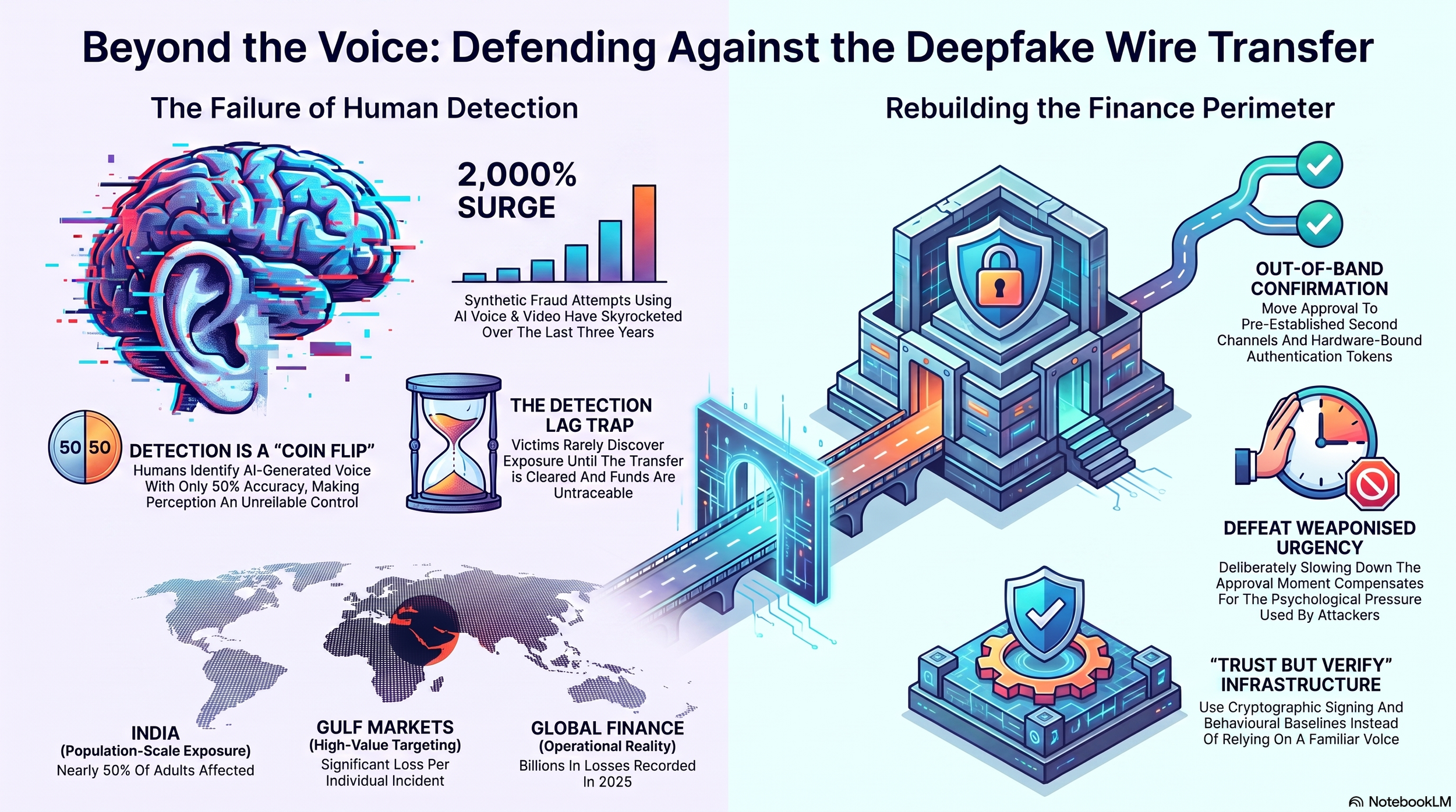
India is exposed at the population scale, while the Gulf faces fewer attacks of far greater individual value
The geography of the threat is uneven in ways that prove instructive. ElOuazzani identified India as the most clearly exposed market by citing a figure that is difficult to absorb, namely that “nearly half of Indian adults have either been victimised by AI voice-cloning or deepfake scams, or know someone who has,” which she characterised not as a rounding error but as a population-scale problem. The exposure, in her account, is structural rather than incidental, because “what makes India particularly exposed is the combination of rapid digital adoption, an enormous mobile-first population, and verification infrastructure that has not kept pace with the threat.” She added that “attackers go where the volume is, and where defences are still catching up.”
The Gulf presents the inverse profile, which ElOuazzani drew out directly when she noted that “the targets in the Gulf markets tend to be higher-value: executives, finance teams and cross-border transactions,” so that “the attack surface is smaller, but the potential loss per incident is significantly larger.”
Her counsel to regional security leaders refused the comfort of comparative ranking, since in her view “the harder question is not which market is worst affected today” but rather “whether your verification controls and your people are prepared for the version of this threat that arrives next quarter.” That distinction moves the regional conversation away from threat-league tables and towards institutional readiness, which remains the only variable an individual organisation can actually control.
Detection cannot be the primary control when humans identify synthetic voice with the accuracy of a coin flip
The instinct to answer a technological problem with a technological fix breaks down at the point of human perception, and the number ElOuazzani offered explains exactly why. As she put it, “when humans can only detect AI-generated voice with roughly 50% accuracy, detection cannot be the primary control,” which leaves an organisation “essentially asking people to call a coin flip.”
The methods that actually work, in her account, abandon the notion of detection as a single moment in favour of “out-of-band confirmation through a separate, pre-established channel,” alongside “hardware-bound authentication tokens that cannot be replicated acoustically” and “behavioural baselines that flag deviation from known communication patterns, regardless of how convincing the voice sounds.” ElOuazzani identified contact centres and executive workflows as the points “where urgency is weaponised deliberately” and consequently “where controls collapse first.”
Sorri reached a structurally similar conclusion from the vantage of a hardware vendor when he argued that “the most effective defence is not a single technology but a layered approach to identity verification,” listing multi-factor authentication, device-based identity validation, biometric liveness detection, behavioural analytics and secure access management frameworks as the components of that layering.
The cultural shift he prescribed was a deliberate one, since in his view “businesses must move away from assuming that a familiar face or voice is sufficient proof of identity and instead adopt a ‘trust but verify’ mindset supported by multiple authentication factors.”
Axis approaches the problem at the level of the sensor, and Sorri’s description of the company’s philosophy was uncompromising when he said that “trust must be established at the very moment light hits the sensor,” because “we don’t just focus on making the image look good; we focus on making the data mathematically indisputable.” That philosophy resolves into a system of cryptographic signing where “any attempt to alter pixels or inject AI-generated content breaks the signature, immediately flagging the video as untrusted,” and the common thread running across both vendors is the retirement of human perception as a control surface.
Finance functions are rebuilding approval around what cannot be faked, and the hardest variable to fix is speed
The crisis ElOuazzani described amounts at root to a collapse of trust in the channels finance teams once relied upon, which she summarised as “a fundamental crisis of trust in voice and video as verification channels.” She observed that banks “that once approved high-value wires based on a CFO’s callback are realising that the voice on the line may not be the person they think it is.” The response from the more capable finance functions, in her telling, rebuilds approval around mechanisms harder to fake than a voice, including “predetermined code words, out-of-band confirmation through a second registered channel, and mandatory dual authorisation above defined thresholds.”
Sorri described the same redesign from the institutional side when he noted that teams are “redesigning approval processes to reduce reliance on individual judgement and single-channel communication” while introducing additional controls around executive payment requests, “recognising that senior leaders are among the most frequently impersonated targets in deepfake-enabled fraud schemes.”
The obstacle that neither additional technology nor additional process resolves is speed. ElOuazzani identified urgency as the active ingredient in the fraud itself when she explained that “fraud works because urgency disables judgment,” so that “until organisations deliberately slow down the approval moment, no technical control fully compensates.” The shift in the attacker toolkit is what makes that urgency so effective, and the figure she cited marks a change in kind rather than degree, since “fraud attempts using synthetic voice and video have surged by over 2,000% in three years,” which she read not as a trend line but as “a capability change.”
She added that “the financial loss per incident is higher precisely because the deception is more convincing.” Sorri confirmed the same trajectory from the supply side when he warned that “what previously required significant technical expertise can now be achieved with commercially available platforms and relatively modest resources,” so that organisations “must assume that the quality of deepfakes will continue to improve.” ElOuazzani returned the question to where she believes it belongs, describing a threat the perimeter was never built to meet when she observed that the danger now “is a CFO wiring funds because a convincing video call said to,” for which “your perimeter tools weren’t built.” She concluded that no tool resolves the problem of “human trust being weaponised,” which instead “requires a different kind of organisational honesty about where your real exposure sits.”
