
Why Acronis Is Betting That the Next Decade of Managed Services Gets Built at the Infrastructure Layer, Not Bolted On to It
For most of the past decade, the infrastructure conversation in managed services ran quietly in the background. Virtual machines ran on VMware, storage was provisioned and then forgotten, and hyperscaler compute costs were rising but remained an abstraction in most partner conversations.
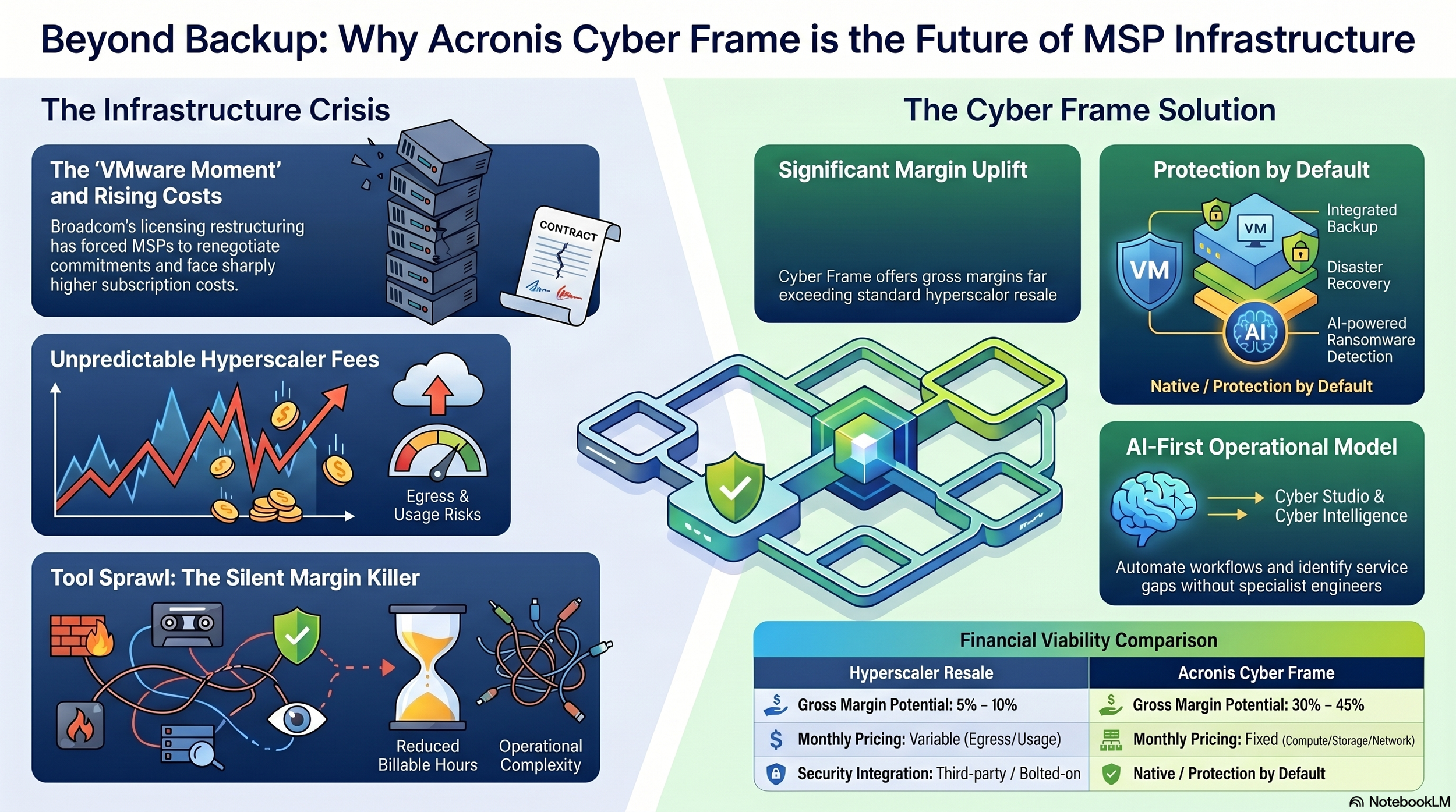
Broadcom's 2023 acquisition of VMware ended that. The licensing restructuring that followed replaced perpetual licences with subscription models, drove costs sharply higher, and left thousands of service providers renegotiating commitments they had not anticipated needing to renegotiate.
Hyperscaler egress fees arrived as a separate problem, surfacing as line-item shocks in customer bills. Demand for sovereign cloud, where data must stay within defined geographic or jurisdictional boundaries, has moved in parallel from a niche compliance requirement to mainstream procurement criteria across Europe, the Middle East, and Asia-Pacific.
Acronis launched Cyber Frame into this confluence of pressure points. The platform, announced at the company's global virtual broadcast on 13 May 2026 and made generally available the same day, is a hyperconverged infrastructure and infrastructure-as-a-service solution purpose-built for MSPs, cloud service providers, hosting providers, and telcos. It is not Acronis's first expansion beyond its backup roots, but it is the one that reaches furthest into territory the company has not previously occupied.
The VMware Moment Created a Window, and Acronis Moved Through It
Gaidar Magdanurov, President at Acronis, was direct about the market logic. "Service providers are rethinking their infrastructure strategies in response to major market shifts and need infrastructure that fits their business," he said. "Acronis Cyber Frame brings infrastructure, protection, and management together in a single, natively integrated platform, helping partners simplify complexity and achieve stronger margins from their infrastructure services."
The margin argument is specific enough to test. Acronis's own data sheet puts the gross margin available through Cyber Frame at 30% to 45%, against 5% to 10% for straightforward hyperscaler resale. Rick Hebly, Senior Director of Platform Marketing and Education at Acronis, described the structural problem that makes those numbers matter.
"Monthly variabilities in cloud consumption, such as egress fees, introduce fluctuations that either end-customers need to account for or MSPs need to absorb," he said. "With Acronis Cyber Frame, fixed monthly prices for compute, storage, and network resources remove variability and risk to enable predictable costs for customers and margins for partners."
Hebly went further in characterising what the commercial model actually enables. "Acronis Cyber Frame is a Partner Cloud, exclusively delivered through and priced for MSPs with tools included, allowing MSPs to repackage their value-added and outcome-based services such as managed infrastructure and applications that escape the commodity trap and enable higher margins than resource by resource, SKU for SKU infrastructure resales."
The platform is built on optimised OpenStack and KVM, developed in collaboration with Virtuozzo, a deliberate choice that avoids proprietary hypervisor lock-in while delivering the orchestration, automation, and multitenancy that service provider operations require. The minimum deployment is three nodes, with five or more recommended for production environments that need full high availability. Partners deploying their own hardware run Cyber Frame Local; those who want to start without capital expenditure provision from Cyber Frame Cloud now live across more than 30 Acronis data centres worldwide.
Protection by Default Is a Product Decision With a Commercial Argument Behind It
Every virtual machine provisioned on Cyber Frame ships with backup and disaster recovery, anti-malware and ransomware detection, behavioural analysis, endpoint detection and response, and remote monitoring and management included from day one, without additional configuration. Acronis describes this as protection by default, and it is the design decision that most clearly separates Cyber Frame from a straightforward virtualisation replacement.
For MSPs managing disaggregated tool stacks, the operational cost of fragmentation accumulates in ways that do not always show up in vendor comparisons. Magdanurov put it plainly in his post-event commentary. "Tool sprawl is the silent margin killer for MSPs," he said. "AI assistance and automation are now embedded across every Acronis service. Natively integrated AI means less context switching, fewer tabs and more billable hours. Consolidation, when done with AI at the core, attacks tool sprawl directly."
Scott Harrison, Cybersecurity Solution Specialist at Grey Matter, described the practical consequences from a partner perspective. "Acronis Cyber Frame represents a major step forward in secure, resilient infrastructure," he said. "By combining virtual machines, networking, storage, cyber protection, disaster recovery, and RMM into a single AI-powered platform, it gives clients enterprise-grade cyber resilience with far less complexity.
Instead of stitching together multiple tools, organisations can operate from one natively integrated platform designed for security, efficiency, and scalability from day one. For our clients, this is more than infrastructure modernisation, it is a smarter, more cost-effective operational model built for the future."
The pricing architecture reinforces the model. Magdanurov described it during the broadcast: "Pricing is by compute, storage and network. You can create your own offerings and charge by resource, instance, user or any other unit you want at a margin you control. No direct vendor-to-end-customer contracts that erode the relationship over time." RMM, EDR, backup and recovery are included at no additional cost across both deployment models.
The 13 May Broadcast Was Not Just a Product Launch. It Was a Platform Restructuring.
Cyber Frame was the centrepiece announcement, but the broadcast carried a broader argument about Acronis's architecture direction. The company organised its roadmap around a three-part framework it calls By AI, With AI, For AI. The first addresses how Acronis builds software, using a development foundation called Cyber Fabric designed to deliver capabilities natively into the platform at speed without accumulating technical debt.
As Magdanurov explained: "Pure AI-assisted development without a secure, performant foundation produces fragile code at scale. Cyber Fabric is the solution: plan, build and run software with reliability and security woven into the fabric itself."
The second pillar covers how AI is embedded across existing services, and the third addresses the emerging reality that customer environments now run AI workloads, AI agents, and AI-generated data, all of which require specific protection and governance. Alongside Cyber Frame, Acronis introduced Cyber Console, a unified interface consolidating managed service delivery, partner training, billing, and support into a single environment.
Cyber Intelligence is the platform's operational AI layer. "The business value is not just operational savings," Magdanurov said. "Intelligence also drives revenue generation by discovering service gaps in customer environments and turning them into managed-service opportunities your sales team would otherwise miss."
Cyber Studio, the no-code workflow builder, was designed with a specific partner constraint in mind. "Most MSPs cannot hire an AI engineer right now," Magdanurov said. "The supply is not there, the salaries are out of reach and the road to profitability for a custom-built AI practice is long." Cyber Studio addresses that gap directly: integration, automation, and generative AI in one place, with an agent builder and workflow orchestration open to third-party services, requiring no engineering headcount to operate.
Magdanurov described Cyber Frame as the biggest announcement of the event. "This is the one that has the greatest positive impact on MSPs delivering infrastructure services," he said, characterising the platform not as a product category extension but as a structural shift in how the channel can participate in infrastructure economics.
Sovereign Cloud and Agentic Workloads Are the Two Structural Tailwinds Driving the Timing
The sovereign cloud market is growing under regulatory pressure that vendor positioning cannot manufacture. The European Union's NIS 2 Directive, data residency requirements across Gulf states, and localisation mandates across Southeast Asia are converting compliance conversations into procurement decisions with defined timelines.
Hebly made the deployment case for partners with existing data centre operations. "Partners with data centre operations designed to meet specific local compliance requirements can deploy Acronis Cyber Frame Local to run hyperconverged infrastructure and deliver managed infrastructure as a service within their respective perimeters, ensuring digital sovereignty while also taking advantage of included management, security and data protection," he said.
Hebly also identified a secondary revenue motion that the deployment model enables. "Partners can also leverage Acronis Cyber Frame Local as secondary infrastructure to customer-owned private cloud deployments, as a secure, sovereign and compliant backup storage and disaster recovery destination," he said. A Cyber Frame Local deployment can serve both as primary infrastructure for managed services and as a protection target for customers running their own private cloud environments, two conversations that partners can hold simultaneously.
The agentic AI workload problem runs alongside sovereign cloud and is accelerating faster. Enterprise environments are already running AI agents, systems that reason, plan, and act across data and applications without step-by-step human instruction. These agents produce data, consume data, and operate across infrastructure layers in ways that existing backup policies, security detection models, and monitoring tools were not designed to cover.
Acronis's decision to position Cyber Frame explicitly as infrastructure for AI workload protection and governance places the product ahead of the customer problem rather than behind it. Omdia forecasts the global partner opportunity for AI services at $267 billion by 2030, with agentic AI representing a growing share of that figure.
What Partners Need to Believe for This Architecture to Pay Off
The early access programme, which ran from 31 March 2026 with more than 750 partners enrolled ahead of general availability, gives Acronis operational evidence to support the platform's claims rather than simply assertions. For that evidence to translate into substantive infrastructure business at the pace the company needs, partners need to trust that the integration runs deep enough to reduce operational complexity rather than relocate it.
Magdanurov's framing of the competitive window was unambiguous. "The MSPs who move now will build the next decade of managed services on a platform designed for AI from the foundation, not retrofitted to it," he said. "MSPs who wait will spend the next three years catching up to the ones who did not."
The conditions Acronis anticipated when designing the product are real and not easing. VMware displacement is ongoing and structured, not a one-cycle disruption. Hyperscaler cost unpredictability is a function of pricing architectures that are not being revised in partners' favour.
Sovereign cloud demand is being written into law across multiple jurisdictions. And the infrastructure requirements of AI-driven environments are arriving, whether the channel is ready for them or not. Acronis has built Cyber Frame to meet all four simultaneously. Whether the platform executes on that ambition at the commercial scale the company needs is the question the next twelve months will settle.
