
Why $500 million is the number that decides who invests alongside a sovereign fund
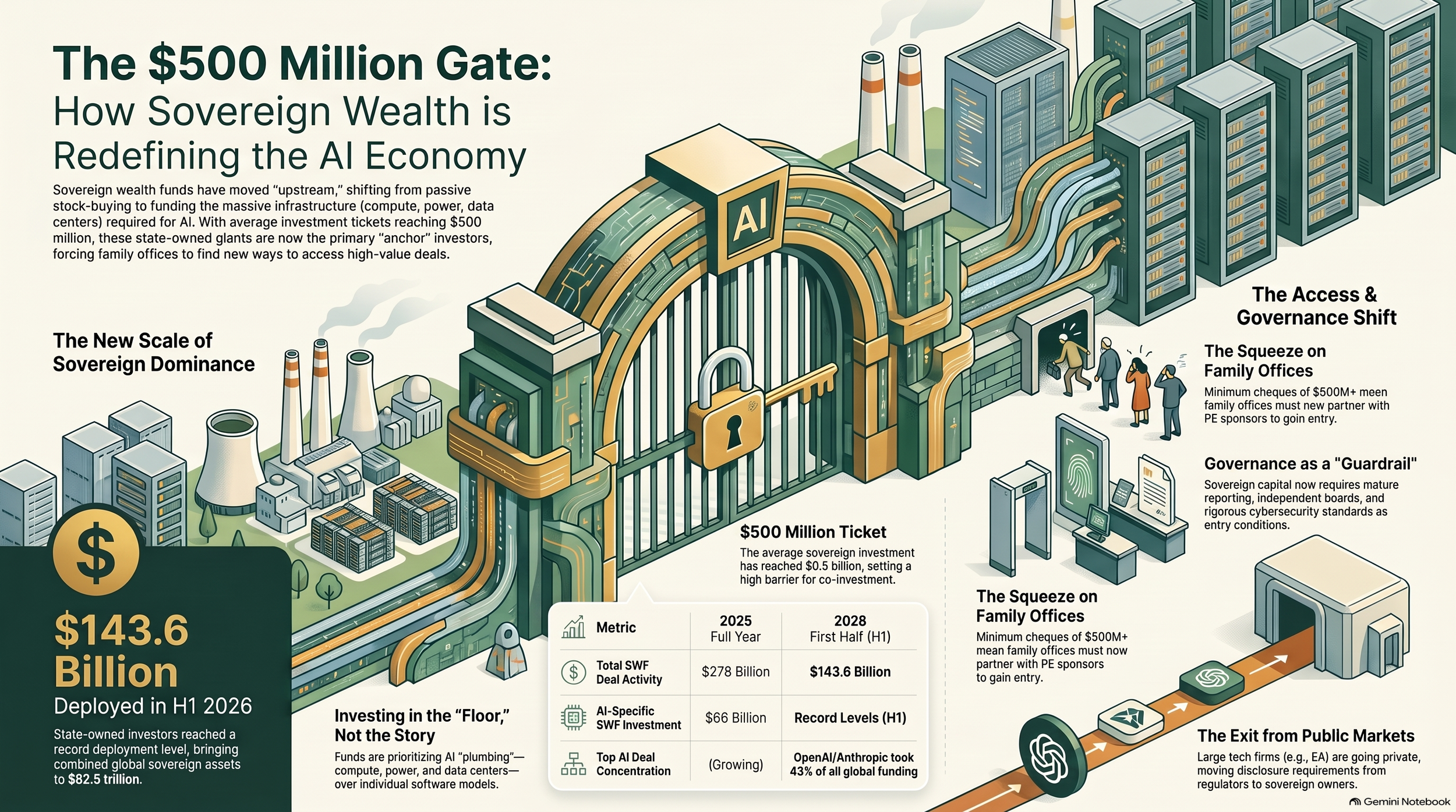
State-owned investors deployed $143.6 billion across 366 transactions in the first half of 2026, according to Global SWF's half-year report published on 1 July, taking the combined assets of sovereign wealth funds, public pension funds and central banks to an all-time high of $62.5 trillion. Gulf sovereign funds committed a record $53.9 billion across 108 deals in the same period, more than a third of all global sovereign capital deployed, with Abu Dhabi's Mubadala Investment Company topping the global ranking at $15.2 billion. Gulf funds participated in 21 of the 42 global deals above $1 billion.
Those figures follow a 2025 in which sovereign investors put roughly $66 billion into artificial intelligence and digitalisation, sovereign wealth fund assets passed $15 trillion for the first time, and total deal activity reached $278 billion across 562 investments at an average ticket of $0.5 billion. The average ticket is the number that matters most for anyone trying to invest beside these funds, and it explains almost everything about how access now works.
"Sovereign money has moved upstream. It has stopped trying to pick which model wins and started investing in the compute, power and land that every model depends on," said Madhur Kakkar of Elevate Financial Services. He described the position as a bet on aggregate demand for compute, which he considers more durable over a long horizon than attempting to identify a single winner.
Michael Smirnow, Chief Investment Officer at Arabian Capital Gulf, made the same point about where in the stack the money is going. "Sovereign funds are no longer buying the AI story, they are buying the floor it stands on: compute, data centres, power and networks," he said. "That is a statement about duration, not about momentum." When a fund with a 20-year horizon underwrites a data centre, he said, it treats digital capacity the way an earlier generation treated ports, grids and pipelines, as the toll infrastructure of the next economic cycle.
The 2026 transaction record supports that reading more than the 2025 one did. The Artificial Intelligence Infrastructure Partnership, founded in September 2024 by BlackRock, Global Infrastructure Partners, MGX, Microsoft and Nvidia, completed its acquisition of Aligned Data Centers on 21 July 2026 at an enterprise value of approximately $40 billion, taking 100% of the equity across 51 sites and more than 6 gigawatts of operational and planned capacity in the Americas.
The Kuwait Investment Authority, Temasek and xAI joined as additional participants. BlackRock chief executive Larry Fink, who chairs AIP, said the investment furthers the group's goal of "delivering the infrastructure necessary to power the future of AI." On 1 July 2026, MGX closed its first fund at $49 billion against a $45 billion target, the largest dedicated AI fund raised to date, while working towards a stated ambition of more than $100 billion in assets under management. Qatar's QIA has committed $20 billion to an infrastructure joint venture with Brookfield.
Vijay Valecha, Chief Investment Officer at Century Financial, said the behaviour has changed rather than the appetite. "These funds are no longer investing passively by buying Nvidia and waiting," he said. "They are funding the plumbing, not just the story." His broader argument is that the mandate itself has been rewritten. "Sovereign wealth funds are no longer custodians of past prosperity; they are becoming active participants in shaping the infrastructure of the next economy," he said.
Warsha Joshi, a family business advisor and identity coach who works with multigenerational families across South and Southeast Asia, the Middle East and Africa, described the same instinct in the language her clients use. "If you are investing in the source, in a way you are also stabilising your future investments, because you have now invested in what is going to hold these businesses in strength," she said. She takes the logic one step further than most capital allocators are willing to. "Along with data, along with AI data centres, water is the next thing that is going to become rare, and that is the source," she said. "Water is going to be just as crucial in keeping that AI segment working."
The direct equity positions have moved just as fast. MGX co-led OpenAI's $122 billion round at an $852 billion post-money valuation, a raise larger than total annual venture capital investment in the United States in any year before 2021. MGX and QIA both backed xAI's $20 billion Series E in January 2026. In February, Singapore's GIC and Coatue led Anthropic's $30 billion Series G at a $380 billion valuation, with MGX as co-lead and QIA participating. By May, Anthropic's $65 billion Series H at a $965 billion valuation had drawn GIC, Temasek, MGX and QIA, the Qatari fund's third consecutive round in the company. Anthropic has since filed confidentially for an initial public offering.
Regional strategy is where the divergence sits. Temasek said in July 2026 that it intends to lift AI-related exposure from 6% of portfolio value to 15% by 2031, against a record net portfolio value of S$518 billion, or roughly $400 billion, alongside raising private credit from 2% to 5% and core-plus infrastructure from 1% to 5%. Chief Executive Dilhan Pillay described AI as "integral to how we sense emerging opportunities," and the fund named five deployment areas: energy and data centres, semiconductors, cloud service providers, foundation models, and AI applications and software infrastructure.
Kakkar reads the contrast plainly. "The Gulf is building the capacity; Singapore is allocating against it," he said. "The common thread is clear, that sovereign capital is increasingly backing the infrastructure that enables the next phase of the digital economy."
Hamza Dweik, Head of Trading MENA at Saxo Bank, put the shift in historical terms. "What unites these approaches is a recognition that AI and digital infrastructure are becoming as strategically important to economic growth as transport, energy and telecommunications were in previous decades," he said.
What sovereign capital is buying looks a lot like what a family enterprise has always bought
The mechanics of a $49 billion fund and a single-family holding company have almost nothing in common. The time horizon does. "Sovereign wealth, at an incredibly different scale, is still a family office," Joshi said. "Family offices and family businesses think long term. There is always a long-term view. That is how family offices are designed to think."
She draws a distinction that gets collapsed in most coverage. A family that runs a business, the family enterprise itself, and the family office are three different entities, and only the middle one generates the cash flow that eventually becomes investable wealth. The office exists to deploy what the enterprise produced, which is why its questions are about durability rather than momentum.
That produces a diligence standard technology companies are not built to meet. "A family office or sovereign wealth fund is going to look at sustainability rather than scalability, at stickability," Joshi said. "Show me how far you are going to take this wealth, and what level of socio-economic impact you are going to make with the money."
The process is also personal in a way growth-stage founders rarely anticipate. "Everything is relational. I want to see the white of your eye. I want to see your emotional responses to some of the questions I might have for you. I want to sit down and have a couple of meals with you before I even talk business," Joshi said. "This is what does not happen in tech businesses, because it is very PE style. Show me glossy presentations, show me some Excel sheets with a graph going up, and here is a cheque drawn out. It does not work like that in family business."
Her explanation for why this capital is now buying artificial intelligence at all comes back to the same horizon. "It is well understood that AI is going to influence every aspect of our life, every aspect of human life, every aspect of business," she said. "It is shifting the way businesses transact. It is shifting how governance is even built in."
The average sovereign ticket is now half a billion dollars, which decides who can follow
Concentration at the top of the market is the reason private investors cannot simply buy the same assets. PitchBook reported that AI startups raised $255.5 billion globally in the first quarter of 2026, exceeding the full-year 2025 total, with OpenAI, Anthropic and xAI accounting for 67.3% of it across three deals while the remaining $83.5 billion was spread across 1,543 others. Senior analyst Dimitri Zabelin said the platforms absorbing that capital are "structural, not cyclical." Crunchbase data put global startup funding at $510 billion across the first half of 2026, of which OpenAI and Anthropic alone took $217 billion, or 43%.
Sovereign funds are the marginal buyer in rounds no conventional venture fund can price, which changes what a co-investment relationship is actually worth. "A sovereign anchor investor often acts as a powerful quality signal because these institutions conduct extensive due diligence and typically invest with multi-decade time horizons," Dweik said. "If a sovereign investor with hundreds of billions of dollars under management is prepared to allocate capital to a project, it can provide significant reassurance to family offices and private investors evaluating the same opportunity."
Smirnow described the value more precisely. "A sovereign anchor changes the answer to the only question that matters to a co-investor: who else has already looked at this closely and stayed," he said. "It brings validated diligence, staying power through cycles, and access to an institutional network that most private investors cannot open on their own. For a family office it compresses risk and shortens the path into transactions that are effectively closed rooms."
Kakkar was unwilling to let the signal stand in for diligence. Temasek wrote its $275 million investment in FTX down to zero after the exchange collapsed in 2022, a loss the fund still cites when explaining why it is prioritising AI over digital assets. "A sophisticated anchor is useful information, not underwriting," Kakkar said. He named three things the anchor does provide: a long-horizon institution that has underwritten the asset, stronger governance conditions, and a capital structure that is more durable in a downturn because a sovereign holder is not typically a forced seller.
The access problem is arithmetic rather than relationship. "Sovereign minimum cheques can run around $500 million to $1 billion. A family office is unlikely to co-invest on those terms," Kakkar said. "The better place to look is the sponsor, not the sector." Nine of the ten largest sovereign deals last year were co-investments with private equity firms, and Global SWF has identified public-to-private transactions as one of the most reliable channels for private capital deployment during volatility, with sovereign funds acting as anchor and cornerstone investors in consortium take-privates. "The relationships worth building are with the sponsors assembling these consortiums, not necessarily with the sovereign funds themselves," Kakkar said.
Valecha mapped where the openings sit. "The strongest co-investment opportunities in the current environment are in AI and digital infrastructure," he said, citing AIP, MGX, the $40 billion Aligned acquisition and QIA's data centre platform with Blue Owl. "Increasingly, family offices are investing as junior partners, relying on the thoroughness of the sovereign and sponsor due diligence and paying lower fees." He also noted that newer vehicles including the UK Sovereign AI Fund and Canada's Strong Fund are more accessible for co-investment than Norway's fund, which invests almost entirely as a passive public-market holder, and warned that the route carries political weight. "The access is relationship-based, and there are often geopolitical implications to be managed, and there has been an increase in national security review of deals involving sovereign capital," he said.
Dweik pointed at the supporting layer rather than the models. "The most attractive co-investment themes today extend beyond AI software itself and into the infrastructure supporting it," he said. "Global demand for AI is creating enormous opportunities across data centres, energy generation, cooling systems, fibre networks, semiconductor supply chains, and cybersecurity providers. These are often long-duration assets capable of generating predictable cash flows while benefiting from powerful structural growth trends."
Private capital is positioning accordingly. UBS surveyed 307 family offices across more than 30 markets for its 2026 Global Family Office Report, published on 28 May, with an average family net worth of $2.7 billion. Alternatives account for 42% of the average portfolio, 65% report exposure to the AI value chain, and 60% plan changes to strategic asset allocation within 12 months, the highest level UBS has recorded. Citi found 70% of family offices make direct private investments, and PwC's data shows the large majority of those are structured as co-investments or club deals rather than solo cheques.
The squeeze is visible at the deal-sourcing end too. Ismail Badereldine, chief executive of Dubai-based platform FinBursa, told AGBI that families were historically approached only "when there was $50 million left to close." Saudi Arabia's Public Investment Fund gathered roughly a dozen prominent Saudi business families on the Red Sea in early 2026 to press for greater participation in domestic opportunities. The 120 families operating out of the Dubai International Financial Centre collectively manage more than $1.2 trillion, capital on a par with a large sovereign fund, and the centre now hosts over 1,250 family-related entities.
Governance is the entry condition, and technology companies still treat it as a box to tick
Conditions attached to sovereign capital have become a qualification round for the companies that take it. "Sovereign capital comes with a due-diligence standard, not just a cheque," Smirnow said. "Reporting cadence, board composition, risk systems, audit quality, related-party clarity, these are conditions of entry, and they change how a company is built. That is the line between a promising business and an investable institution."
Joshi sees the gap between what that capital requires and what growth companies build. "Tech businesses tick a governance box because it is a compliance tick box, instead of an absolute necessity to even gain funding from a sovereign wealth fund or a family office," she said. Her diagnosis of why businesses fail sits underneath that. "Most people think the family business collapses because of a lack of strategy, or a lack of governance, or a lack of market presence," she said. "The family business collapses when family dynamics are not managed well, because that is where it actually starts collapsing. And when that collapses, it is only a matter of time before it reflects on the business."
What governance actually does, in her account, is remove the discretion that produces small failures. "Strong governance formalises decision making. It establishes clear boundaries on decision-making capacities. It eliminates emotional biases and reactive decision making, because that is where the micro failures start to happen, which collectively eventually lead to a slump," she said. She reaches for a mechanical image to explain the function. "Governance is basically the guardrails you are setting. It is like a train. We know where the destination is, but without governance the train can go anywhere. The individuals run the company, but governance holds the individuals on track."
Concentration of authority in one person is the version of that risk sovereign investors have already tested publicly. Norway's fund, Tesla's sixth-largest outside investor, voted against Elon Musk's pay package in November 2025, citing "dilution, and lack of mitigation of key person risk." Joshi put the same question in family office terms. "Will a sovereign fund or a family office usually invest in a key person risk?" she said. "If they choose to, what we do not see in the background is how strong the business is if that key person is removed from the scene."
Kakkar was careful about where the discipline originates. "The discipline that reaches a company comes from the conditions attached to the capital, not from the fund's culture rubbing off," he said, listing audited reporting, board representation, related-party controls and stronger disclosure. He added a consequence companies rarely price in. "A state-linked shareholder also pulls that company into foreign investment screening in every market it subsequently enters," he said.
The assumption that all sovereign investors are equally disciplined does not survive the data. Global SWF published the seventh edition of its Governance, Sustainability and Resilience Scoreboard on 30 June 2026, assessing the 200 largest state-owned investors managing $34 trillion on behalf of 76 countries against 25 indicators. The average score edged up to 60%, with sustainability and resilience improving while governance, including transparency, stayed flat. Nine institutions achieved perfect scores: La Caisse, Ontario Teachers' and BCI in Canada, Norway's NBIM, Nigeria's NSIA, Temasek, and Australia and New Zealand's Future Fund, Rest and NZ Super. Nearly two-thirds of the assessed funds have now adopted or invested in AI, with half reporting their first AI-related initiative in the past 12 months.
"I would be careful with the idea that sovereign investors are uniformly disciplined," Kakkar said. "What a company inherits depends heavily on which fund it takes money from."
Dweik said the bar has risen anyway, because the funds are investing as strategic partners rather than passive shareholders. "Accessing sovereign capital today often requires companies to demonstrate mature governance structures, independent boards, strong cybersecurity standards, robust risk management frameworks, and transparent reporting," he said. "Governance is no longer simply a compliance exercise; it has become a growth enabler." He added that data governance and responsible AI systems are moving up the diligence list as models reach finance, healthcare and critical infrastructure.
Valecha grounded the payoff in capital markets access. "Stronger governance helps companies access financing, particularly from equity and debt capital markets, which promotes innovation, productivity and entrepreneurship," he said, citing OECD analysis. "Good corporate governance protects investors by providing a formal structure of procedures that promote the transparency and accountability of board members and executives to shareholders."
The commercial argument is that the infrastructure gets reused. Kakkar said what a company builds to satisfy a sovereign shareholder is broadly what a lender, a licensing regulator or an IPO underwriter asks for next. "Build it once, and the company enters new markets faster and accesses capital on better terms," he said. "Governance should not slow growth. It should make growth more credible." Smirnow reached the same conclusion from the other side. "Companies that adopt this discipline early scale across borders; companies that postpone it hit a ceiling exactly when growth becomes expensive," he said.
Joshi wanted the point on the record for a sector that rarely raises it. "Governance needs to be part of this, and it is not talked about much," she said.
A trillion-dollar valuation only holds if you can count what it enables downstream
Anthropic was valued at $380 billion in February and $965 billion by May. OpenAI closed at $852 billion. Those numbers are the reason the long-horizon investor and the momentum investor have started to look identical from the outside, and Joshi is direct about what they are. "Pure valuations are speculations in every way possible," she said.
Her test for whether one is defensible has nothing to do with revenue multiples. "If a valuation of $100 on one company means that company is going to affect a thousand companies out there, and allow each of them to make a dollar of profit, or a dollar of impact on each of those companies' ability to contribute to local GDP, then does that $100 make a difference?" she said. "Yes, because this is now at scale." The valuation is underwritten by the aggregate economic activity it enables downstream, which is a slower and more auditable claim than the one usually made in a funding announcement.
The same horizon governs how this capital treats a downturn. "Everything that goes up must come down. It is a law of nature," Joshi said. "They are not investing just to ride out the next slump. They are investing knowing that there is going to be a slump and it is accounted for. They are already accounting not just for the next slump but possibly the next two slumps after that." She added the qualifier that ties it back to governance: "Governance is what drives businesses beyond slumps."
There is a cost to the buildout that shows up in households before it shows up in returns. Temasek's AI work includes engaging portfolio company boards on job redesign and reskilling in partnership with unions and government agencies. Norway's fund, the first to pass $2 trillion, uses AI systems to screen ESG risk across more than 7,000 portfolio companies on behalf of Norwegian citizens. Joshi declines to treat the disruption as a moral question. "If I rewind the clock nearly 150 years, when the world started to go industrial, a similar shift happened," she said. "Did we stop the change from happening? It just required us to begin thinking differently."
She uses an image from the family businesses she advises. "We have decided to shake the tree. Leaves are going to fall. The roots are going to get unsettled a little bit," she said. "It is up to us now to water the soil enough for the tree to settle in again, for new leaves to grow." Her point about where responsibility sits is the one most likely to be uncomfortable for readers on either side of the trade. "The tipping point is now occurring where it is affecting the common man on the street's life," she said. "The decision will also lie in every single pair of hands that turn on a laptop and type in a few words to use AI. This is a collective responsibility from now on."
Institutions are buying digital-asset infrastructure faster than accounting standards can converge
Custody has become a procurement decision. The 2026 EY-Parthenon and Coinbase survey of 351 institutional investors, conducted in January, found 61% operating a multi-custodian model against 36% using a single custodian, rising to 69% among enterprise-scale institutions. Regulatory compliance as a custodian selection criterion rose to 66% from 25% a year earlier, and security and key-signing protocols to 66% from 8%, while 73% of respondents plan to increase allocations in 2026 and 66% already hold exposure through spot exchange-traded products.
"Institutions are largely buying this infrastructure rather than building it themselves and are insisting on redundancy," Kakkar said. "The question is no longer who can provide custody; it is who can provide custody that stands up to scrutiny from regulators, auditors and internal risk committees."
Smirnow set out the preconditions. "In digital assets, infrastructure is the opportunity, nothing institutional happens before it exists," he said. "Four things have to be in place: a clear regulatory perimeter, segregated custody, defensible valuation methodology, and disclosure a client can audit." He pointed to Bahrain, where the central bank has built crypto-asset activity into its rulebook with prior-approval requirements for custody arrangements, and said his own firm holds client assets separately from the firm's balance sheet, "the single point most clients test first."
Valuation is where the divergence is widest. US GAAP now requires qualifying crypto assets to be measured at fair value through net income, while IFRS still has no dedicated crypto-asset standard, a gap Kakkar identified as a material issue for institutions reporting under IFRS and an argument for independently governed, multi-exchange benchmark pricing. "The market has developed pricing infrastructure rather than waiting for accounting standards to converge," he said.
Regulation is closing the gap from the supervisory side. Valecha said Dubai's VARA requires virtual asset service providers to disclose client account values and transaction information at least monthly, subjects assets under management to ongoing independent valuation, and requires documented valuation policies. "Rather than just being an administrative price-feeding exercise, valuation is becoming an institutional discipline in the region," he said. He added that VARA's Virtual Asset Issuance Rulebook requires whitepapers and risk disclosures, with April 2026 guidance clarifying content, material risks and ongoing changes, while ADGM's Financial Services Regulatory Authority has finalised a staking regime with disclosure expectations covering slashing and loss allocation. "Disclosure is expanding beyond simple token issuance," he said.
Dweik said the standard being applied is imported wholesale. "Investors now expect the same standards for digital assets that they receive in traditional financial markets, including secure custody, independent pricing, transparent valuation methodologies, and robust disclosure requirements," he said. "The institutions that succeed will be those that bridge the gap between traditional fiduciary standards and emerging blockchain technologies."
Kakkar listed what clients actually test. They need to understand whether they own the token directly or an instrument linked to it, who holds custody, what happens if the platform fails, how the asset is priced, what liquidity constraints apply and which regulatory protections exist. "Disclosure is where client confidence is won or lost," he said.
Tokenisation is being used to widen the investor base at the top of the market
The most consequential tokenisation activity in 2026 has come from the sovereign side rather than from crypto-native issuers. Mubadala Capital tokenised one of its private-market funds through a tie-up with infrastructure provider Kaio, opening a vehicle previously reserved for selected institutions to a broader set of institutional and family-office investors. Saudi Arabia executed its first sovereign-native tokenised title deed transfer in early 2026, and the Qatar Financial Centre is moving to permit real estate tokenisation.
The institutional appetite is measurable. In the EY-Parthenon and Coinbase survey, asset managers' interest in tokenising their own assets jumped to 64% from 40% in a year, 63% of investors said they are interested in allocating to tokenised assets, and 61% expect tokenisation to significantly affect trading, clearing and settlement within three to five years. Consultancy Kearney has identified private markets as the largest tokenisation opportunity in the Gulf.
Dweik said the direction of travel runs through traditional instruments. "Tokenisation is also expanding beyond cryptocurrencies into traditional financial assets," he said. "Governments, banks, and asset managers are exploring tokenised bonds, funds, and real-world assets because they can improve settlement efficiency, increase transparency and potentially broaden investor access. However, adoption will depend on investors having complete confidence in ownership rights, pricing integrity, and regulatory oversight."
Valecha put the sovereign role in the same terms. "Gulf sovereign wealth funds are not simply providing capital to the digital-asset ecosystem; they are building institutional-grade governance and setting a standard for digital-asset platforms and tokenised products globally," he said. Smirnow said the same maturation is visible in his own market, with regional funds now piloting tokenisation of private-market vehicles and the capability sitting inside regulated investment-firm structures.
As technology companies exit public markets, disclosure will have to come from their owners
On 4 August 2026, Electronic Arts stopped trading on Nasdaq. A consortium of Saudi Arabia's Public Investment Fund, Silver Lake and Affinity Partners completed a $55 billion take-private, the largest all-cash buyout on record, paying shareholders $210 a share, a 24.8% premium to the price before the sale was reported. PIF holds 93.4% of the resulting structure, Silver Lake 5.5% and Affinity 1.1%, funded with roughly $36 billion of equity and $20 billion of debt. EA had been listed for 37 years and posted GAAP net revenue of approximately $7.5 billion in its 2026 financial year. Turqi Alnowaiser, PIF's deputy governor and head of international investments, said "entertainment and sports are key areas of strategic focus" for the fund. Silver Lake chief executive Egon Durban said the consortium intends to invest in EA's growth, including the use of AI in game development.
Valecha treats the transaction as evidence of what anchor capital does to deal economics. "The participation of PIF and Silver Lake in the EA transaction is an example of how sovereign capital can improve both the credibility and economics of a deal," he said. "Anchor participation lends confidence to other investors on pricing, governance and execution, while minimising cost of diligence."
Kakkar reads the same deal as the central governance risk of the cycle. Sovereign capital is now large enough and patient enough that major technology companies do not need public markets, and when they leave, much of the disclosure regime imposed by public-market investors leaves with them. His argument is that the new owners are the only parties capable of replacing it. "Sovereign funds are ultimately accountable to citizens, not merely to a small group of limited partners," he said. "If they require consistent reporting, independent valuation and clear governance conditions across their private portfolios, they can establish a disclosure norm in private markets where securities regulators have limited reach."
Valecha expects the technical standards to be set physically rather than through negotiation, in the absence of any settled playbook for allocating scarce GPU compute across sovereign borders, proving chip provenance for export-control compliance, or coordinating power contracts between grid operators and compute buyers. "The standard isn't decided by committee; it's decided by whoever pours the foundation first," he said. A protocol embedded in the first wave of sovereign-financed data centre buildouts carries a durable advantage, since rebuilding physical infrastructure to a competing specification later is prohibitively costly. "Countries building out their own sovereign AI capacity won't invent a governance framework from scratch," he said. "They'll rather copy whichever existing model looks most proven and replicable."
Dweik expects the pattern to resemble the previous decade of sustainability reporting. "Just as institutional investors helped establish sustainability reporting as a market norm, sovereign investors may help establish a global baseline for responsible AI development and digital market governance," he said. "This could accelerate international adoption of common standards, reduce regulatory fragmentation, and ultimately create a more investable and trusted global technology ecosystem. For investors, this means governance itself may become one of the most valuable competitive advantages in the digital economy."
Smirnow reached the same destination by a different route. "Whoever sets the standards early sets them for everyone," he said. What sovereign investors require has stopped being a negotiating position and has become market practice. "That is the real opportunity of this cycle: not a single vintage of returns, but a set of frameworks that make emerging asset classes credible enough to be allocated to at scale. Institutionalisation is what turns a theme into an asset class, and it is what ultimately brings private investors and family offices in on the same terms as the largest funds."
