
Only 29% of Boards Have AI Expertise as Tech Tops Leadership Agenda
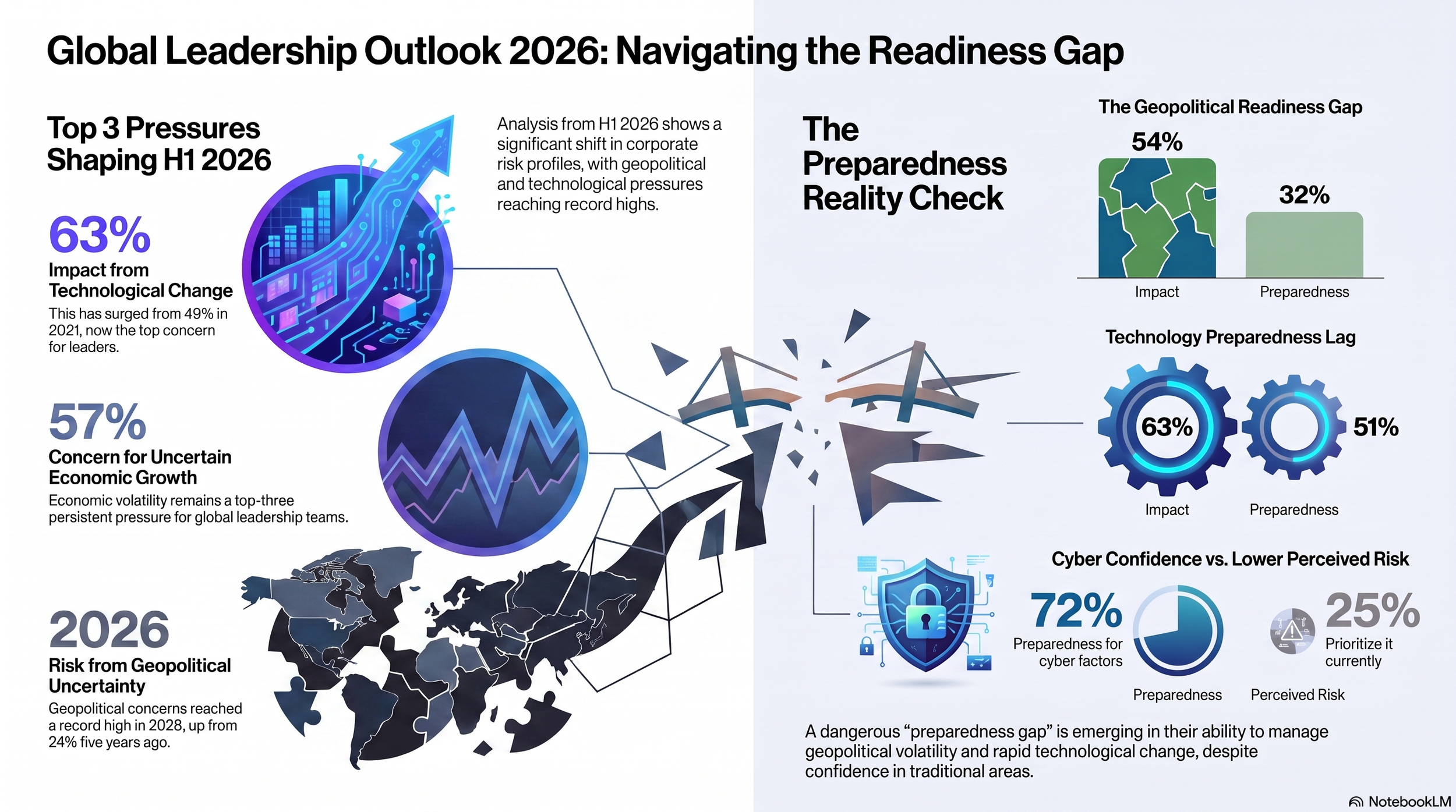
Only 29% of global leaders believe their board has the right expertise to advise on their organisation's AI implementation, in the same survey wave that placed technological change at the top of the corporate agenda for the first time since 2021. Russell Reynolds Associates published its H1 2026 Global Leadership Monitor on Monday, drawing on more than 2,700 executives, board directors and next-generation leaders surveyed between 7 April and 8 May 2026. Some 63% named technological change among the five external factors most likely to influence organisational health over the next 12 to 18 months, ahead of uncertain economic growth on 57% and geopolitical uncertainty on 54%.
That 34-point distance between what leaders say will shape their business and what their boards are equipped to oversee is the most consequential number in the report. Technological change stood at 32% in the second half of 2022 and 57% six months ago, so the agenda has been rewritten inside three years while board composition has moved on a far slower cycle. Uncertain economic growth, which had held the top position since 2023, has now been displaced, and the availability of key talent and skills has fallen to 43%, its lowest reading across ten waves.
The re-ranking has run ahead of the re-equipping
Implementation is well underway. Some 35% of leaders report that generative AI is fully implemented in their team's daily workflow, close to double the 19% recorded twelve months ago, while only 9% say their teams have taken no steps at all. Belief in the capability is near universal, with 90% describing a strong understanding of generative AI as non-negotiable for future C-suites.
Confidence to execute has recovered without catching up. Preparedness to address technological change reached 51% in H1 2026, a seven-point rise in six months following several years of decline, and remains below the levels recorded in 2021 and 2022. Just over half of leaders, 52%, believe they personally hold the skills to help implement AI, an 11-point improvement over the year that still leaves half the executive population outside that group.
Sector exposure varies widely enough to complicate any single reading. Technology leaders selected technological change at 81%, professional and business services at 77% and financial services at 73%, while consumer registered 52% and industrial and natural resources 44%. The industries with the deepest technical bench are the ones reporting the most acute pressure, which suggests proximity to the technology has increased rather than settled executive concern.
Productivity gains have appeared in workflows while the financial case waits
The operational returns are visible. Some 67% of leaders reported that team productivity increased over the previous twelve months as a result of generative AI, and 57% reported an increase in team skills and capabilities, indicating that upskilling programmes are taking effect at the level of daily work.
Financial returns have stayed muted. Only 25% of leaders reported an increase in organisational profitability attributable to AI, and 22% reported new revenue streams. These figures sit well below the adoption and enthusiasm measures recorded in the same survey. Confidence that the organisation holds accurate, high-quality data on which to build AI solutions has remained at roughly 40% for a year, so the foundational constraint has proved durable through a period of rapid deployment.
Regional acceleration has intensified the governance question. The UAE has announced a framework to move half of government sectors and services to agentic AI within two years, followed by a Dubai initiative to accelerate agentic AI adoption across the private sector. “The pace of technological adoption in the UAE, particularly when it comes to AI, is staggering,” said Nicolas Manset, Head of the Middle East at Russell Reynolds Associates. “The government’s push for global digital leadership makes technology one of the defining forces facing organisations in this country.”
Geopolitical uncertainty rose 11 percentage points in six months to 54%, the highest reading recorded across the survey's ten waves, and preparedness to manage it sits at 32%, the weakest score of any factor tracked. Board directors register the concern most acutely at 58%, ahead of CEOs on 54% and C-level leaders on 53%.
The geography is uneven. Oceania recorded 67%, Europe 61% and Asia 56%, while the Americas registered 44%, and among individual markets Spain reached 76%, the United Kingdom 67% and Australia 66%. Protectionism fell from 22% to 15% globally over the same period, and policy uncertainty declined from 38% to 31%, indicating that executives have priced specific trade and regulatory instruments while remaining unable to price the wider instability.
Two unfamiliar risks are therefore reaching the boardroom at once, each with preparedness scores in the low thirties or barely above half. Cyber factors, by contrast, carry a 72% preparedness score after a decade of board-level attention, offering a reasonable benchmark for how long it takes governance capability to mature around a novel category of risk.
Judgement has become the scarce commodity of the transformation
Asked which skills leaders most need to address the top factors affecting organisational health, 55% named strategic thinking, 24 percentage points clear of decision-making and change management on 31%. Resilience followed at 27%, innovation and creativity at 26% and purpose-driven leadership at 21%, with technology literacy selected by 17% and financial acumen by 11%.
The implication for succession planning and executive assessment across the sector is direct, because boards recruiting to deliver AI transformation will be evaluating candidates on quality of judgement under conditions none of them have governed before. “The pressing challenge, as shown by our survey, is building the executive capabilities and board-level governance necessary to guide organisations through this transformation,” Manset said. “That will ultimately be the differentiator between long-term success and failure.”
The pipeline supplying those capabilities is loosening at the same time. Nearly two-thirds of leaders report being open to moving beyond their current employer, three percentage points higher than a year ago, while 86% of next-generation leaders want more responsibility within two to three years and 67% aim for a C-suite role. Only 29% believe their aspirations will be met at their current organisation, which places a retention exposure directly beneath the executive layer now carrying the technology mandate.
