
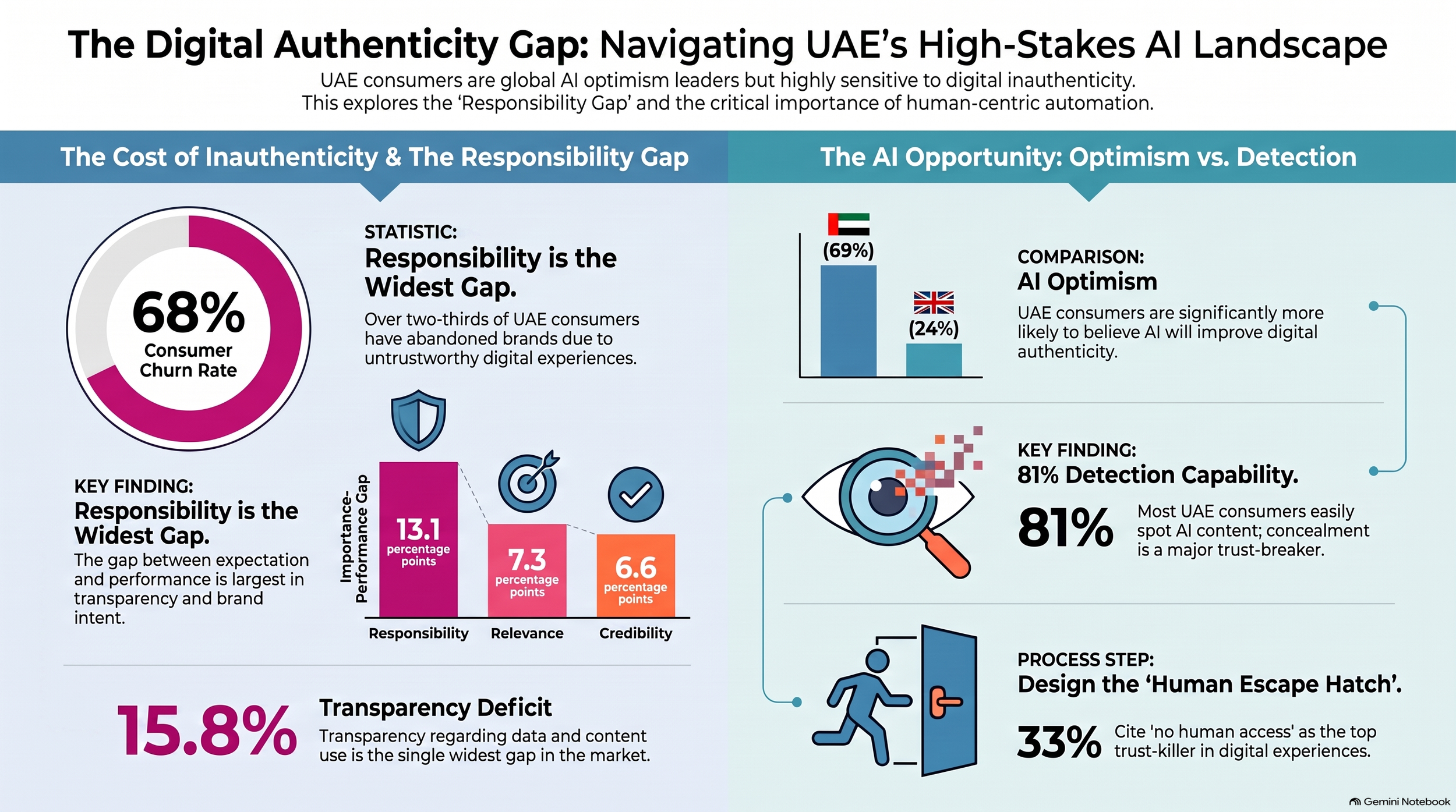
AI optimism runs highest in the UAE, where 68% have already abandoned a brand over a digital experience
Two in three consumers in the UAE, 68%, have already reduced their engagement with, switched away from, or stopped using a brand because its digital experience felt untrustworthy, inconsistent or inauthentic. The figure is the highest of the four markets in a study Ipsos conducted for Sitecore among 4,047 consumers in the United States, the United Kingdom, Australia and the UAE, ahead of the 58.1% global average and well clear of the UK’s 51.2%.
It sits alongside a second finding that appears, on first reading, to contradict it. UAE consumers are the most optimistic in the study about artificial intelligence in brand communications, with 69.2% expecting AI to improve digital authenticity, against 24.4% in the UK and 32.8% in the US, and 83.1% comfortable with brands using AI to personalise their experiences, against 44.1% of British respondents.
The same respondents produced both results, which is what makes the study useful to anyone who has spent 20 minutes inside a customer service chat trying to reach a person about a billing error, or read a product description assembled by a system with no working knowledge of the product. Willingness to accept automation in those moments does not translate into patience when the automation fails, and the UAE data indicates that receptiveness raises what a customer expects to receive in exchange for it.
Sitecore defined the term for respondents as the extent to which a brand’s digital experiences feel honest, accurate, consistent, relevant, transparent, and responsibly delivered, measured across nine signals grouped into credibility, relevance and responsibility. A Sitecore spokesperson described that definition as operational, giving organisations “an operating discipline you can score, signal by signal, on every website, app, email, and chatbot interaction a customer has.” Consumers rated each of the nine twice, once for how much it matters and once for how well brands currently deliver it, and the gap between those two ratings is what the study measures.
92.6% call digital authenticity a top investment priority while 83% already rate brands authentic
Alongside that priority reading sit 91.4% of UAE respondents saying brands need to do more of it, against a global average of 88.5%, and 83% who describe brands as very or somewhat authentic digitally today. The approval score is high enough to be misread as satisfaction by anyone reading only the aggregate.
The spokesperson’s reading of that tension is that aggregate approval and signal-level performance measure different things. Consumers “have stopped treating it as a soft metric and started treating it as a purchase condition”, the spokesperson said, adding that the 68% attrition figure “is the one that should sit on a CMO’s desk”. On the individual signals, the UAE shows brands underperforming against stated importance on all nine, at an average gap of 9.0 percentage points, compared with 21.6 points globally.
“A brand can look authentic enough in the aggregate while still failing on the specific behaviours that decide whether a given interaction earns or costs trust,” the spokesperson explained, listing clear data-use explanations, easy human access and demonstrable action in the customer’s interest among those behaviours.
The persistence of that shortfall through a decade of digital spending has to do with where the money went. “A decade of adding channels widens the surface area for inconsistency faster than it closes the trust gap on any one of them,” the spokesperson said, noting that most investment went into scale, speed and channel proliferation, with governance, content operations and disclosure practices attracting far less of it. The spokesperson also noted that expectations move with capability, since “each improvement in what’s technically possible resets the bar for what good looks like.”
Transparency records a 15.8-point gap in the UAE against 6.6 points for credibility
Broken into its three pillars, the UAE gap measures 6.6 percentage points on credibility, 7.3 on relevance and 13.1 on responsibility. Within responsibility, transparency about data and content use records the widest individual gap in the market, followed by perceived brand intent at 12.1 points and human accountability at 11.5. The same rank order holds in the US, UK and Australia, where the absolute gaps run considerably larger.
Credibility and relevance are largely execution problems, the spokesperson said, improvable through better data quality, cleaner content operations and faster platforms, all of them concrete and visible in a scorecard. Responsibility works differently, since it “asks consumers to judge why a brand did something”, a judgement no amount of technical refinement produces on its own. “You cannot personalise your way into perceived intent,” the spokesperson stated.
Closing that gap calls for structural commitments, which the spokesperson listed as a disclosure policy, an escalation route to a real person and a consistent pattern of acting in the customer’s interest over the brand’s short-term interest. Those commitments are slower to build and harder to fake, and they carry an asymmetry identified as the reason responsibility stays the hardest pillar in every market studied: “Trust in them compounds over many interactions and can be undone by a single bad one.”
The raw ratings in the UAE deck show the same pattern inside a single question. Asked how important it is that brands make it easy to get help from a real person when needed, 93% rated it very or somewhat important, the joint highest score of any signal. Asked how well brands perform on that signal, 77% rated them very or moderately well, the lowest performance score in the set.
No clear way to reach a person is the top complaint in the market most comfortable with automation
Asked what most damages their confidence in brands digitally, 32.9% of UAE consumers cited the absence of a clear route to a human being, ahead of inaccurate or misleading information at 31.6%, privacy and data security concerns at 30.9%, and overly automated or robotic interactions at 28.2%. Globally the same item leads at 46.2%, which puts the UAE lower in frequency and identical in rank order.
Human access appears again among the things that build confidence. Easy access to human support is the second most cited trust builder in the UAE at 33%, behind strong privacy and data security protections at 34% and ahead of honest and straightforward communication at 32%. When something goes wrong, 45% of respondents want the issue resolved as quickly as possible and 37% want to reach a real person quickly, against 13% who want an apology.
The spokesperson reads the finding as a design failure in how automation has been deployed, given that 90.9% of UAE consumers agree AI is beneficial when used responsibly. The industry has “under-invested in making the human escape hatch part of the automated design”, the spokesperson said, with the route to a person too often bolted on outside the journey. Brands closing that gap treat “a real person, reachable quickly, as a designed feature of the automated journey”, where “automation compresses time to resolution and frees human capacity for the moments that actually require judgement.”
UAE consumers also expect the direction of travel to be favourable, which separates them from every other market surveyed. Only 20.1% believe the human element of digital experiences has worsened over the past two years, against 67.3% in the UK and 50.9% globally, and 49.8% expect it to improve over the next two, against 12.9% of British respondents.
80.7% say they can spot AI content, which removes the commercial case for staying quiet about it
Detection confidence in the UAE runs well above the UK’s 47.6% and the 60.1% global average, and it is the highest reading in the study. The commercial consequence, according to the spokesperson, is that brands “can no longer plan around the assumption that AI-generated content will pass as indistinguishable from human-made content.”
Where a brand stays silent and the audience senses AI use regardless, “the read shifts from efficient to concealed”, the spokesperson said, describing that combination as the one that erodes trust fastest even in a market as receptive as the UAE. The spokesperson also pointed to a craft problem, noting that content is frequently easy to identify as machine-generated because it is generic, repetitive or subtly off, which damages the relevance, accuracy and tonal consistency signals brands already underperform on.
Sitecore’s recommendations for organisations leaning heavily on generative content run to three: keep a visible layer of brand judgement and editing before publication, treat disclosure as a stated value ahead of any external pressure to explain, and apply “does this still sound like us” as a release gate for AI-assisted work. The underlying shift, the spokesperson said, is that “quality of use is now doing the trust work that concealment used to attempt.”
Responses to undisclosed AI use produced the most unusual result in the UAE data. Asked how undisclosed AI-generated content affects their trust, 43% said it increases trust, 40% said it decreases trust and 18% reported no impact, against 78.2% in the UK who said it decreases trust. Whether that reflects genuine comfort, a reading of AI deployment as evidence of technological sophistication, or a question interpreted differently by a young sample is beyond what the data settles, and it is the result most worth further research.
For brands operating across all four markets, Sitecore’s position is that tolerance variation is the wrong variable to optimise, since “content crosses borders faster than policy does” and regulatory direction in the EU and UK is moving towards mandatory disclosure of AI-generated content. “The reputational floor is set by your most demanding market, whether you plan for it or not,” the spokesperson said. What varies by market, in the company’s recommendation, is tone and creative treatment, with disclosure in the UAE presented as a value statement along the lines of “we use AI responsibly to serve you better”, while the underlying rule holds everywhere.
51% now judge a brand more by its app than by its branch
Against that 51% who said digital interactions are more or much more important than real-world ones in judging whether a brand is authentic sit 38% who rate them equally and 12% who consider them less important. For an organisation still built on the assumption that the branch, showroom or flagship store is where the real brand shows up, the spokesperson said, “that assumption is now backwards for roughly half its customers.”
Sitecore set out three structural consequences: single ownership of the customer promise across physical and digital channels, investment in digital at budget levels historically reserved for flagship physical experiences, and the merger of customer service and digital experience into one accountable function, on the grounds that “a bad automated interaction online is no longer a lesser incident than a bad experience in a branch.”
Most organisations currently have no way of seeing the 68% who have walked away, which the spokesperson acknowledged when describing how measurement is built. Systems organised around acquisition efficiency, with brand health tracked separately and infrequently, absorb authenticity-driven departures into an undiagnosed churn line. A figure of that size, the spokesperson said, is “too large to keep living inside an unattributed churn bucket.”
Sitecore’s recommendation is to instrument the nine signals as leading indicators alongside CSAT and NPS, then run cohort analysis linking specific signal failures to subsequent movement in engagement frequency, repeat purchase and lifetime value, “the same way a support team tracks the retention impact of a bad ticket.” Asked where a chief marketing officer with budget for one change should direct it, the spokesperson named responsibility, since “it’s the pillar where a modest, well-targeted improvement produces a disproportionate trust return”, and set out three markers of progress: a narrowing of the gap on transparency, human accountability and brand intent, tracked through a quarterly pulse on the nine-signal model; a falling rate of no clear way to reach a human as a cited trust breaker; and movement in the retention and lifetime-value cohorts. The last of those, the spokesperson said, is what allows a marketing lead to demonstrate to a finance lead that the work “kept customers and positively impacted the bottom line.”
Anyone reading the UAE numbers should account for the composition of the sample, since the 1,016 respondents skew markedly young at 51% millennials, 28% Gen Z and 1% boomers, a distribution that alone would predict higher AI comfort than a global sample carrying considerably more Gen X and boomer weight. Sitecore cites that skew as one of three explanations for the divergence, alongside a higher baseline of satisfaction with brands’ current digital performance, where “AI is being evaluated as an extension of something that’s already working”, and several years of AI-forward public-sector digital services giving consumers a large-scale reference point for automation in everyday transactions. The result, in the spokesperson’s reading, is “a market that has, on balance, already seen the responsible version work.”
The sampling caveat leaves the central finding intact for the sector. In the market where consumers are most willing to accept AI in their dealings with brands, the largest single complaint is that there is no obvious way to reach a person, and two in three have already acted on their dissatisfaction by taking their business elsewhere.
