
Riverbed bets two decades of monitoring data is the moat agentic AI rivals cannot copy
Where much of the enterprise software industry treats agentic AI as a reason to start over, Riverbed has wrapped a modern agentic framework around proven components that already understand the endpoint, the network and the application.
Simply put, agentic AI is a type of artificial intelligence that not only answers questions or flags problems but also decides what to do and then acts on it, carrying out the steps a human operator would otherwise have to take.
Richard Tworek, the company’s Chief Technology Officer, treats that inheritance as the whole point rather than a constraint. The platform’s consistent thread, he said, is the ability to diagnose what is actually happening to keep an entire enterprise running efficiently, not merely the IT department that supports it, with the launch recasting that diagnostic capability as something closer to prevention, a move from reactive operations toward an autonomous model the company says rests on complete data visibility, context-aware intelligence and trusted operational governance.
The data Riverbed has been collecting for 20 years is part a competitor that cannot quickly assemble
The scale Riverbed claims for the shift is considerable. “Riverbed is now shipping our third generation of AI for digital employee experience, where AI moves beyond chatbots and self-service to help organisations proactively prevent disruption before employees are impacted,” said Dave Donatelli, CEO, Riverbed in an earlier press release shared by the company.
He grounded that lead in the company’s history rather than its newest engineering, pointing to more than 25 years of expertise across applications, networks, devices and AIOps combined with a unified data architecture purpose-built for autonomous operations.
“Today, our AI is already operating at massive scale across many of the world’s largest brands, helping enterprises reduce disruption and advance toward autonomous operations,” he said. That history is the asset the rest of the story turns on, because the products announced in Dubai are less a set of separate launches than successive expressions of the same underlying bet, that an agentic layer is only as good as the data beneath it, and the data is the part a competitor cannot quickly assemble.
Three generations of the intelligence layer track how much work has been lifted off the IT desk
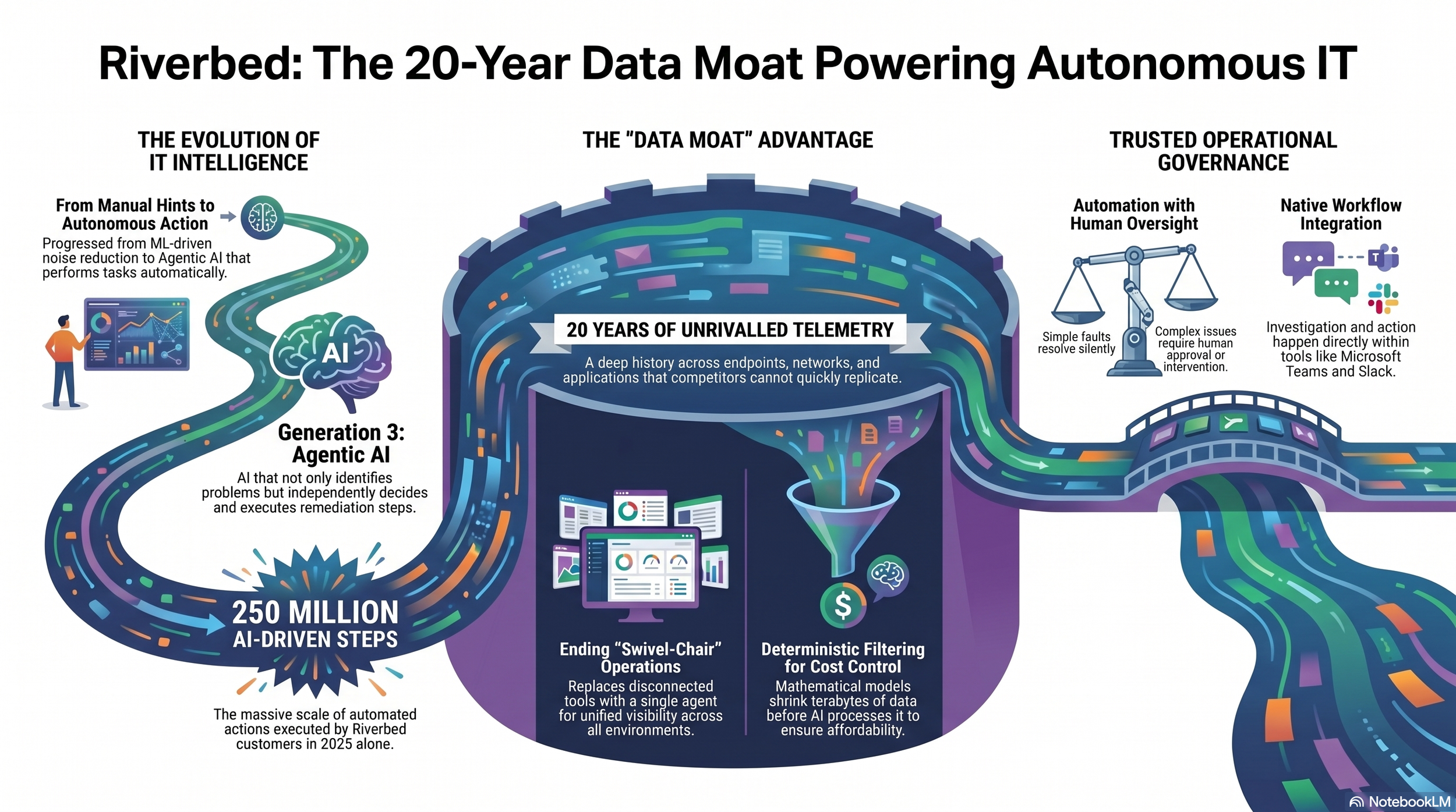
The clearest illustration of how that inheritance is being modernised rather than replaced sits in the generational arc of Riverbed’s intelligence layer. The first generation, built on machine learning, set out to reduce the volume of problems reaching IT in the first place. The second used generative AI to give engineers hints on where to look once an issue surfaced. The current release, anchored by Riverbed IQ 4.0, moves the work off the team altogether through an agentic framework that enables authorised AI-driven actions, intelligent workflow creation and natural language interaction across IT roles, and Tworek summarised its ambition in the plainest possible terms.
“This means the IT department can do something else, as the system is actually doing the work automatically in the background,” he said.
Beneath that promise, the platform monitors call quality, network conditions and database performance without pause, and an agentic engine assesses what it finds. “Our agentic engine, the brain, is constantly looking at these things and being able to make assessments,” he said. “Now, if we can fix it without any of us knowing about it, we’ll fix it in the background.”
Governance is the condition of automation, not an addition to it
The restraint built into that autonomy is as deliberate as the automation, because not every fault is allowed to resolve itself. “It doesn’t do it automatically without some governance,” Tworek said, describing a spectrum in which easy problems are handled silently while difficult ones wait for a person to approve the action, decline it or defer it, a governance layer enterprises now scrutinise more closely than the automation it sits beside.
Riverbed has extended the same reasoning to where engineers already work through a conversational interface it calls Riverbed Q, which integrates with Microsoft Teams, ServiceNow and Slack so that investigation and action happen inside the tools people already use rather than in another console demanding their attention.
A rival would have to master the endpoint, applications, communications and the network at once
That last point opens onto the argument Tworek makes most forcefully, which is why a larger technology company could not simply arrive and replicate what Riverbed has. The answer lies in the data the platform collects at the end point, covering network information, application performance and the quality of a user’s connection down to the Wi-Fi access point, gathered in environments where zero-trust tunnels have historically blinded conventional monitoring.
The unified agent that sees through those tunnels closed a blind spot that existed four or five years ago, and the breadth of what sits behind it is what Tworek believes protects the company. “If we go head-to-head against our competitors just on tech alone, we win,” he said, casting the challenge facing any new entrant as a stack of separate mastery problems rather than one.
A rival would need to understand the endpoint, applications and communications, work out how to collect meaningful telemetry from the device, and then either build network expertise or buy a network company outright. “It’s hard,” he said. “It’s not something you can do in your basement.”
The platform now integrates Riverbed’s application and network performance monitoring natively through that single agent, and the launch deepened it further with APM+, one of several capabilities the company describes as unique to the digital experience market, which connects application behaviour and transactions directly to employee experience to speed root cause identification.
The pain that makes the integrated approach saleable is mundane and widely felt, namely the proliferation of disconnected tools, and Tworek described the engineer forced into a swivel chair, turning from one console to the next, against a single package that puts network, application and endpoint insight in one place and spares customers both the integration burden and the licence costs that, in his words, were going through the roof.
Deterministic models cut the data down before an agentic skill is ever called
Having that much data raises a different problem, which is the cost of letting AI loose on it, and Riverbed’s method for keeping agentic operations affordable rests on a division of labour between two kinds of intelligence.
Traditional models are deterministic, running mathematical algorithms to find anomalies in vast volumes of data, while AI systems are probabilistic, highly confident of an answer rather than certain of it, and throwing a large language model directly at terabytes of telemetry is both unreliable and ruinously expensive, producing answers that are roughly 75% right and that shift between runs while token consumption climbs. Riverbed instead passes the full data volume through deterministic models it has turned over four or five years since moving the workload from on-premise to a SaaS environment, shrinking the dataset to a manageable subset before agentic skills narrow the focus so the language model examines a defined problem rather than everything at once.
“We’ve taken this vast amounts of terabytes of data, reduced it down deterministically, then taken an agentic model with skills, zeroed in, and now we minimise our token usage,” Tworek said, using a slow Teams client as the worked example of a fault traced from the endpoint without exhausting compute on the search. The appetite for that scale is already visible in the company’s own figures, with Riverbed customers executing more than 250 million AI-driven automation steps in 2025 alone.
Sitting on the desktop is what lets the platform follow work wherever it goes
The same endpoint-first logic is what allows the platform to make sense of work that no longer happens in any one place, with employees connecting from home, from another country or, in Tworek’s recurring image, from a burger joint, across networks no enterprise controls. The unified agent sits close enough to the user that location becomes irrelevant, carrying plug-in modules for network, unified communications and application monitoring, and Tworek reduced its remit to a phrase.
Two of the launch’s new modules build directly on that position, with Aternity Replay 2.0 extending session replay from individual users to fleet-wide visibility so teams can see what employees experienced without asking them to reproduce a fault, and High Frequency Analytics capturing telemetry at one-second resolution to catch the short-duration and intermittent issues that coarser collection intervals miss.
In an environment it does not own, Riverbed defines its role precisely, and Tworek reduced it to three verbs, to observe, to look for anomalies and to suggest, before adding remediation to the list, the agent’s vantage at the endpoint letting it tell an operator whether a fault originates in a SaaS application reached outside the corporate data centre, in a traditional data centre or on the device itself.
AI Assurance carries the same data moat into territory that did not exist when the platform was built
The newest of the six innovations extends that moat into ground that did not exist when the platform was conceived, with AI Assurance, which Riverbed describes as a digital experience industry exclusive, set to help organisations monitor AI adoption, shadow AI usage, operational cost and agentic behaviour as AI embeds itself across enterprise workflows.
The product grew out of the company asking customers what they were worried about and recognising that it already held the instruments to answer them, a sequence Tworek described in almost offhand terms. “We’ve got some technology here that’s actually pretty cool, we can monitor that,” he said, the same diagnostic capability that had long been trained on databases and network connections now turned toward the autonomous agents acting on a company’s behalf.
That recognition is the argument in miniature, because Riverbed is not asking enterprises to believe its models are cleverer than anyone else’s. It is asking them to accept that the two decades of endpoint, network and application data feeding those models cannot be assembled on any timeline that matters, a conviction Tworek traces back to the single discipline that has run through everything he has built. “You see a problem, and you use technology to solve it,” he said.
APM+, Riverbed IQ and Aternity Replay are generally available now, while AI Assurance and High Frequency Analytics are expected in the summer of 2026, by which point the company will have wagered its lead on a proposition that cuts against an industry forever chasing the newest model, that the advantage belongs to whoever has spent the longest watching how things actually break.
