
MEA has operationalised data sovereignty faster than Europe, but the control it built ends where its own systems do
Enterprises across the Middle East and Africa have gone further than their European counterparts in turning data sovereignty from stated intent into operational reality, according to new research from Veeam Software, yet the same study locates the region’s defining weakness in the distance between the controls these organisations have built inside their own walls and their ability to see and govern data the moment it crosses into third-party platforms, public cloud and AI systems. That single tension runs through every notable finding in the regional data, because the visibility that underpins sovereignty was constructed for an environment in which an organisation knew where its data sat, and that environment is dissolving.
The research, commissioned by Veeam and conducted by independent polling company Censuswide, surveyed 1,000 enterprise IT, data and security decision-makers at organisations of at least 500 employees across the United Kingdom, Germany, France and the Middle East and Africa, with the regional cohort spanning Turkey, Israel, the UAE, Saudi Arabia, Nigeria, South Africa and Kenya. Fieldwork ran between 21 and 27 April 2026. The MEA sample of 250 sits inside that wider EMEA study, and the regional headline conceals country-level divergences sharp enough to caution against treating the Gulf and Africa as a single market.
The region has closed the intent-to-execution gap that still defines the European markets
The clearest signal in the regional data is maturity of execution. In MEA, 60% of organisations report that their data sovereignty strategy is fully defined and operationalised, the highest proportion of any region in the study and ahead of the EMEA average of 52.7%, while the same 60% rate data sovereignty as a critically important top priority over the coming 24 months, exceeding the global figure of 56.6%. Mena Migally, Regional Vice President, EMEA East at Veeam, places that result at the front of his regional assessment. “The Middle East stands out as one of the most advanced regions in implementing data sovereignty strategies,” Migally said. “Around 60% of organisations report that they have fully operationalised sovereignty, significantly ahead of many European markets.”
The lead, in his account, is the product of policy and enterprise behaviour moving in step rather than any single technological advantage. “This maturity reflects strong alignment between government ambition and enterprise execution,” Migally said. “Governments in markets such as the UAE and Saudi Arabia have made it clear that control over data, infrastructure and digital ecosystems is essential to national competitiveness, with increasing focus on localisation, trusted infrastructure and sovereign AI.” The country figures beneath the regional average show how unevenly that maturity is distributed, with Saudi Arabia leading operationalisation at 69.2% and Nigeria registering the most intense urgency in the region, at 83.3% calling sovereignty critically important, while remaining mostly in implementation rather than execution at 61.1%.
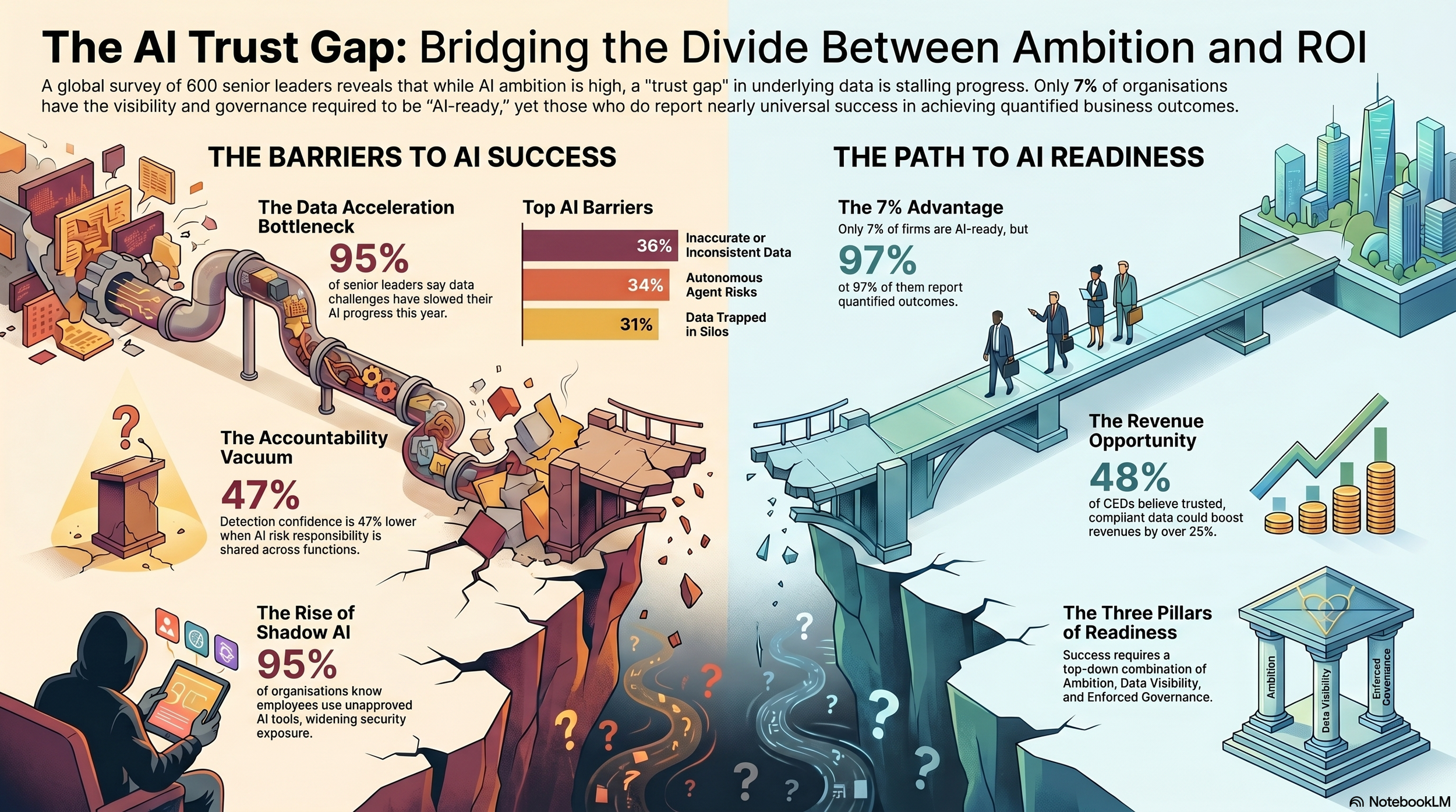
What the region is protecting is control, and control is precisely what the external environment erodes
The reason MEA organisations pursue sovereignty points directly at the blind spot the research goes on to expose. The leading motivation in the region is gaining greater control over data, cited by 41.8%, followed by reducing breach risk and protecting data from foreign government access, each at 37.8%, with legal compliance ranking lower than it does in the UK, where breach prevention alone reaches 58.3%.
The components MEA organisations deem most important reinforce the same priority, with operational control and cross-border data flow tying at the top, at 30.4% and 30.0% respectively, both ahead of physical data residency, while South Africa emerges as the most control-focused market, scoring highest for wanting greater control at 50.9%.
Migally is direct that the nature of the regional challenge has shifted as a result, and that strong internal governance is no longer the whole of the task. “While the UK struggles with execution, Germany with prioritisation, and France with operational visibility, the Middle East is evolving into a new phase defined by complexity at scale,” Migally said. “This is driven in part by growing reliance on third-party ecosystems and cross-border data flows, both cited as major blind spots across EMEA at over 33%.”
He puts the redefinition in a single line. “It is no longer just about implementing controls but about ensuring control at scale without dependency,” Migally said. The figures bear out the diagnosis, with more than one-third of regional respondents, at 37.6%, naming third-party vendors and service providers as their single biggest blind spot in knowing where data is stored, processed or accessed, the highest such figure of any region and a reversal of the global pattern, where data used for AI or analytics dominates at 40.1%. Physical data residency, the component the localisation agenda leans on most heavily, is also the hardest for the region to manage, cited as the most difficult element by 32.0%, the steepest difficulty score for residency anywhere in the study.
AI adoption is widening the same gap faster than governance can close it
The external dependency at the heart of the region’s exposure deepens as AI takes hold, because the platforms organisations cannot fully see are the ones they are racing to build on. Nearly half of MEA organisations, at 44.8%, run a hybrid AI approach, using local models for sensitive workloads and global platforms for broader use, while a substantial share depend entirely on global providers. Migally identifies this as the precise point at which even disciplined organisations lose their footing. “Even with strong internal governance, maintaining visibility, control and independence across external platforms becomes significantly harder, particularly in environments where global providers dominate critical infrastructure,” Migally said.
His prescription follows from that diagnosis, and it reframes the regional task around movement rather than location. “Organisations must now prioritise data portability, to ensure freedom to move and recover data across environments, avoiding vendor lock in, particularly as AI and cloud ecosystems expand, comprehensive platform coverage, ensuring all workloads are protected, wherever they reside, and strong local partner ecosystems, capable of reducing reliance on external providers and addressing concerns around foreign technology dependencies,” Migally said. On the last of those, he is emphatic about regional specificity. “In the Middle East, this last point is particularly important,” Migally said. “Local service providers and sovereign cloud initiatives are playing an increasingly strategic role, enabling organisations to meet regulatory requirements while retaining operational flexibility.” The motivations for building AI in-house underline how tightly the region binds its AI ambition to security and control, with security, expressed as avoiding shadow AI, leading at 38.8%, privacy close behind at 38.4%, cost at 37.2% and sovereignty at 36.4%, and the UAE is the market most driven by security and privacy, at 46% and 50% respectively.
The EMEA contrast sharpens what the region has and has not solved
Placed against its European counterparts, the MEA position reads as advanced on execution but subject to the same structural fault that runs across the whole study, a fault Tim Pfaelzer, Veeam’s senior EMEA leader, frames as the defining issue for the entire region. “AI is accelerating across EMEA but the real differentiator will be data trust not speed,” Pfaelzer said. He points to a contradiction sitting at the centre of the EMEA-wide data. “Data sovereignty is not being ignored. In fact, 98.9% of organisations say it is important to their strategy, and more than half describe it as a top priority,” Pfaelzer said. “Yet despite this awareness, behaviour tells a different story. When forced to prioritise, 72.5% of organisations say accelerating AI takes precedence over strengthening sovereignty controls.” MEA is the notable exception to that final figure, with only 56.4% prioritising AI speed over sovereignty, the lowest in the study, which is the quantitative form of the discipline Migally describes.
What unites the regions, in Pfaelzer’s account, is the underlying cause rather than the symptom, and he reduces it to a single proposition. “Sovereignty is no longer a location problem. It is a control problem,” Pfaelzer said, a formulation that maps directly onto the MEA finding that operational control and cross-border flow matter more to regional organisations than where data physically sits. He ties the remedy to the concept that runs through Migally’s regional analysis. “This is where Data and AI Trust becomes critical. Trust is built on visibility into where data resides and how it flows, governance that is enforced consistently across environments, and resilience so that data can be recovered quickly and confidently,” Pfaelzer said, before drawing the conclusion that gives the research its edge. “Across EMEA, the organisations that will lead will not be those that move fastest with AI. They will be those that can move fast while still maintaining control, building trust into the foundation of everything they do,” Pfaelzer said. On that test, MEA has built more of the foundation than most, which makes its remaining exposure across external platforms the more consequential.
The sovereignty imperative in MEA is enforced through a degree of personal executive exposure that is unusual by global measure, and that exposure sits alongside the visibility gap rather than in spite of it. In the region, 58.4% of respondents report that C-level executives hold personal legal responsibility for cyber resilience outcomes, a figure that rises to a near-universal 94.4% in Nigeria, while South Africa is the most likely market to say executives carry no such liability, at 47.3%. The accountability has yielded organisational gains, with 42.8% reporting stronger leadership alignment, yet it has come at a measurable human cost, with 41.6% reporting heightened personal stress or anxiety, peaking at 64% in Turkey, concern over personal liability reaching 56.4% in South Africa, and tension between executives peaking in the UAE at 54%. Holding individuals legally answerable for resilience while a third of organisations cannot fully see where their data travels once it leaves their systems places those individuals in an exposed position, which is the sharpest expression of the gap the research describes.
Regulatory confidence is high, though it rests partly on a moving target
Despite sitting outside the European Union, MEA organisations express strong confidence in their readiness for the bloc’s incoming AI rules, with 93.6% expecting to meet the requirements of the EU AI Act, half anticipating no issues, and a further 43.6% expecting only minor difficulty, and Kenya is the most confident market at 64% expecting no problems at all. That confidence reflects the Act’s standing as a global benchmark whose reach extends well beyond European borders.
It is worth noting, against that self-assessment, that the Act’s timeline has shifted since the survey closed, with the European Parliament’s endorsement of the Digital Omnibus on 16 June 2026, and Council adoption and publication expected in July, deferring the most demanding high-risk obligations for Annex III systems from August 2026 to 2 December 2027. The extension grants preparation time, but the underlying difficulty for MEA organisations is unchanged, since confidence in meeting a standard means little without the visibility to demonstrate compliance across the external platforms where so much regional data now resides.
The next phase of sovereignty is control without dependency
The through-line from every figure is consistent. MEA has proven it can implement sovereignty, with execution metrics that lead EMEA and an executive layer prepared to be held personally accountable for the outcome, and Migally casts what remains not as a deficiency but as the region’s next opportunity. “Data and AI Trust provides the framework to manage this shift,” Migally said. “It allows organisations to extend visibility beyond internal systems, enforce governance across ecosystems, and ensure that data remains portable, recoverable and trustworthy, regardless of where it is stored or how it is processed.”
He returns, in closing, to the distinction between the sovereignty the region has built and the sovereignty it has yet to define. “The Middle East has already demonstrated leadership in sovereignty,” Migally said. “The opportunity now is to define what sovereignty looks like in an interconnected, AI-driven world, where control is not just about where data sits, but how freely it can move, how effectively it can be governed, and how confidently organisations can operate without dependency.” The region answered the first question ahead of its peers by building control for the data it holds. The second is harder, because it asks whether that control can extend to data it no longer fully sees, and it is the one that now matters most.
