
Healthcare's AI Ambition Is Running Ahead of the Infrastructure Meant to Carry It
Healthcare organisations worldwide are pushing artificial intelligence towards the bedside faster than their infrastructure can safely support it, according to the eighth annual Healthcare Vertical Enterprise Cloud Index published by Nutanix.
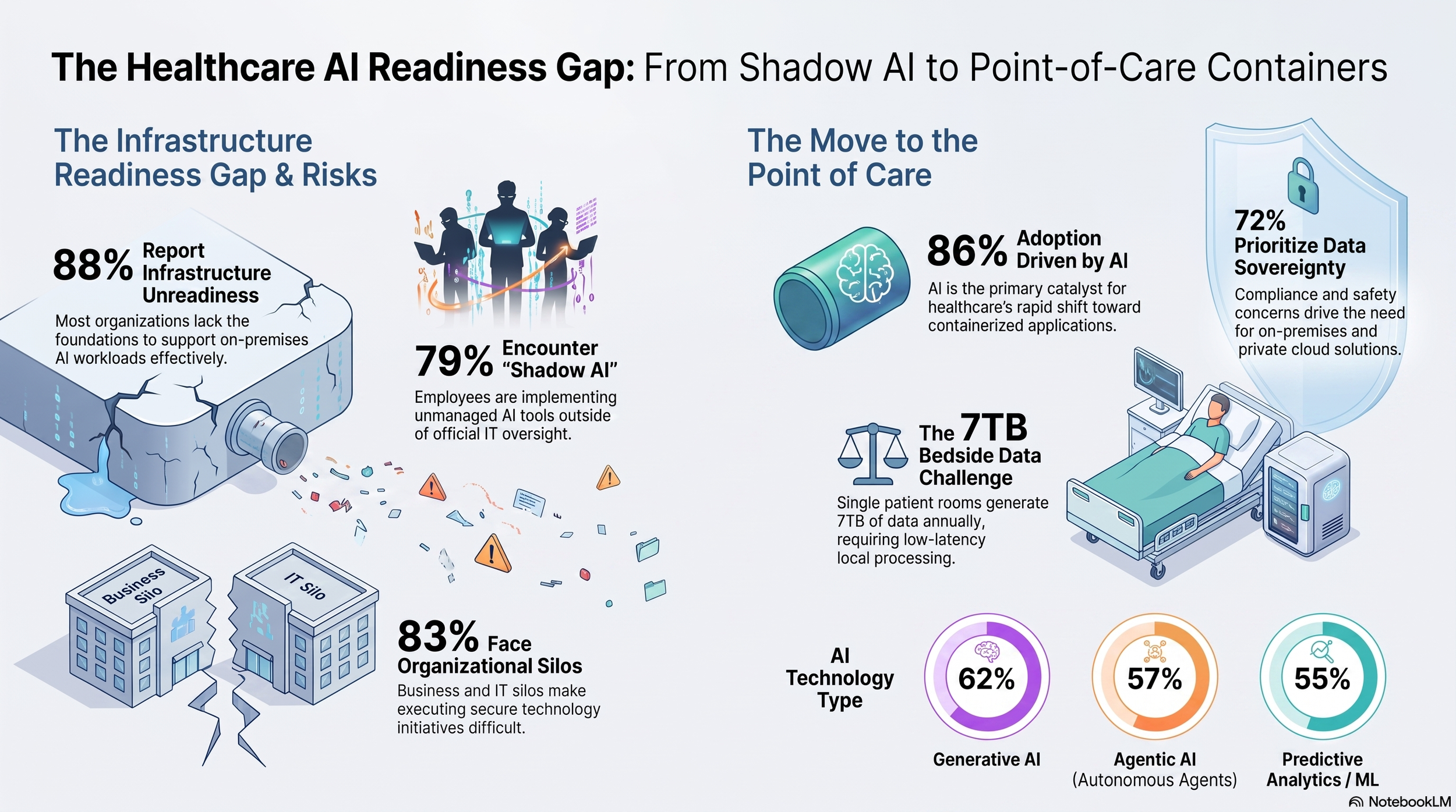
The survey found that 88% of healthcare IT leaders regard their current infrastructure as not fully ready to support AI workloads on-premises, even as leadership presses for wider deployment across clinical and administrative functions. That readiness gap sits at the centre of a sector where AI adoption is accelerating, unmanaged AI use is spreading, and the demands of real-time clinical processing are rising in tandem.
The stakes are amplified by where healthcare data is now being generated. Up to 75% of it is expected to originate at the Edge, or Point of Care, rather than inside central data centres, which pulls AI processing towards the bedside and away from cloud-only models that introduce latency into time-sensitive clinical decisions. For a sector governed by patient safety obligations and strict compliance rules, the distance between AI ambition and infrastructure reality carries consequences that reach beyond IT performance metrics.
Shadow AI has become a governance problem the sector cannot ignore
The report identifies the unmanaged spread of AI as one of the most pressing risks facing healthcare technology leaders. Seventy-nine per cent of healthcare organisations encounter AI applications or agents implemented by employees in non-IT functions, a pattern that places tools outside formal oversight and beyond the reach of security and compliance controls. The concern is widely shared, with 83% of respondents saying the use of AI tools and agents outside official oversight creates business risk.
Structural fragmentation compounds the challenge. The same proportion, 83%, believes silos between business units and IT make it difficult to execute technology initiatives effectively, which slows the coordinated governance that safe AI adoption requires. As deployment scales, these organisational divides threaten to widen the space in which unmonitored AI can operate, a dynamic that carries particular weight in environments handling protected health information.
“Clinicians are exhausted, and they're turning to AI because they genuinely believe it can help them, and they're right,” said Sammy Zoghlami, SVP EMEA at Nutanix. He added that when 88% of healthcare organisations report their infrastructure is not ready to support AI on-premises, and nearly four in five are already encountering AI tools deployed outside IT oversight, the signal is that innovation is coming second to risk. Zoghlami explained that the industry needs to get the foundations right before the gap between AI ambition and readiness becomes a patient safety issue.
Containers are emerging as the foundation for AI at the bedside
To close the distance between clinical demand and infrastructure capability, healthcare organisations are turning to containerisation as a way to run AI workloads where data is generated. Close to 86% say AI is meaningfully accelerating their adoption of containers, which bundle application code and dependencies in secure, portable environments and allow AI models to be deployed locally rather than routed through the cloud. Close to 81% expect the level of application containerisation to increase at their organisation, and 80% are already building new applications in containers.
The clinical rationale is rooted in the physical realities of care delivery. Single patient rooms can generate up to 7TB of data annually, and high-density device environments such as ICU beds often include 15 to 20 connected devices, conditions under which cloud latency can affect clinical outcomes. Running AI locally through containers allows hospitals to manage data gravity, preserve clinical continuity even if an external WAN connection fails, and deliver AI-driven insights while keeping sensitive information within the hospital's own walls.
“Healthcare organisations are embracing AI as a strategic enabler of better patient outcomes, operational efficiency, and clinical innovation,” said Assem Al Achkar, Public Sector Sales Manager, South Gulf, Nutanix. He explained that as AI adoption accelerates, many healthcare providers are discovering that their existing infrastructure was not designed to support the demands of real-time, data-intensive AI workloads. The challenge Al Achkar identified is the need to build secure, scalable, and sovereign-ready digital foundations capable of supporting AI from the data centre to the point of care.
Agentic AI is moving onto the healthcare agenda
Beyond current deployments, healthcare leaders are looking towards autonomous systems capable of learning and adapting over time. Close to 58% expect AI agents to improve productivity and efficiency as part of their organisation's strategy, while 57% anticipate that agents will transform business processes and operations. More than half, at 55%, see potential for AI agents to create new products, services, or revenue streams, with early expectations concentrated in administrative automation and operational optimisation.
These expectations sit within a broader adoption curve. Looking three years ahead, 57% of organisations anticipate using agentic AI or autonomous agents, alongside generative AI at 62% and predictive analytics or machine learning models at 55%. Over the same horizon, 55% expect to run more than five AI-enabled applications, including 12% who expect to be running more than 10, a trajectory that raises the governance and infrastructure demands the sector is still working to meet.
Decisions about where AI infrastructure sits are increasingly governed by the sensitivity of the data involved. Seventy-two per cent of healthcare organisations regard data sovereignty as a high priority or a must-include when making infrastructure decisions, a reflection of the compliance obligations attached to protected health information. Fifty-four per cent run containerised applications on-premises or on private clouds today, compared with 47% on public clouds, and the same 54% feel the need to run infrastructure within a single country because of customer or stakeholder expectations.
That preference points towards hybrid models rather than a wholesale move in either direction. Close to 63% currently run AI applications on managed service providers, where a third-party vendor hosts or manages container infrastructure so workloads can operate both centrally and at the Point of Care. Healthcare leaders expect hybrid deployment to remain common for the foreseeable future, balancing the control of on-premises systems against the reach that managed and cloud environments provide.
“Healthcare leaders are prioritising data residency, regulatory compliance, and low-latency access to clinical insights, making hybrid multicloud architectures and modern application platforms increasingly essential,” said Al Achkar. He added that organisations investing now in modernising their infrastructure will be best positioned to harness AI safely, accelerate innovation, and deliver more connected, patient-centric healthcare services in the years ahead. That view frames modernisation as the determining factor in whether the sector's AI ambitions translate into safe and sustained clinical value.
The gap between ambition and readiness now defines the sector's next phase
Taken across its findings, the report describes a global healthcare sector accelerating into AI while the foundations beneath it remain incomplete. AI is already running in containerised environments, across hybrid infrastructures, and increasingly at the Point of Care, yet organisations are juggling workloads across on-premises systems, private clouds, and managed services without the unified strategy needed to support them consistently or safely. The mandate for IT leaders is to architect for performance, regulatory compliance, and clinical governance not only centrally but locally, where latency and continuity directly affect patient outcomes.
The report was produced from the healthcare vertical responses within Nutanix's global Enterprise Cloud Index study, conducted in November 2025 by Wakefield Research, which surveyed 1,600 cloud, IT, and engineering executives at organisations with 500 or more employees across 14 countries. The resolution it points to lies in infrastructure capable of supporting secure, compliant, and high-performance workloads from the data centre to the bedside, closing a gap that the sector can no longer treat as a future concern.
