
42% of employees would withdraw their job application if AI were choosing who gets hired
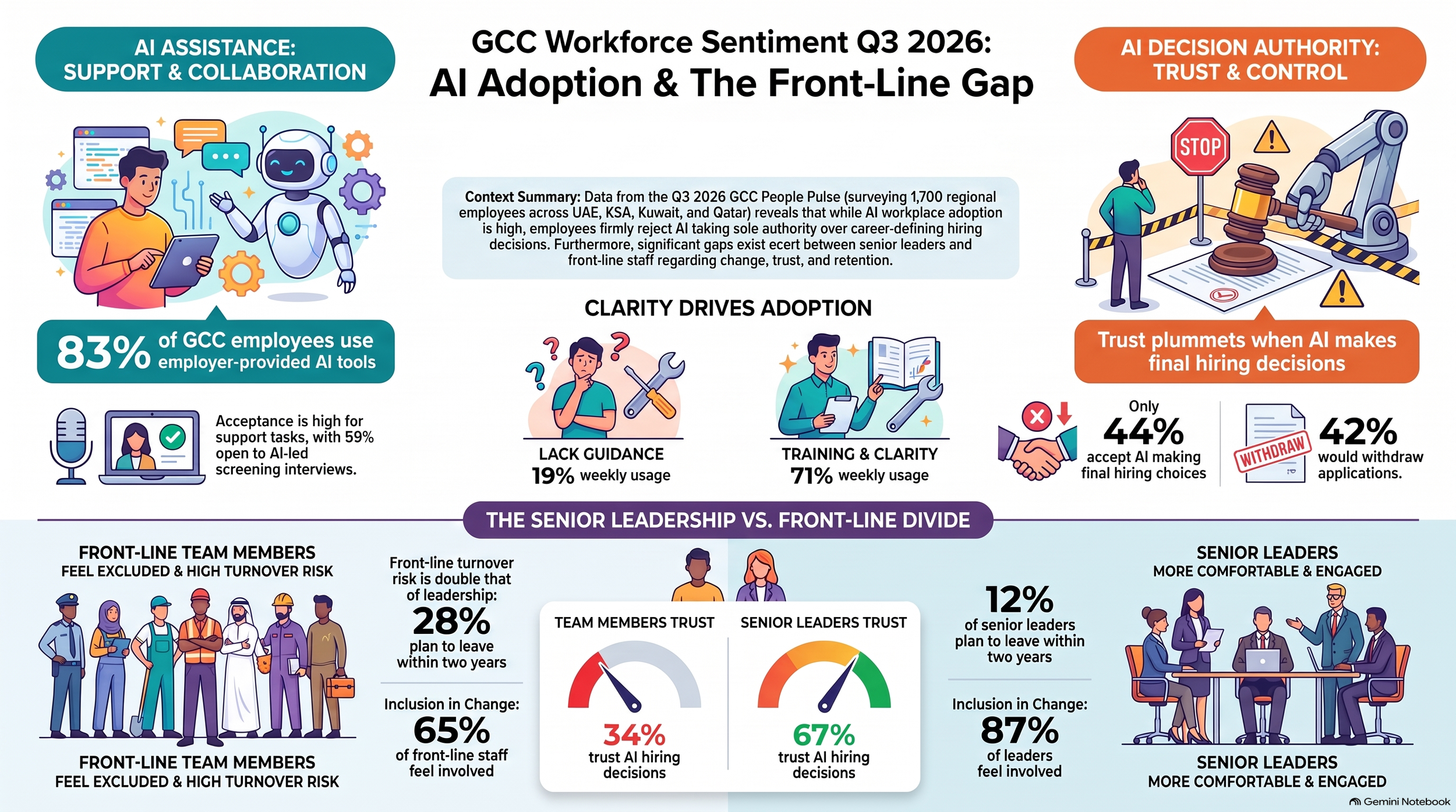
Across the UAE, Saudi Arabia, Kuwait and Qatar, 59% of employees would take part in a first-round job interview conducted by an AI agent. Asked whether they would be comfortable with AI taking the final decision on their application, the figure falls to 44%, according to the Q3 2026 GCC People Pulse: Word on Work, a workforce sentiment tracker run by EXE: Employee Experience Exchange and Ipsos.
The tracker, which polled 1,700 employees across three monthly waves between July and September, found that 83% use AI tools provided by their employer at least occasionally and 54% use them weekly or more. In September, 42% said they would withdraw from a recruitment process if they discovered AI was deciding their application, and 49% said they would be less likely to apply to an organisation that uses AI to make hiring choices.
“AI adoption is no longer simply a question of whether organisations have the technology,” said Ruth Dance, Co-Founder of EXE. “The Q3 findings show that employees want clarity about how AI is being used, confidence that they have the skills to work with it, and reassurance that human judgement remains where decisions matter most. Organisations that focus only on deploying AI risk creating a trust gap between leadership and the people expected to use and live with these technologies.”
In the US, Pew Research Center found in 2023 that 71% of adults opposed employers using AI to make a final hiring decision, against 7% in favour, while 66% said they would not want to apply for a job where AI helps make hiring decisions. The Gulf results sit on the more accepting side of that comparison, although the questions are worded differently and were asked three years apart.
Senior leaders would let AI hire them
Among senior leaders, 67% would be comfortable with AI making the final decision on their own job application. The figure is 51% for senior managers, 40% for people managers and 34% for team members. The same gradient holds for AI screening applications, where comfort runs from 77% of senior leaders to 41% of team members, and for trusting AI to evaluate an application fairly, which falls from 75% to 44%.
“Those designing and approving AI-enabled processes are the most comfortable with the technology, while those most affected by it are the least,” the report stated. “This is typically where resistance to adoption emerges.”
Greenhouse found a similar divide in its 2025 AI in Hiring Report, which surveyed 2,900 job seekers and 1,236 recruiters and hiring managers in the US, UK, Ireland and Germany. In the US sample, 70% of hiring managers said AI helps them make faster and better decisions, while 8% of job seekers said AI makes hiring fairer. Only 21% of recruiters were very confident their systems were not rejecting qualified candidates.
“Trust is at an all-time low for both job seekers and recruiters,” said Daniel Chait, CEO and Co-Founder of Greenhouse. “It’s an AI doom loop that’s getting worse, not better.”
Only 16% of employees in Qatar would be comfortable with AI making a final hiring decision, against 50% in Saudi Arabia, 44% in the UAE and 36% in Kuwait. Qatar also posted the lowest figures for AI screening applications at 34%, AI-led interviews at 36% and trust in AI to evaluate fairly at 32%. Once inside a process, however, 28% of Qatar-based employees would withdraw on learning AI was deciding, the lowest of the four markets and well below the 42% GCC average, even though 48% would be less likely to apply in the first place.
The EU AI Act classifies AI used in employment decisions as high risk. Employers using such systems must notify workers that a high-risk AI system is in use, provide human oversight, monitor for discriminatory impacts and keep system logs, according to an analysis by law firm Ogletree. The European Parliament approved a deal on 16 June 2026 to delay those obligations, and the Council gave final approval on 29 June, moving the compliance date for stand-alone high-risk systems from 2 August 2026 to 2 December 2027.
EXE and Ipsos list “define where AI stops” among their immediate priorities for employers, particularly for hiring and people decisions. “Successful implementation will depend less on the capability of the technology and more on clarity: when AI is used, how decisions are made, where human oversight remains and who is ultimately accountable,” the report stated.
A quarter of team members do not use AI
Among team members, 17% have no access to AI tools and a further 7% have access but do not use them, so one in four do not use AI at work. Among senior leaders, 11% do not use AI, split between 6% without access and 5% who choose not to. Managers sit between the two, with 5% lacking access and 9% leaving available tools unused.
“At the front line, the barrier is access to AI tools; amongst managers, it is reluctance to use tools that are already available,” the report stated. “In both cases, clarity and skills are key, but the needs differ across the organisation.”
Across all employees, 77% say they are clear about how AI should be used at work, while 63% say their organisation is helping them build the AI skills they need. Among employees who have both, 71% use AI weekly. Among those with neither, the figure is 19%. In Kuwait, 32% of employees have no access to AI tools at work, more than three times the GCC average, although that figure rests on a September sample of 50 people.
BCG’s AI at Work 2025 survey of 10,635 employees in 11 countries found the same divide, with 78% of managers using generative AI regularly against 51% of frontline workers. Employees who had received more than five hours of training were more likely to be regular users, at 79% compared with 67% for those with less, while only 36% said their training was enough.
“Without strong leadership support and proper training, this gap will persist,” said Nick South, Managing Director and Senior Partner at BCG.
Beyond AI, 92% of senior leaders would recommend their organisation as a great place to work, against 72% of team members. Confidence in the organisation’s future direction falls from 91% to 74% between the two groups, and the share planning to leave within two years rises from 12% to 28%. The widest gap concerns change: 87% of senior leaders feel involved and prepared when changes are planned, compared with 65% of team members, and team members are almost three times as likely to say they are not involved, at 11% against 4%.
“The data shows that the front line cannot be treated as an afterthought in transformation,” said James Tarbit, Global Head of Employee Experience at Ipsos. “The people closest to the day-to-day reality of work are experiencing lower levels of involvement, confidence and access to emerging technologies. Organisations that want transformation to succeed need to bring these employees into the conversation much earlier.”
Strain rose seven points in a month
Over the quarter, 51% of employees reported feeling under constant strain at work, down from 54% in Q2 and 15 points above the global average the report uses as its benchmark. The fall was the only statistically significant change of the quarter, and it masked a sharp monthly swing: strain dropped to 46% in July, then rose to 53% in August and 52% in September as employees returned from the summer holidays.
The UAE recorded the largest fall of any market, at seven points, and employees aged 18 to 34 recorded an eight-point fall, the largest of any age group. Of employees concerned about AI’s impact on their job security, 65% report constant strain, compared with 38% of those who are not concerned. Concern about AI and job security fell three points over the quarter to 46%.
Gallup’s State of the Global Workplace 2026 report, based on 2025 data, found that 40% of employees worldwide experienced a lot of stress the previous day, rising to 48% in the Middle East and North Africa, the third highest of ten regions. Gallup measures stress felt on the previous day and the People Pulse measures constant strain at work, so the two figures are not directly comparable, although both place the region above the global norm. Gallup also found managers more stressed than individual contributors, at 45% against 39%.
Doubt about direction triples exit plans
Overall, 82% of employees would recommend their organisation as a great place to work, 10 points above the global average, while 79% are confident about its future direction, 24 points above, and 77% believe their leaders do what they say they will. Intent to stay for three years or more rose three points to 79%, and the share planning to leave within two years fell from 24% to 21%.
Among employees confident in their organisation’s direction, 14% plan to leave within two years. Among those who are not, 49% do. Advocacy reaches 94% among employees who believe their leaders do what they say they will, and 40% among those who do not.
Saudi Arabia has the lowest share of employees planning to leave, at 16%, followed by the UAE at 24%, Qatar at 26% and Kuwait at 29%. Among GCC nationals, the figure is 13%, against 27% for Arab expats, 29% for Asian expats and 27% for Western and other expats. “As nationalisation programmes progress, expat attrition risk can easily be overlooked, yet expat employees hold much of the region’s specialist and operational capability,” the report stated.
“Whether organisations are adapting to AI, navigating change or working to retain talent, tech is only one piece of the puzzle,” said Lorna King, Co-Founder at EXE. “Employees need to understand what’s changing, feel equipped to adapt and trust that their voices matter. For GCC employers, the opportunity is to turn insight into action, close the gaps between leaders and teams, and create workplaces where people feel motivated to stay.”
All four measures that moved since Q2 moved in a positive direction: strain, confidence in direction, intent to leave and concern about AI and job security. Only the fall in strain is statistically significant, the report noted. The ten questions on AI at work and in recruitment were asked for the first time in September, to 700 employees, and Qatar and Kuwait each made up 9% of respondents, so their country results rest on much smaller samples.
