
The AI Skilling Crisis That Is Costing Enterprises $5.5 Trillion
Somewhere inside a large organisation, a marketing manager opened an AI tool for the first time. She typed a question, received an answer that sounded authoritative and complete, and used it. Not because she was careless or uninformed, but because nobody had explained that "fluent" and "correct" are not the same thing. Nobody had told her that a confident AI output is not a verified one.
And when something goes wrong with the work she produces using this system, the accountability falls entirely on her. She found the tool through an IT email with login instructions and a two-page acceptable-use policy. There was a note about training resources on the intranet. What there was not, in any meaningful sense, was training.
This is not an edge case. It is the operational reality inside thousands of organisations right now. A Mercer poll published in January this year found that 40% of employees were worried about losing their jobs to AI, up from 28% just twelve months earlier. In the same period, AI was cited as the direct reason for more than 55,000 layoffs across the United States, according to Challenger, Grey and Christmas, with cuts announced at Amazon, Microsoft, and Salesforce, among others.
Anthropic's own CEO, Dario Amodei, publicly wrote that AI was no longer replacing individual jobs but rather functioning as a "general labour substitute for humans." Salesforce CEO Marc Benioff put it differently on an earnings call: "We're the last generation of CEOs to only manage humans. Every CEO going forward is going to manage humans and agents together."
However, the fear running through the workforce is not irrational. The World Economic Forum projects that 39% of workers' existing skill sets will be disrupted within five years. The IMF estimates that almost 40% of global employment is exposed to AI. Deloitte finds that business leaders are three times more likely to prefer replacing employees with AI-ready new hires than retraining the people they already have.
The pressure from the top is to move fast, deploy the tools, and capture the productivity gains. The training and leadership are promising; I’ll follow. It has not followed.
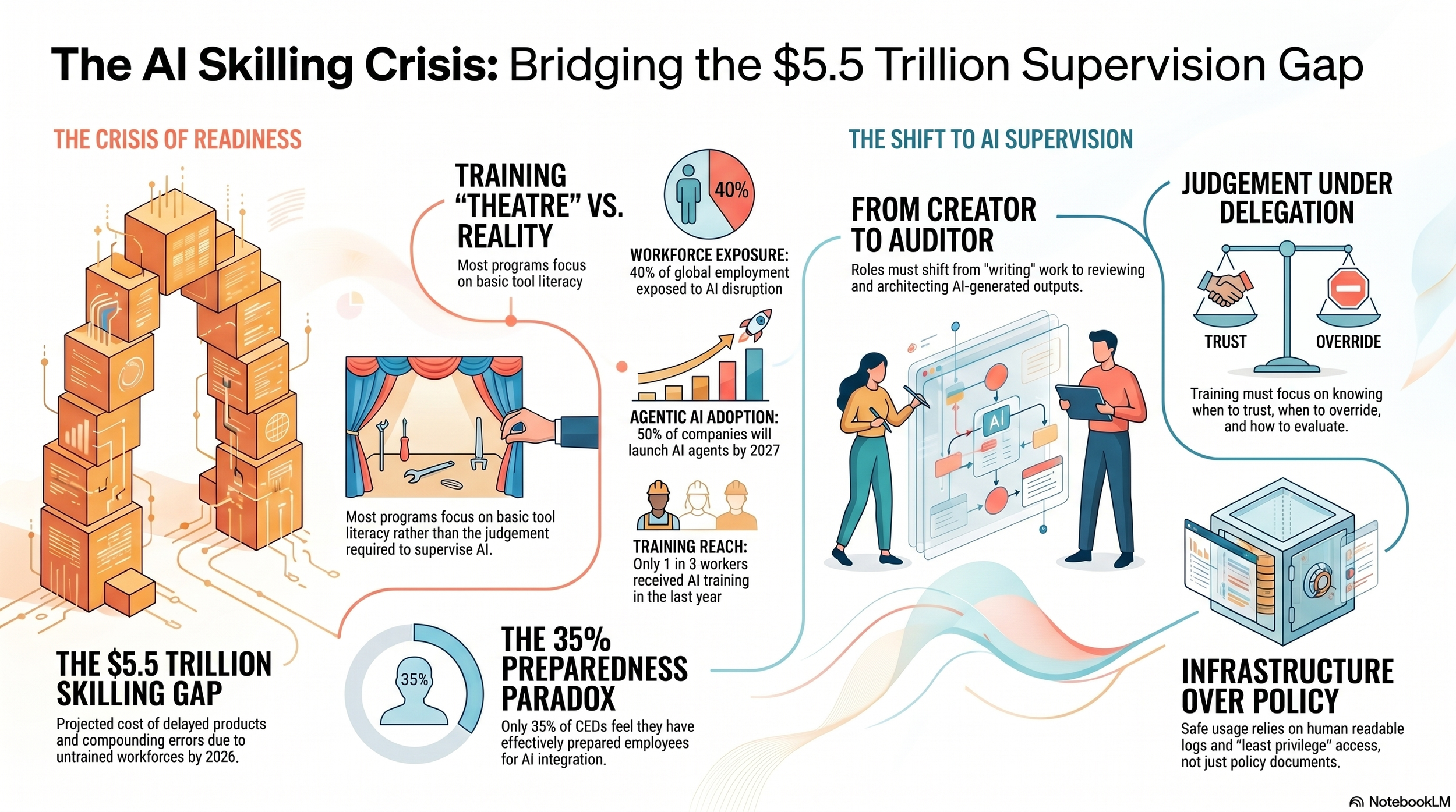
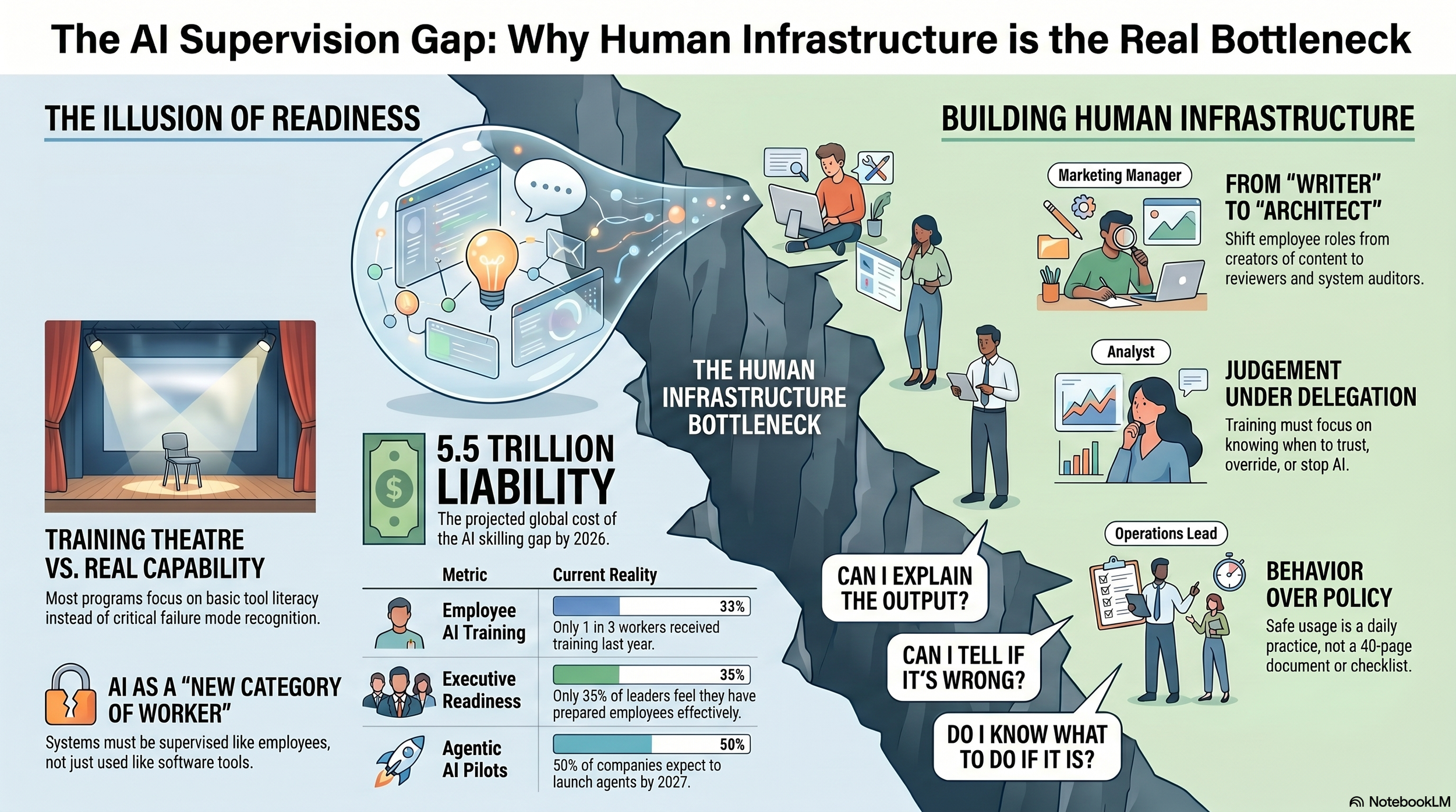
IDC's latest analysis found that despite 94% of CEOs and CHROs identifying AI as their most in-demand capability for 2025, only 35% felt they had prepared their employees effectively. Only a third of workers reported receiving any AI training in the past year. The cost of that gap, in delayed products, missed revenue, and compounding errors that nobody is trained to catch, is projected to reach $5.5 trillion by 2026.
Meanwhile, Deloitte estimates that one in four companies currently using generative AI will have launched agentic AI pilots by the end of this year, rising to 50% by 2027. The agents are being deployed. The people who are supposed to supervise them are not ready.
Most AI Training Is Currently Theatre
The gap between what organisations say they are doing on AI skilling and what is actually happening inside their walls is wide enough to be its own risk category. McKinsey's 2025 State of AI survey found that 88% of organisations reported using AI in at least one function, yet only around 6% reported meaningful enterprise-level profit impact.
Nicos Savva, Professor of Management Science and Operations at London Business School and Director of its Data Science and AI Initiative, drew a direct line between those two numbers. "If the differentiator is organisational capability rather than tool access, training has to build organisational capability, not just tool literacy," he said.
The training most employees receive falls short. Chris Cochran, Field CISO and Vice President of AI Security at SANS Institute, had seen the pattern repeat across industries. "Most AI training today is theatre," he said. "Companies hand out a deck on prompting, walk people through a tool, and call that enablement, but employees come out of it with no real ability to spot when AI is in a failure mode, or to know who's the informed captain when it is."
Avinav Nigam, Founder and CEO of TERN Group, drew a sharper line between what companies were delivering and what was actually needed. "Orientation is: here is the tool, here are the prompts, here is a walkthrough," he said. "Training is something deeper, building the judgement to know when to trust what a system produces, when to intervene, and when to stop it entirely. Those are skills. They require deliberate development, not an onboarding deck."
Ramprakash Ramamoorthy, Director of AI Research at Zoho Corp, put the same problem differently. "Most organisations treat AI training as a one-time checkbox," he said. "Sit through a demo, learn the product, move on. That is not training. That is orientation." Pedro Lacerda, Senior Vice President at TASC Outsourcing, set out what real preparation required.
"Meaningful AI training goes far beyond basic tool walkthroughs or prompt guidance," he said. "It focuses on helping employees understand how these systems actually work, where they can fail, and when human judgment needs to take over." That understanding, in his view, was the precondition for everything else, and the thing current onboarding consistently skipped.
The deeper problem was that surface-level training misidentified what the job had become. Meriam ElOuazzani, Vice President for the Middle East, Turkey, and Africa at Censys, reached this conclusion based on years of customer deployments. "AI is not a tool," she said. "It is a new category of worker, and like any worker, it needs to be supervised. Most organisations have not trained anyone to do that."
What Real Training Has to Build
Return to the marketing manager. She is not alone. Across her organisation, the analyst feeding AI-generated numbers into a board report, the operations lead delegating approval workflows to an automated system, and the developer accepting AI-generated code without adversarial checks are all in the same condition: confident in the output, uncertain about its accuracy, and unclear about who answers if something goes wrong. That is not an AI problem. It is a training problem.
Savva proposed three layers for meaningful AI capability. The first was fluency, understanding what these systems could and could not do, and how to recognise a hallucination. The second was what he called context engineering: structuring tacit organisational knowledge so that an AI system could act on it reliably. The third, and the most neglected, was "judgement under delegation: when to trust the system, when to override it, and how to evaluate work you did not personally produce." That final layer, he argued, was closer to the skill set of a good manager than a good analyst. Most programmes were still building analysts.
Zijian He, Head of Research at Utopai Studios, applied the same reorientation to technical training. "Meaningful AI training must move beyond 'how to use a chatbot' to 'how to audit a system,'" he said. The shift he described was fundamental: "Meaningful training for a coding-agent-driven era involves a fundamental shift in the developer's role: from a writer of code to a reviewer and architect." Training, in his account, had to centre on systemic evaluation and the ability to catch logic failures a model would overlook.
Ramamoorthy sharpened the point. "Your employees are now supervisors of probabilistic systems," he said. "That is a fundamentally different job than using software. Software does what you tell it. AI does what it infers you meant, which is close enough most of the time and wrong in the worst moments." Cochran connected the capability question directly to accountability. "If nobody on the team can tell you who owns the decision when an agent gets it wrong, you haven't trained anyone," he said. "You've just licensed a tool."
Nigam located the blockage precisely. "The bottleneck in AI adoption is rarely the technology," he said. "It is the people operating it, without understanding it." His argument was that the industrial economy had over-indexed on efficiency and repeatable execution. The emerging economy demanded something different: curiosity, ethical reasoning, the ability to communicate across complexity. Lacerda put it in operational terms: "the biggest challenge today lies in ensuring employees know how to spot errors, question results, and step in when something does not look right, even as the technology itself becomes more capable."
Savva pointed to something else that many deployment strategies ignored. Today's agents did not learn continuously from experience. Each interaction began from the same baseline. The layer of continuous improvement, noticing what had gone wrong and encoding the lesson so the next attempt was better, had to be done by humans. "The bottleneck is shifting from production to evaluation," he said, "and most firms have invested heavily in the former and almost nothing in the latter."
The Mindset Wall That Precedes Everything
For Joe Dunleavy, Regional CTO for Europe and Global Head of the Dava.X AI group at Endava, the training design question sat atop a more fundamental problem that no programme could fully solve. Three years in, he was still encountering fixed-mindset paralysis at every level of the organisations he worked with. "Going from that fixed mindset to a more open mindset is a huge thing," he said. The causes were not simply irrational: fear of job displacement, genuine scepticism about the technology's significance, and the volume of competing material all contributed. The pattern he observed repeatedly was that scepticism rarely survived direct experience. "People are sceptics until they use it," Dunleavy said, "and then they go, 'Oh my god, I can't believe this is as powerful as it is.'"
The intervention that consistently worked, in his reading, was not exhortation but programme discipline. "Run it as a programme, with change management components to it, just like anything else," he said. "Do a pilot, build a champions network, do deeper dives in specific areas. Make it real for the legal team, make it real for the marketing team." The urgency was unambiguous. "For relevance in a jobs market, you need to have this in your toolbox," he said. "It's a necessity." PwC's 2025 AI Jobs Barometer underscored why. AI-exposed roles were already evolving 66% faster than others and commanding an average 56% wage premium. The gap between those who had invested in AI capability and those who had not was no longer theoretical. It was showing up in hiring data.
Agents Change the Nature of the Governance Problem
The marketing manager using a generative AI tool is one version of this problem. The company deploying AI agents to screen job applicants, process invoices, handle customer queries, and execute operational workflows is another version entirely, and a significantly more consequential one. The move from AI tools to AI agents made the oversight question structural rather than operational.
Savva drew a distinction between two models that most organisations had not yet deliberately chosen. Human-in-the-loop placed a person in front of every decision before it took effect, the right approach for high-stakes, low-tolerance processes. Human-on-the-loop lets the agent run autonomously, with a person monitoring aggregate behaviour and intervening at the process level, the right approach for high-volume, lower-stakes work. "The mistake firms make is applying one model uniformly," he said. "Either bottlenecking everything through human review, or letting everything run unsupervised. The skill is matching the oversight model to the risk profile of the process."
At TERN, Nigam described how that line was drawn in practice. AI screened, assessed, and shortlisted. A human made the final call. "Removing human accountability from a consequential decision is not an efficiency gain," he said. "It is a risk you have not priced correctly." ElOuazzani identified the visibility problem that governed everything else. "You cannot supervise what you cannot see," she said. "Visibility is the precondition for governance." On where the standards question stood, she was pointed. "The standards for managing agents have been written," she said. "The gap is that almost no one inside the business has been set up to apply them in daily operations."
Ramamoorthy proposed three layers of agent governance: containment, restricting what an agent could access and applying least-privilege principles; observability, ensuring that every agent action produced a human-readable log; and escalation logic, hard stops for categories of decisions involving financial commitments above a threshold, regulated communications, or irreversible actions. "The organisations getting this right are not the ones with the most sophisticated models," he said. "They are the ones with the most disciplined infrastructure around those models." Cochran added the evaluation dimension that was currently most absent. "Plenty of people can build with AI, but very few can stress-test what they have built," he said, "and until that gap closes, oversight is mostly for show."
Zijian He called for teams to confront the over-reliance problem directly. "The most visible gap today is over-reliance," he said. "Management must train teams to adopt an adversarial review mindset, testing and interrogating AI output as if it came from an unverified third party." On accountability, he was equally direct: "Every significant output or decision generated by an agent must be tagged, recorded, and traceable to the original prompt and the overseeing employee."
Safe Usage Is a Practice, Not a Policy
The marketing manager, the analyst, the operations lead: none of them needs a forty-page responsible AI framework. They need to know what they can and cannot include in a prompt, what they are responsible for checking before they act on the output, and who to call when something looks wrong. That clarity does not exist in most organisations.
Cochran identified the disconnect plainly. "The big policy conversations on responsible AI don't reach the people actually using these tools every day," he said. "A marketing manager doesn't need a framework; they need to know whether they can drop a draft press release into a chatbot without getting sued or fired." Ramamoorthy's version was shorter: "Policy documents do not make AI safe. Behaviour does."
Lacerda described safe usage in practical terms. "It also means treating AI outputs as drafts, checking them for accuracy before use, and following company guidelines on data privacy and approval workflows," he said. At its core, he argued, "safe usage is about combining efficiency with responsibility, so that AI supports decision-making without replacing accountability." El Ouazzani argued that the organisations which got this right made the discipline deliberate rather than assumed. "Safe AI usage is not a default," she said. "It is a deliberate, supervised practice. That is what turns AI from an exposure on the attack surface into an advantage on the balance sheet."
Zijian He put the accountability requirement in the clearest terms. "Safe usage translates directly to traceability and accountability," he said. "It is not just about preventing proprietary data from leaking into public models. It is about ensuring that every AI-driven contribution is auditable and aligned with the company's long-term risk frameworks."
Nigam proposed a practical test that cut through the policy language. Three questions worth applying before any consequential task was handed to an AI system: could you explain what the output was based on, could you tell if it was wrong, and if it was wrong, did you know what to do? If the answer to any of them was no, the task was not ready. The organisations that moved fastest with AI safely, he concluded, were "not the ones that trusted it most from day one. They are the ones that were most deliberate about where they drew the line."
The marketing manager will not be the last person handed a powerful system without the context to use it well. As agentic deployments scale, the number of employees in that role is growing faster than the number of organisations willing to take it seriously. The companies that close the supervision gap will not be distinguished by what they deploy.
They will be distinguished by how seriously they invested in the people around those deployments: training built for supervisory capability, oversight matched to the risk of each process, and a culture where employees were expected to challenge AI output rather than defer to it. The tools are already here. The question is whether the people using them know what they are actually doing.
