
The AI dividend enterprise IT keeps promising has not turned up
Two-thirds of the way through this report there is a number that undoes most of what precedes it. Some 66% of organisations have tied bonuses or performance reviews to AI efficiency gains. In the same survey, 71% of respondents say their total workload has stayed flat or grown since adopting AI, and 52% say it has actually increased. Enterprise IT has started paying people against a productivity dividend that, by its own account, the majority have yet to receive.
That is the state of AI in IT service management going into 2026, and the honest reading of it is more useful than the celebratory one. The technology works. The operating model built around the technology does not yet pay for itself, and the survey population is now experienced enough that this can no longer be attributed to early-stage friction.
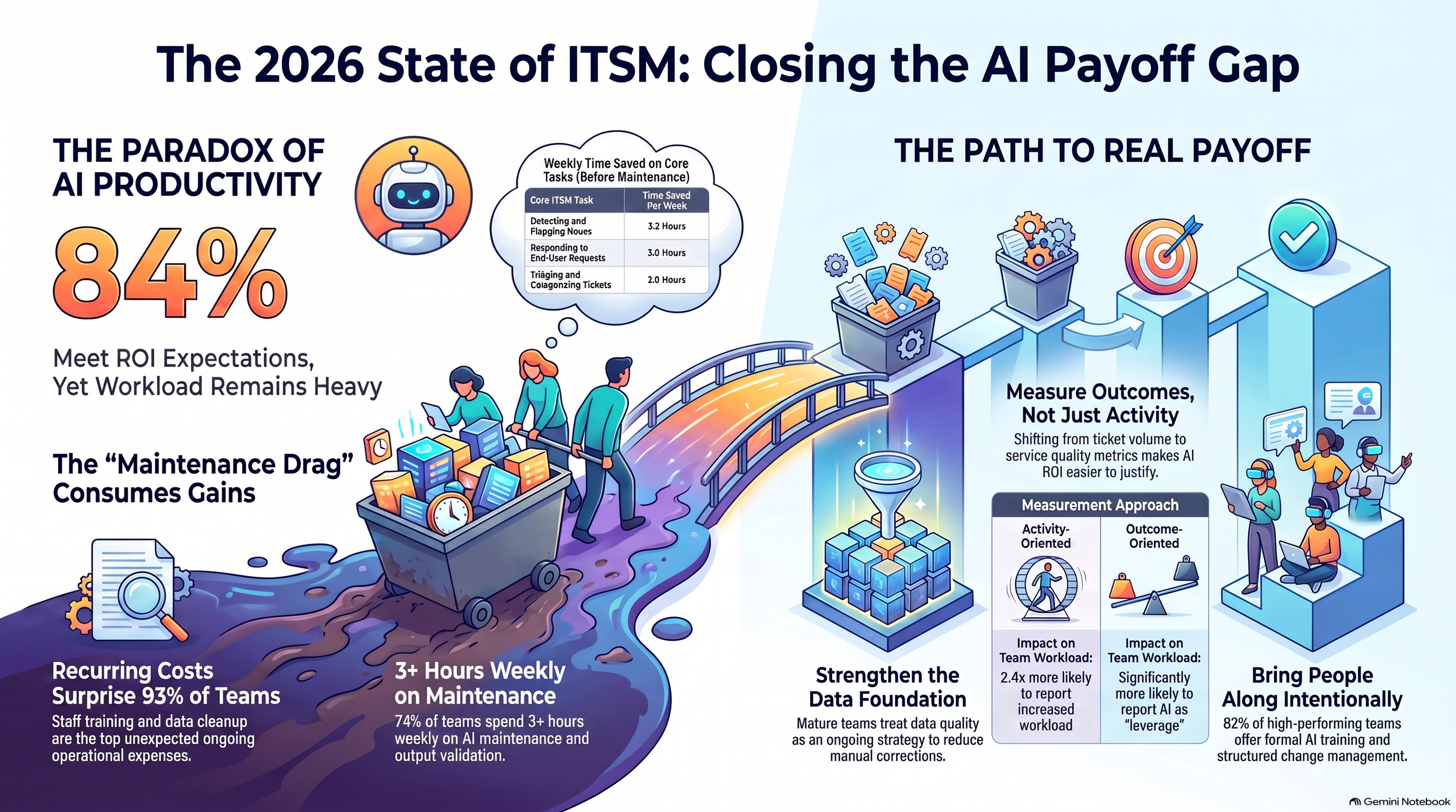
The temptation with a finding this awkward is to assume the gains were overstated. They were not. Respondents reported weekly savings of 2.7 to 3.3 hours across every measured task category, with detection and flagging of issues at the top. Average incident resolution time in SolarWinds Service Desk environments fell from 27.42 hours to 22.55 hours once generative AI features were switched on, a reduction of 17.8%. Some 86% reported improved employee productivity, with 47% calling the improvement significant. The instrumentation is sound, and the direction of travel is consistent.
Hold that against the maintenance data and the picture resolves. Nearly three-quarters of respondents, 74%, spend three or more hours a week on AI monitoring and maintenance, and 44% spend more than six. The technology is returning roughly three hours per task category and taking back three to six hours in supervision. For a meaningful share of teams, the exchange is close to neutral, and for some it is negative. Nobody planned this. It emerged.
The mechanism is documented in the survey rather than inferred from it, which is what gives it force. Asked how AI has added to their workload, 48% cited managing and maintaining tools and integrations, 47% cited reviewing and validating AI-generated output, 37% cited training and tuning models, and 33% cited handling errors thrown by AI automation. These categories did not exist at this scale three years ago. They are now the fastest-growing part of the service desk job, and they are almost entirely invisible in the metrics IT reports upward.
The cost model was wrong in a way that should have been predictable
Only 7% of respondents said AI costs matched what they expected going in. That figure deserves to be sat with. This is a technology in its third budget cycle, deployed by seasoned management-level professionals in organisations averaging 2,938 employees, and 93% of them mispriced it.
The categories where they were caught out explain why. Staff training surprised 48%, data quality and cleanup 47%, ongoing tuning 45%. Every one of those is a recurring operating cost that scales with usage, and every one of them was almost certainly modelled as a project expense that would amortise away after year one. Insufficient data quality and integration complexity were named as the top reasons AI underdelivers, which is another way of saying that the model was never the expensive part. The expensive part is the institutional plumbing required to make the model reliable in production, and enterprise IT has a long history of underfunding plumbing.
Budgets have grown anyway. Some 85% report year-on-year increases and 36% describe the increase as significant, at a moment when only 23% say AI has significantly exceeded ROI expectations. The gap between 85% and 23% is where the next round of finance scrutiny will concentrate, and IT leaders would be wise to construct their answer before the question is asked.
The measurement finding is the one worth acting on this quarter
The single most consequential result in the research is a ratio rather than a percentage. Organisations using an activity-oriented measurement approach are 2.4 times more likely to report increased workload than those measuring outcomes.
Read that carefully, because the causation runs in an unintuitive direction. The technology is the same. The deployment is the same. What differs is the instrument, and the instrument changes the experience. A team that counts tickets and response times watches AI generate more measurable activity and correctly concludes it has more work. A team measuring prevented incidents, service quality and employee productivity sees the same underlying operation and reads a return. Only 21% of respondents fall into that second group. The remaining 79% are running modern technology through a measurement regime designed for a ticket queue, and then wondering why the numbers feel wrong.
The functional distribution of returns tells the same story from another angle. Incident resolution leads at 26%, knowledge management and documentation at 23%, IT operations and monitoring at 21%, proactive prevention at 20%. User self-service trails badly at 9%. AI pays where the workflow was already structured, already instrumented, already understood. Where the process was ambiguous, AI has inherited the ambiguity and added a review burden on top. That is a finding about organisational readiness rather than about model capability, and no vendor roadmap will resolve it.
Ownership sits with IT leadership, and the survey removes the usual escape routes
Some 56% of respondents say the primary pressure to adopt came from their own IT leadership strategy. Executive mandate accounted for 15%, business unit demand 9%, vendor roadmap 7%. This was not imposed. IT chose it, which means IT owns both the upside and the awkward middle period the data describes.
The workforce numbers show what that ownership now involves. Some 93% of organisations have written AI responsibilities into ITSM job descriptions, 82% have structured change management, 82% offer formal training, and 78% have created new roles or teams to manage AI. Underneath that formal apparatus, 72% of respondents believe AI will make their role more strategic while 48% are at least somewhat concerned it could replace roles like theirs. Both readings are rational. They coexist in the same teams and frequently in the same person, and the organisations where the optimistic reading prevails are those spending on training, role clarity and honest communication rather than on additional tooling.
What this report is, and what it is worth
This is vendor-sponsored research and its conclusions point where sponsored research points, towards a product that helps embed AI into service workflows. The methodology holds up better than most. UserEvidence conducted the survey independently across North America, EMEA and Asia-Pacific, with 844 verified professionals spread across technology at 47%, manufacturing at 12% and financial services at 10%, using nearly 20 different ITSM and enterprise service management platforms. Participation was open to customers without requiring them.
Judged on its own evidence, the report makes an argument that cuts against the marketing it was commissioned to support. Adoption has stopped meaning anything. Every respondent has AI, most have had it for over a year, and the differentiator is no longer the stack. It is whether an organisation has done the unglamorous work of cleaning its data, consolidating its tools, defining ownership and rebuilding its measurement regime around outcomes rather than activity.
The teams that complete that work will report a dividend. The teams that do not will keep producing dashboards that improve every quarter while their people stay precisely as busy as they were the day before AI showed up, and at some point a CFO is going to notice the discrepancy.
