
Sanjiva Weerawarana and the Refusal to Be Peripheral
For much of the global technology industry, the question still surfaces quietly – Where is Sri Lanka? There is a bias that most technology firms are present in the Valley, so many assume a tech company in Sri Lanka, perhaps is just an outpost or a sales office.
There is a geographical pause that often precedes a suggestion - perhaps you should move, this would be easier if it were closer to where serious technology is built. Sanjiva Weerawarana has been answering that question for more than 20 years, sometimes directly, more often by building a company that makes the question and all the suggestions that follow irrelevant.
In 2024, the Swedish investment firm EQT acquired a majority stake in WSO2, the enterprise software company founded by Weerawarana in 2005, at a valuation reported to exceed $600 million.
By then, WSO2 had crossed $100 million in annual recurring revenue, employed more than 800 people across Sri Lanka, the US, Europe, and Asia, and built software used by governments, banks, telecom companies, and large enterprises around the world.
Much of that software was, and remains, fully open source, and Weerawarana continues to run the company from Colombo.
The geography matters, not because it explains success, but because it was never supposed to allow it. For years, he had been told that serious enterprise software could not be built in Sri Lanka. He had been told repeatedly that if he wanted capital, credibility, or scale, he would need to move.
He did not. “I would say 75% of the venture capital firms I pitched to asked where Sri Lanka was,” Weerawarana said. “And if I wasn’t moving back to the US, they weren’t interested.”
That refusal to relocate his base was not a tactic or a negotiating posture. It was central to what he was trying to prove. “I never wanted to build a company to prove that we could sell it,” he said. “I wanted to build a company to prove that we could build it.” That insistence did not begin with WSO2. It began much earlier, inside a house where technology was fixed rather than abstracted.
Becoming One of “They”
Weerawarana’s mother was a schoolteacher, and his father was an officer in the Sri Lankan Army. He did not come from wealth or from a family that assumed access. His father did not go to university when he was young because he did not have the money. He left school after O-levels, started working early, and became a technician repairing radios in the 1950s.
Later, through the army, he received a formal education, earned an engineering degree in 1957, trained in the UK, and eventually became chief signals officer. At home, Weerawarana’s father fixed things. Radios were opened and repaired, not replaced; components were tested, soldered, and taken apart again.
Weerawarana tried to help and often got shocked in the process. “I’ve been zapped many times trying to help him fix stuff,” he said. The shocks were not discouraging. They were part of learning that technology was physical, fragile, and understandable.
As a child, he asked questions: how does that work, why is it like that. His father’s answer was usually short. “They came up with it.” It always made Weerawarana wonder who these mysterious ‘they’ were. “For me, that was a motivating factor. I want to be a ‘they’.”
It was not rebellion so much as dissatisfaction. The answer ended the conversation too early. It assumed that invention belonged elsewhere, to unnamed people, in unnamed places. “How do you become a ‘they’,” he said. “That has been my fundamental motivation from childhood.”
As he grew older, that question widened beyond technology. It began to apply to countries, to economies, to how the world quietly sorted itself. “Why are we considered second class when we’re not?” he said. “We’re not even called the second world. We’re called the third world. There is no second world. Who decided that?”
Education, Then Scale
After finishing school, Weerawarana spent a year in Delhi at the American Embassy School. He had an uncle working with the World Health Organization who was based there, and his parents believed that exposure to international education gave an advantage that local schooling could not. It was not about prestige as much as access: access to different expectations, different standards, different assumptions about what was possible.
In 1985, he went to the US as an undergraduate, a path that was still uncommon for Sri Lankan students at the time. He completed both his bachelor’s and master’s degrees in four years. “I didn’t want my parents to pay,” he said, “So I studied as hard as I could.”
A PhD followed, driven less by career planning than by curiosity. In 1997, he joined IBM Research after his adviser suggested that IBM Research and Microsoft Research were the two places where deep technical work could still intersect with real-world impact. IBM employed more than 400,000 people at the time. Weerawarana’s employee number ran into six digits. “You don’t give your name when you call HR,” he said. “You give your number.”
What struck him was not the scale itself, but how little of it actually moved anything. “In a company of 400,000 people, there were very few people leading things,” Weerwarana said. Decisions were made by a small group. Most people executed. Research, in theory, sat at the edge of change. In practice, much of it felt insulated.
“It was like, imagine this beautiful problem and imagine this beautiful solution to this imaginary problem,” he said. “I went to industry because I wanted to feel real problems, not imaginary problems.”
As the web shifted from an information medium into a computing platform, he found himself in the right place at the right time, not because he predicted the shift, but because he knew how to write production code and was impatient with anything that could not be used.
He built software meant to survive contact with reality. That experience left him with a durable conclusion. “You don’t need thousands of people,” he said. “You need 5 or 10 people who are really committed.”
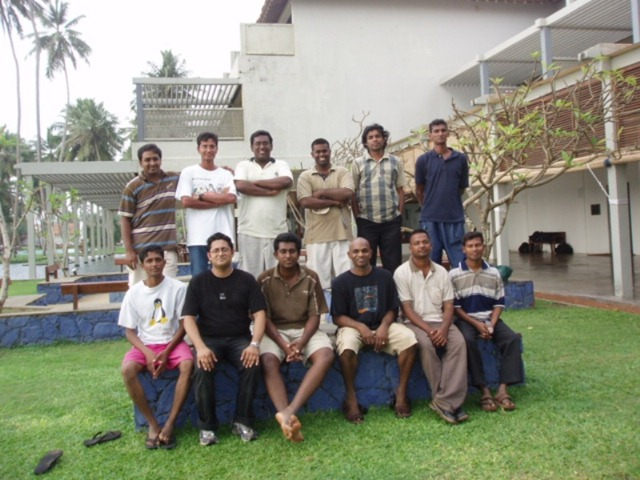
WSO2 First team outing
Coming Back Without Shrinking the Ambition
When Weerawarana returned to Sri Lanka in the early 2000s, he encountered a software industry almost entirely structured around services. “India has no shortage of people,” he said. “But India had then become comfortable with the services business model.” The logic was clear: services paid immediately, while products required patience.
He helped establish the Lanka Software Foundation in 2003, before WSO2 existed, with the clear goal of creating technology rather than consuming it. One of its early projects involved rebuilding an Apache enterprise web services stack, funded with $100,000 from a European development agency. The project succeeded technically, it demonstrated that complex infrastructure software could be built locally.
It did not translate into commercial enthusiasm. “I went and met all the major companies,” he said. “Nobody was interested.”
“I hate serving the world,” he said. “I want to challenge the world.”
Starting WSO2 From Where It Wasn’t Supposed to Be
WSO2 was founded in 2005 as an enterprise middleware company, built on open source, where technology could be built out of Sri Lanka, even with a headquarters in the US.
At the time, each of those choices was treated as a liability. Together, they were considered implausible. Open source was still regarded as risky. Middleware was unfashionable. Sri Lanka was peripheral.
Weerawarana raised the company’s first funding round of $625,000 on a simple slide deck. “It was a simple slide deck, white background with black text,” Weerawarana recollected.
The pitch relied on depth of understanding rather than presentation. He left IBM in April 2005, before funding was secured, prepared to find another job if the company failed. He gave up his US green card in 2006. Over the years, he personally pitched to more than 150 venture capital firms.
“About 75% of them said, ‘Where is Sri Lanka?’” he said. Others rejected the model. Some rejected the ambition. WSO2 rarely had competing offers. “We pretended we had choices, but we didn’t,” said Weerawarana. In 2006, Intel Capital invested $4 million, after one partner pushed the deal through internally. “If I hadn’t met him,” Weerawarana said, “the company would have died.”
Scale Without Erasure
Over the next 20 years, WSO2 grew steadily, often quietly. It built a broad middleware platform spanning API management, integration, identity, and developer tooling. Much of the software remained fully open source, even as competitors moved towards restrictive licensing.
By the early 2020s, its software was used by thousands of organisations globally. The company crossed $100 million in annual recurring revenue and employed more than 800 people, with Sri Lanka remaining the centre of gravity. Offices existed elsewhere, but the authority did not migrate.
In 2025, WSO2 acquired Moesif, an API analytics and monetisation company, extending its platform as APIs became central to enterprise systems. The acquisition was not framed as conquest. It was framed as completion.
“Software runs the world now,” Weerawarana said. He points to sanctions, platform dependence, and geopolitical fragmentation. “What happens if tomorrow you’re told you can’t use Microsoft or Google?” he asked. WSO2’s software is fully open source. “Nobody can take it away,” he said.
Leadership Without Deference
Weerawarana is clear that culture does not scale on its own. It has to be designed, enforced, and corrected continuously. Every full-time employee still meets him before joining. “I need five minutes,” he said. “I just want to see if I can work with you.”
By the time candidates reach him, their technical competence has already been assessed. What he looks for is harder to quantify.
“I’m checking whether you’re arrogant,” he says. Senior candidates are deliberately interviewed by junior employees. The point is not to test authority, but to observe behaviour. “It’s very easy to be nice to me,” he says. “I’m the CEO. How are you with people who don’t have power?”
The company runs broad leadership forums rather than narrow executive layers. Roughly 10% of the organisation participates. Employee satisfaction surveys are run every 6 months. Leaders are monitored closely. “People don’t leave companies,” he said “They leave managers.”
He admits he is not easy to work with. He is impatient. He changes his mind. He expects to be challenged. “If people agree with you all the time,” he said, “you’re already in trouble.” The principle he returns to is simple. “Strong opinions, weakly held.”
A Longer Ending
Weerawarana does not believe technology will save humanity. He does not believe it will destroy it either. He is sceptical of abundance narratives and indifferent to futurism that removes purpose from work. What matters to him is agency: who builds, who decides, who controls the foundations.
What he has built is not just a company, but a sustained argument against a deeply held assumption in the global technology industry: that creation has a fixed geography, and that serious software must come from a narrow set of places and people.
For most of his career, he was told that legitimacy required departure. Instead, he stayed. He built patiently, accepted rejection, relied on chance, and insisted on control where it mattered. He did not move closer to power. He forced power to acknowledge him.
“Stop assuming that ‘they’ are somewhere else,” he says. “We can be the ‘they’.”
That is not a slogan. It is the organising principle of his life’s work.