
Banks See Returns From AI, But Most Struggle to Deploy It at Scale, Riverbed Global Survey
Financial services firms are seeing tangible returns from artificial intelligence investments, but most are still struggling to move AI from experimentation into everyday operations, according to a new global survey released by Riverbed.
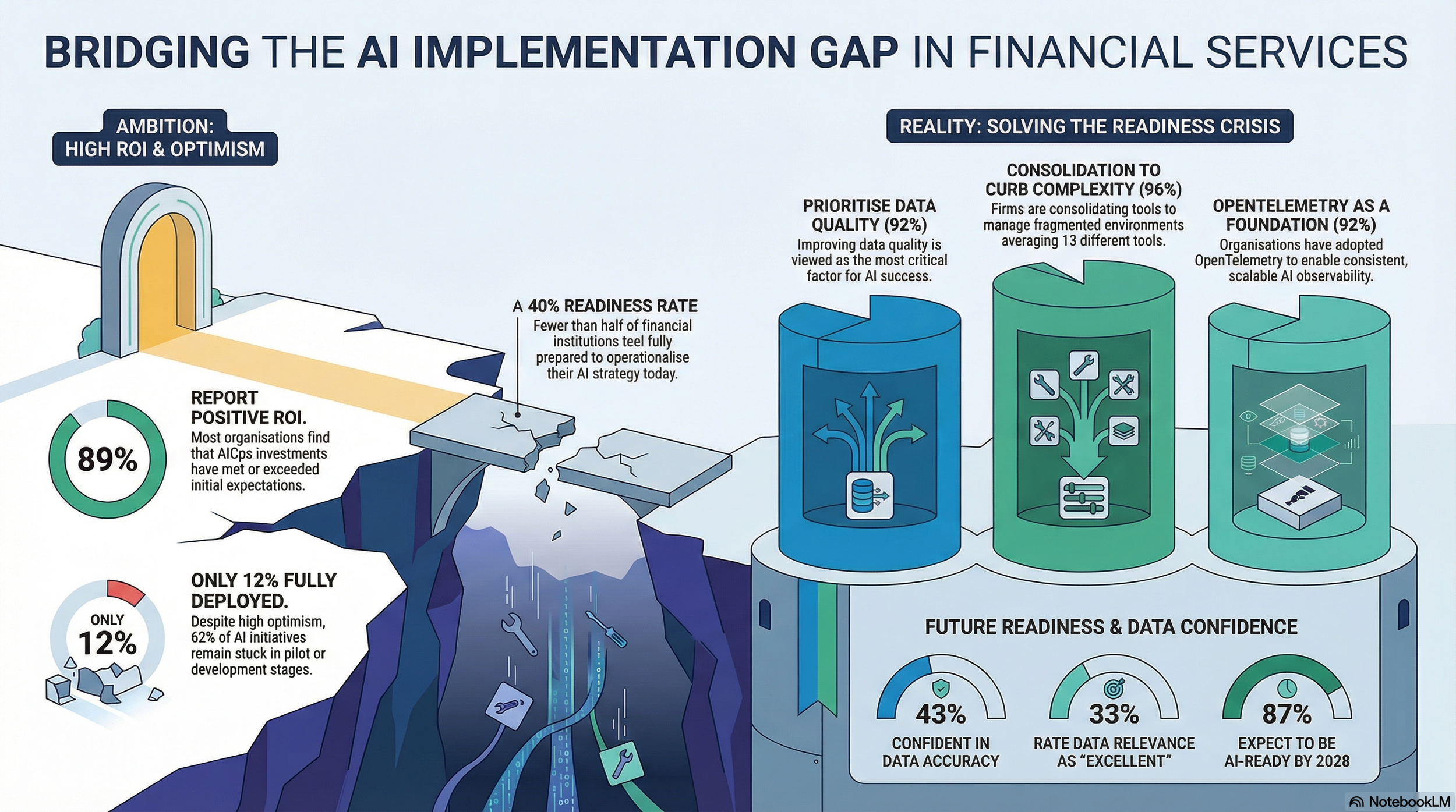
The report, The Future of IT Operations in the AI Era, surveyed 1,200 business and IT decision-makers across seven countries, including 250 from the financial services sector. While 89% of financial services organizations say returns from AIOps initiatives have met or exceeded expectations, only 12% have fully deployed AI projects across their enterprises. A further 62% remain in pilot or development stages .
The findings point to a widening gap between AI ambition and operational readiness in one of the world’s most tightly regulated industries.
“Financial Services organisations are among the most sophisticated and disciplined adopters of AI, and our research shows they’re already seeing strong returns,” said Jim Gargan, Chief Marketing Officer at Riverbed. “However, the sector operates under unique pressures, including rigorous regulatory scrutiny, zero tolerance for downtime and a critical need for data accuracy.”
Data quality remains the main barrier
Nearly all financial services respondents agree on what is holding AI back. Ninety-two percent say improving data quality is critical to AI success, the highest level of agreement among all industries surveyed.
Yet confidence in existing data remains low. Only 43% say they are fully confident in the accuracy and completeness of their data, and just 33% rate it as excellent for relevance and suitability.
For banks and insurers, this lack of trust has consequences. AI systems built on incomplete or inconsistent data struggle to pass internal risk controls and regulatory scrutiny, limiting their use to contained pilots rather than production systems.
Operational complexity slows AI at scale
The survey also highlights how fragmented IT environments are compounding the problem.
Financial services organizations use an average of 13 observability tools from nine different vendors. This fragmentation limits visibility across applications, networks, and user experience, making it harder to diagnose issues or rely on AI-driven insights.
As a result, consolidation is accelerating. Ninety-six percent of respondents say they are actively consolidating tools and vendors, and 95% believe a unified observability platform would make it easier to identify and resolve operational issues. An equally high proportion say they are open to switching vendors as part of this process, reflecting growing frustration with complex, disconnected toolsets.
Gargan said simplifying IT environments has become essential to making AI usable at scale.
“Success now depends on simplifying IT, consolidating observability tools and vendors, improving data quality, embracing open standards like OpenTelemetry, and ensuring network and application performance can support AI at scale,” he said.
Performance issues affect daily work
Beyond infrastructure, the survey points to ongoing performance challenges affecting employees.
Staff in financial services spend around 41% of their working week using unified communications tools such as video calls and messaging platforms. While nearly two-thirds say these tools are essential, only 47% report being very satisfied with their performance.
Issues linked to unified communications account for 16% of IT support tickets and take an average of 41 minutes to resolve. In an industry where responsiveness and reliability underpin customer trust, these persistent problems continue to place pressure on IT teams.
Open standards gain ground
One area where financial services appear more advanced is in the adoption of OpenTelemetry, an open standard for observability.
Ninety-two per cent of financial services organisations have implemented or begun implementing OpenTelemetry. Nearly all respondents say cross-domain correlation is critical to their observability strategy, and 97% view OpenTelemetry as a foundation for future initiatives such as AI-driven automation.
The report notes that open standards are increasingly valued in regulated environments, where transparency, traceability, and flexibility are essential.
Middle East banks face familiar constraints under faster timelines
The survey’s findings resonate strongly in the Middle East, where banks are under pressure to modernise rapidly while maintaining strict regulatory control.
Across the Gulf, financial institutions have invested heavily in AI-driven services as part of broader national digital strategies. However, many operate hybrid environments that combine cloud platforms with legacy core banking systems, alongside data residency and compliance requirements that limit how data can be moved and used.
These conditions mirror the global challenges highlighted in the survey. Inconsistent data quality, limited end-to-end visibility, and fragmented tooling make it difficult for AI projects to progress beyond pilots, even where executive support and funding are strong.
The report’s emphasis on network performance and AI data movement is particularly relevant in the region, where data is increasingly distributed across local data centres, regional cloud zones, and edge environments. Eighty-one per cent of financial services respondents globally say network performance and security are essential to their AI strategy, underscoring the importance of reliable, governed infrastructure as AI scales.
At the same time, strong adoption of open standards such as OpenTelemetry aligns with regional efforts to avoid long-term vendor lock-in while adapting to evolving regulatory frameworks.
Overall, the survey suggests that financial services firms are confident in AI’s value and disciplined in measuring returns, but constrained by data quality, operational complexity, and the difficulty of scaling AI in highly regulated environments.
While 87% of respondents expect their organisations to be AI-ready within the next three years, only 40% say they are fully prepared today.