
Zaphira Nature’s GCC-Spec Haircare Play: How Hanane Bouchouicha-Sykora Is Building a Local Premium Brand in Dubai
In a Dubai salon chair, Hanane Bouchouicha-Sykora does not begin with curl charts. She begins with feeling. “Aquatic, creamy, and then you’re gonna find thick, creamy, but thick,” she says, describing texture like it is a product specification.
Her point is commercial, not poetic. Textured-hair customers switch brands fast, chasing results. If a routine feels inconsistent from one wash to the next, trust disappears and repurchase goes with it. “In one brand, you can see that there is a lot of texture and a lot of different type of materials,” she says. “So imagine if you go from one brand to another. You don’t know what you are using.”
That problem, for Hanane, is not a small consumer annoyance. It is the business case for Zaphira Nature: make textured-hair care feel premium, modern and predictable, with products designed for GCC conditions rather than copied from somewhere else’s climate and habits.
The market is moving in her favour. According to IMARC Group, the UAE hair care market was valued at USD 436.68 million in 2024 and is forecast to reach USD 613.51 million by 2033.
According to Mordor Intelligence, the UAE hair care market is expected to be worth $442.54 million in 2025 and projected to grow to $586.34 million by 2030. A “natural” angle is not niche anymore either. According to Grand View Research, the UAE natural hair care product market generated $343.2 million in revenue in 2024 and is expected to reach $559.7 million by 2030.
Growth numbers, though, do not automatically translate into trust for a young UAE-made brand. Hanane names the real friction directly. “The only obstacle for me is the mindset,” she says. “They think that what is produced in Europe, America is better. And this is the complex of colonisation.”
The founder’s thesis: identity, not correction
Hanane’s brand is not built on “fixing” hair. It is built on refusing the idea that hair needs fixing. “I was an accountant, a financial accountant auditor before,” she says. “I finished my high studies, I worked in the domain, but I didn’t like what I was doing. It’s not me.”
The pivot into beauty came from her own journey with textured hair and the social pressure around it. Growing up in Algeria, she says straight hair was treated as the standard. “If you are not like this, you are not beautiful,” she says. “Even your grandmother, your mother, they start to make you, and they start to torture you just to make you the same as them.”
She tried what many women try: keratin, protein treatments, salon “fixes”. Then the mirror became the turning point.
“I realised when I was seeing myself in the mirror, it’s not me,” she says. “I was looking like everyone. It’s not me. It doesn’t reflect Hanan.” She describes the emotional logic behind it in plain terms. “You realise that you are doing this because you are losing confidence in yourself,” she says. “I don’t like my hair, and my hair, it’s a part of my body.”
The brand is a response to that loss of self. “When I see someone with curly hair, or kinky or Afro, the natural shape, it reflects, for me, her personality,” she says. “This person has allured a common point, which is self-acceptance.”
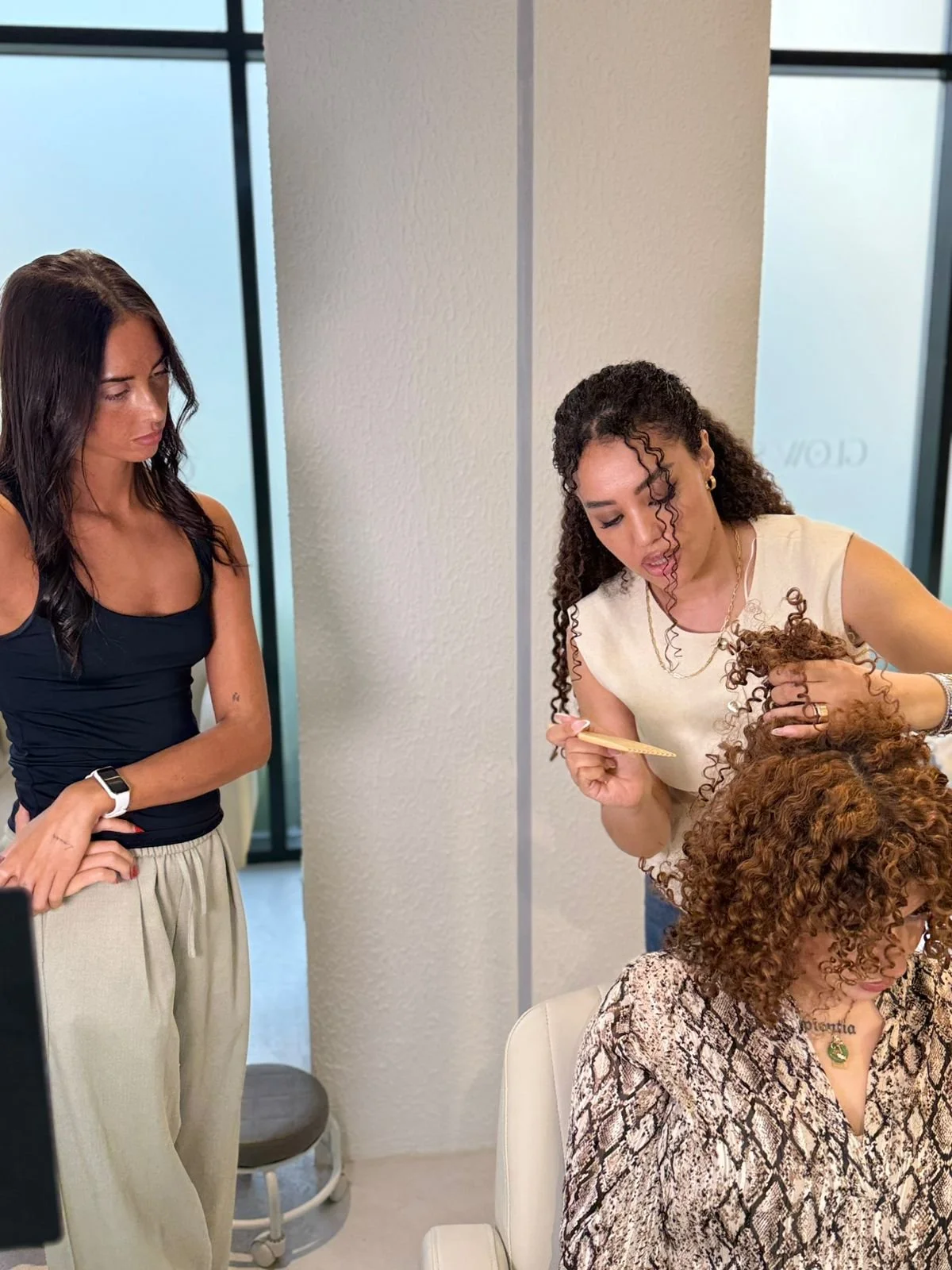
Hanane Bouchouicha-Sykora, styling and training
Building the product: five years, three years, and a manufacturer that would move
Many founders romanticise product development. Hanane describes it as conflict resolution with a supply chain.
“We found difficulty in how to find the manufacturer because everyone is trying to sell their stock,” she says. “They don’t want to create a new thing. They want to sell what they already have.” The timeline is long enough to be a filter. “It took me five years,” she says. “And the three years of formulation.”
She is clear about what she did and what she refused to pretend she could do. “I’m not a chemist,” she says. “So what I’m going to do, I’m going to give you to a chemist to do it, to accompany you to do it. Make things properly.” Her job was to define the performance requirements and the ingredients she wanted, then push until the product matched the vision.
“The key was patience,” she says. “You have to be stubborn.”
The competitive context makes that stubbornness rational. According to Croda Beauty, the global textured hair market is valued at approximately $15.66 billion and is growing at around 4.7% annually, outpacing the overall hair care industry. In other words: more demand, more launches, more noise, more choice. If a product is not meaningfully differentiated, it disappears.
Selling in Dubai: the hard part starts after you ship
Hanane says the most common founder mistake is thinking the product is the hard part.
“I realised that the part of creating a product it was the easiest one,” she says. “The most difficult thing now is how to sell those products.”
Dubai is a difficult first battlefield: intense competition, expensive attention and consumers trained to equate premium with imported. Hanane describes Zaphira as a young business that needs time to build behavioural repeat. “You cannot force a baby who is in the stage of crawling to run,” she says. “It’s a stage, it’s a step going to take her time.”
Her positioning is intentionally premium, but her product philosophy is built around reducing complexity. In the salon, she repeats a message that doubles as a retention strategy: fewer products, more consistency, and realistic routines. “You don’t have to put three, five products,” she says.
Then she turns the experience into an asset. “The concept is a ritual,” she says. “The thing specific about the product, the brand, is the concept, because the concept is really special. It takes all the sides of care from the smell to the texture, to the feeling, the whole experience.”
That ritual is designed to do what performance alone cannot: turn maintenance into something customers look forward to. She describes a signature fragrance created specifically for a range and names the notes. “It was made with vanilla, jasmine, fleur de rangé, orange flour, and the ylang essential oil,” she says. “Each range going to have a new perfume, because the concept is a ritual.”
The salon strategy and the regional scale plan
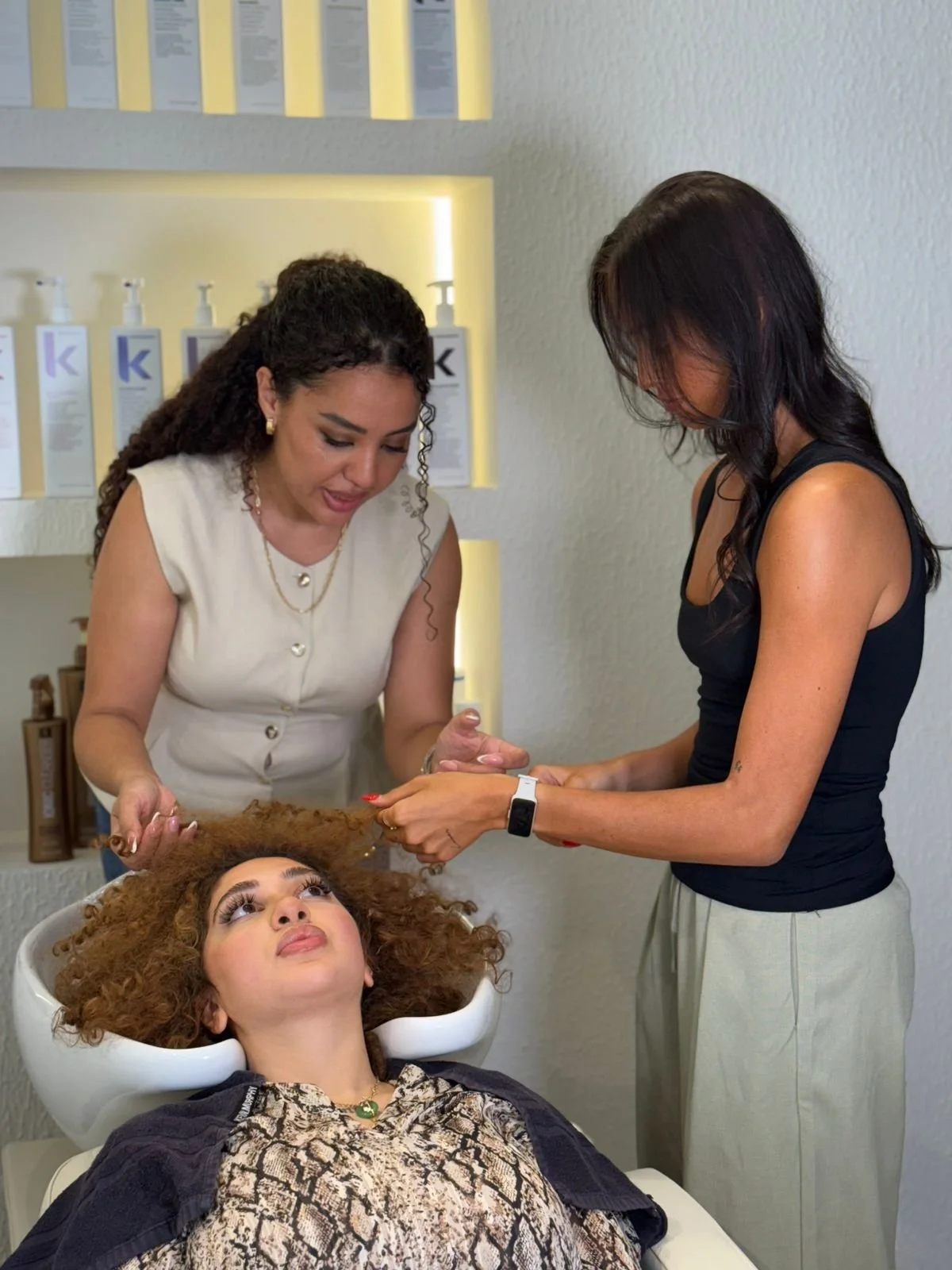
Salons are where a premium haircare brand earns credibility quickly. They also teach routines, which is where repetition is born. Hanane names partners to show traction. “We’re in all of the Bianco Salons,” she says. “We’re also in Locks by LuLu in JLT. Refresh Curls, Salon 9, we’re onboarding. We’re at almost 10 salons now.”
Expansion beyond the UAE is not an ambition; it is the market logic. According to Mordor Intelligence, the GCC hair styling products market is expected to reach $128.54 million in 2025 and grow to $187.33 million by 2030. Dubai, for Hanane, is a testing ground for product-market fit across many nationalities. Scale comes from the wider GCC, where demand is greater and where salon networks can accelerate adoption.
Globally, the textured-hair boom also sets expectations for what “winning” looks like. Pattern Beauty has expanded from a small launch footprint to a wide retail and product base, according to the National Retail Federation. Bread Beauty Supply built a minimalist routine proposition and is positioned as “Clean at Sephora,” according to Sephora’s own brand information.
Mielle Organics joined P&G Beauty in 2023, according to P&G’s deal announcement, showing how quickly founder-led brands in textured hair can become strategic assets.
Hanane is not trying to compete with that scale on day one. She is trying to win a different argument: that a local premium brand can be engineered for GCC realities and still feel aspirational.
“Curly is not crazy,” she says. “Curly is just natural hair.”
That line is culture, but it is also a business thesis. If the UAE market is growing, if natural hair care is accelerating, and if textured hair is now a global engine, then the brands that win in the Gulf will be the ones that build for the region and sell with respect.