
The Marketers Winning With AI Have One Thing the Others Do Not
Three-quarters of marketing organisations globally now use at least one form of artificial intelligence. Eighty-six% say AI is raising customer expectations. Close to 83% say customers want two-way conversations across every channel they use. And 69% of those same marketers admit they cannot respond to customers promptly because they lack the data to do so. That is the central finding of Salesforce's Tenth Edition State of Marketing Report, and the contradiction it describes is not a technology problem. It is a data problem that predates AI and is being made more consequential by it.
The report, based on a double-anonymous survey of 4,450 marketing decision-makers across 26 countries conducted between October and November 2025, is framed by Salesforce as a marker of the industry's AI progress. Read in full, it is more accurately described as a survey of a function under sustained operating stress. Customer expectations are rising, acquisition is harder, and the CMO role is expanding. Close to 86% of chief marketing officers say their function is becoming broader; they are now accountable for an average of six functional areas, including analytics, data strategy, and revenue operations. AI is being adopted inside that environment, not in calm conditions but under pressure.
Nowhere is that contradiction more sharply visible than in the UAE. Among the 26 markets surveyed, UAE marketers rank among the most AI-confident in the world — 85% trust AI to respond to customer enquiries, four points above the global average — yet 78% say they cannot respond promptly to customers because they lack the data access to do so. The global average for that failure is 69%. A market leading on AI adoption is nine percentage points behind on the operational foundation that determines whether that adoption delivers anything.
Bobby Jania, Salesforce's Agentforce Marketing CMO, put the consequence of adopting AI without resolving the underlying data infrastructure plainly: "We are using the most powerful technology in history to send more one-way spam, faster. You can't give a customer a personalised recommendation or reply if your AI doesn't actually know who they are."
The UAE Picture: More Confident, More Constrained
The UAE cohort of 100 marketing decision-makers shows the full breadth of that adoption lead. Just 41% say they have not yet adapted their strategies to AI's widespread use, compared to 48% globally. And where 84% of marketers worldwide admit to running generic campaigns, that proportion falls to 73% in the UAE — a gap that suggests personalisation efforts in the region are more developed than the global norm, even if they remain incomplete.
Mohammed Alkhotani, Senior Vice President and General Manager of Salesforce Middle East and Africa, said the region's adoption speed was real but incomplete. "The UAE has always been at the forefront of embracing transformative technologies, and our marketing community's confidence in AI reflects this forward-thinking mindset," he said. "However, the research clearly shows that technology adoption alone is not enough. The marketers who will win in this new era are those who can unify their data to deliver the personalised, conversational experiences that customers increasingly demand. Data is the foundation upon which all AI success is built."
The UAE findings are an intensified version of the global pattern, not an exception to it. The tension between AI enthusiasm and data readiness runs through every market in the report. The UAE simply has more of the former and a more acute version of the latter.
Three Layers of AI Adoption — Most Organisations Are Stuck in the Middle
The global data reveals a market divided across three distinct levels of AI engagement. The first is basic usage: content generation, subject-line drafting, campaign performance forecasting, and workflow acceleration. That layer is now effectively standard, and in the UAE, personalising content, generating copy, and predicting campaign ROI are the three most common AI applications. The second layer is integration, where AI connects to live systems, real-time customer data, and cross-functional decision-making. Most organisations globally remain unfinished there. The third is agentic execution, where AI operates autonomously across customer interactions and internal processes. Only 13% of marketers worldwide have reached that layer.
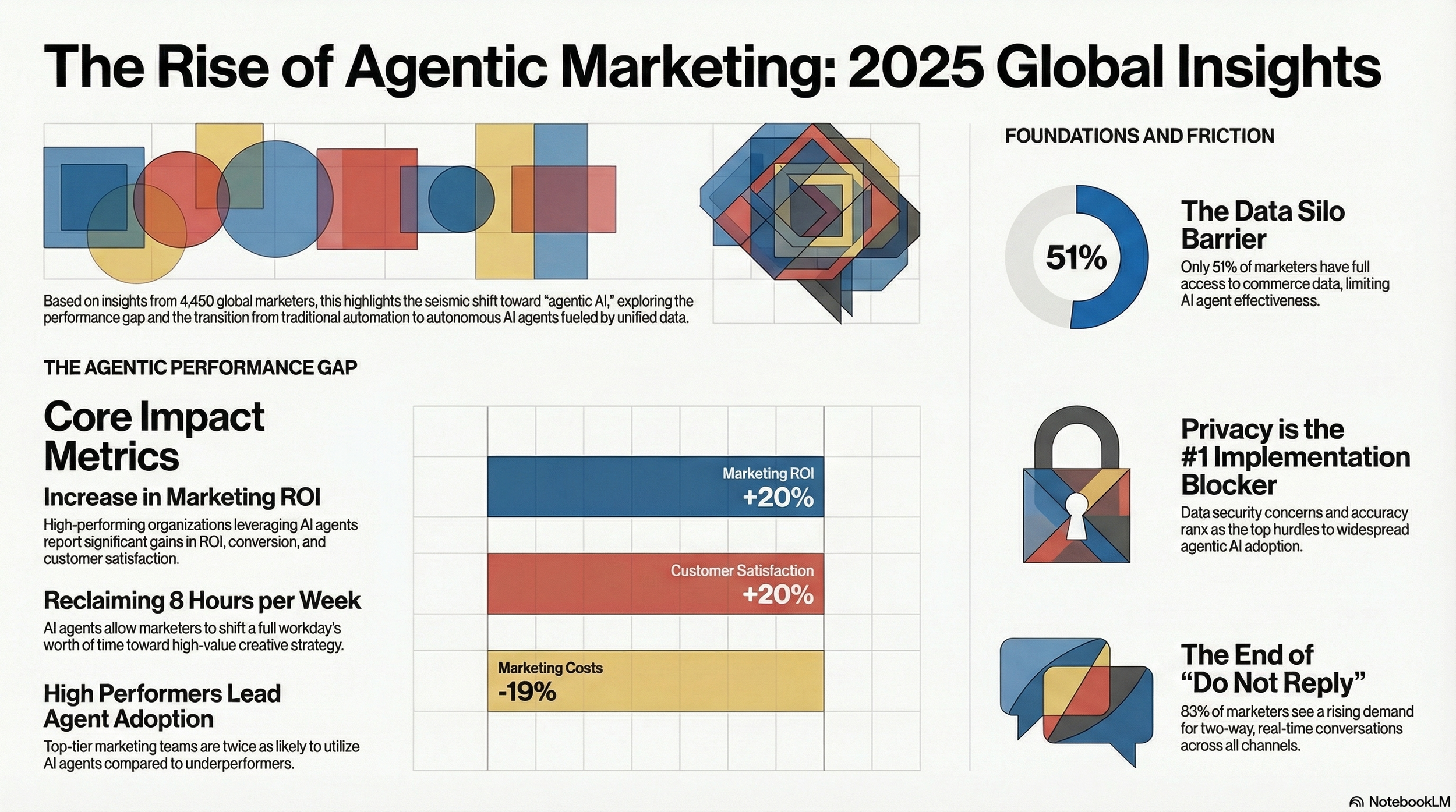
The performance gap between those who have and those who have not is substantial. Salesforce reports that marketers deploying agentic AI see a 20% average increase in ROI, a 20% improvement in customer satisfaction, a 19% lift in conversion rates, and a 19% reduction in marketing costs. High-performing teams are twice as likely as underperforming teams to use AI agents, and those teams expect to reclaim about 8 hours per week through automation.
Sixty-one% of marketers globally still describe full AI integration as a work in progress. Their biggest reported concerns are not philosophical objections to the technology. They are practical limits: privacy and data security, accuracy, and insufficient in-house expertise to deploy AI effectively. The UAE mirrors this pattern, with siloed data across channels identified as the primary barrier to AI-driven personalisation, followed by a lack of overall strategy and difficulty scaling quality control.
Jania framed the distinction between the layers as the industry's defining competitive line: "Every marketer has access to the same AI models. So what separates the winners? Relevant context. Being able to harness the right context is the difference between an AI that automates the status quo and an agent that actually grows your business."
Data Fragmentation Is the Actual Bottleneck
The report returns to the data problem with such consistency that it becomes the document's structural argument rather than a supporting observation. The average marketing organisation draws on at least seven data sources. Slightly more than half of marketers globally have real-time access to data for segmentation, campaign execution, and analytics. One third say that data arrives with a delay. Across functions, the gaps are sharper: only 58% of marketing teams have complete access to service data, 56% to sales data, and 51% to commerce data.
Salesforce reports that 71% of marketers are satisfied with their ability to connect marketing, sales, and service touchpoints — but only 26% are completely satisfied. That gap between functional and fully confident is significant. It means most organisations can operate across fragmented systems, but fall short of the unified customer view that advanced AI requires. In the UAE, where the data access challenge is more pronounced than the global average, that shortfall carries particular weight.
The mechanism matters. AI does not remove data fragmentation. It inherits it. When AI agents operate on incomplete or siloed customer context, the errors compound faster than they would through manual processes. Bad context at machine speed becomes operationally costly more quickly than bad context handled by a person. That is why the report's repeated emphasis on data unification is not a sales argument. It is a technical prerequisite for everything else the report recommends.
Teams that have achieved genuine data unification demonstrate the return. Marketers with fully unified customer data are 42% more likely to respond to customers reliably and on time, and 60% more likely to be deploying AI agents at scale. High performers are 2.8 times more likely to use customer data to create relevant experiences and 2.4 times more likely to have unified their data sources. The data advantage compounds.
Personalisation: Still More Aspiration Than Execution
Personalisation has held a central position in marketing's self-description for years. The Tenth Edition State of Marketing report is more candid about how incomplete the reality remains than the industry typically is. 78% of marketers globally say they need more personalised content than they can currently produce. Fifty-one% acknowledge their campaigns sometimes feel generic. Thirty-seven% report inconsistent messaging across channels. Nearly half (46%) say they lack sufficient data on customer preferences to deliver genuinely relevant content.
Among marketers who are already using AI, 98% report at least one barrier to personalisation. The most common obstacles are data quality issues, privacy constraints, and the difficulty of scaling quality control. That is a striking figure. Near-universal AI adoption for personalisation, combined with near-universal friction in executing it. The report does not frame it in those terms. The numbers support it.
In the UAE, the gap is particularly visible because the ambition is higher. UAE marketers are less likely than global peers to run generic campaigns, which means the distance between where they want to operate and where their data infrastructure currently allows them to operate is, if anything, more exposed.
The channel data adds a further dimension. Marketers globally invest most heavily in personalisation for mobile messaging and paid search, where attribution is measurable, and feedback loops are tight. Website experiences and audio are among the least likely to receive individual-level personalisation. That is partly a technology choice and partly a financial one: investment in personalisation follows the channels where its impact can be most readily demonstrated to leadership. Broader, less attributable environments get less.
Customers Are Expecting Conversations. Organisations Are Still Built for Broadcast
Eighty-three% of marketers globally say customers now expect two-way conversations across marketing channels. In the UAE, 76% report the same. Yet 69% of marketers worldwide struggle to respond promptly to customer enquiries — a rate that rises to 78% in the UAE. That gap between expectation and execution is one of the sharpest in the report.
Email and SMS remain core channels for most marketing teams globally, but both are still predominantly used as broadcast tools. Only 55% of marketers say they frequently reply to customer responses via email and text, and that process remains largely manual. High-performing teams are 1.5 times more likely than underperformers to reply regularly through those channels. Globally, 81% of marketers say they would trust AI to handle customer enquiries — a figure that rises to 85% among UAE respondents, the highest regional reading in the survey.
The structural issue is that most marketing organisations, globally and in the UAE, remain designed for broadcast. Channels built for two-way communication are still being operated as one-way ones. That is not a technology gap. It is an organisational design problem, and one the report suggests high-performing teams have been faster to address. Jania described the stakes directly: "Agentic marketing is the next great evolution in our field: marketing that stops speaking at customers and starts engaging with them. Because if we don't deliver that, consumers will find a brand that will."
Search Is Being Rewritten — and Discoverability Is Harder to Control
Half of all Google searches now generate AI summaries that bypass brand websites entirely, compressing the top of the marketing funnel and reducing the moments in which brands can earn direct customer attention. During the 2025 holiday season, AI and AI agents drove 20% of global orders, equivalent to $262 billion in sales, establishing agentic commerce as a current commercial reality rather than a near-future projection.
Eighty-five% of marketers globally say AI is reshaping their SEO strategy, and 88% have begun optimising for AI-driven search environments including ChatGPT and Google's AI Overview. High-performing marketing teams are 2.2 times more likely than underperformers to have already made that transition. The skills marketers now rank most critical reflect the same shift: data analysis and interpretation, and AI tool management, sit above creative production and channel management in the priority list.
The underlying implication is one the report gestures at without fully naming. Classic digital marketing was built on a chain — customer searches, clicks to a brand surface, converts, and gets measured — that AI-driven answer engines are weakening. SEO is evolving from a traffic discipline into something that spans visibility strategy, structured data management, and content designed for machine interpretation as much as human reading. The organisations that will surface in AI-generated answers are those with the cleanest content architecture and the strongest domain authority. It is, again, an infrastructure question.
The Trust Problem Has Three Dimensions
Salesforce identifies privacy and data security as the top concerns around AI implementation, with accuracy close behind. But the report contains three distinct trust challenges that are worth separating.
The first is regulatory trust: whether companies can use customer data compliantly across regions, channels, and systems as privacy regulation tightens globally. The second is output trust: whether marketers can rely on AI-generated analysis, segmentation, copy, or autonomous customer responses without damaging brand quality or the customer relationship. The third is organisational trust: whether teams have enough confidence in their own data to hand more decisions to automated systems.
That third dimension may be the most consequential, and the most underexamined. With only 26% of marketers globally completely satisfied with how their organisation unifies and uses customer data, the real adoption ceiling for advanced AI is partly psychological. Teams do not automate processes built on data they do not fully trust. In markets like the UAE, where data access challenges are above the global average, that ceiling sits lower.
High Performers Are Not Just Using More AI — They Are Structurally Better Organised
The report's contrast between high and low performers is consistent enough to become its most instructive argument. High performers are more likely to use AI agents, more likely to have unified customer data, more likely to respond individually to customers, and more likely to report a clear line of sight from marketing activity to sales pipeline impact. Eighty-three per cent of marketers say they can see their influence on the pipeline, and that revenue accountability is strongest among the leading teams.
The pattern suggests that high performance in this environment is not driven primarily by tool adoption. It is driven by operational maturity: cleaner data, tighter alignment with sales and service, and more reliable feedback loops between marketing activity and commercial outcomes. AI then compounds those strengths. It does not typically create them from scratch. Better organisations tend to be better at choosing the tool before they buy it, which is why they extract more value from it afterwards.
That observation has direct implications for both the global market and the UAE specifically. Confidence in AI, and even investment in AI, does not automatically produce the structural conditions that make AI effective. The organisations closing the gap fastest are those treating data unification and cross-functional integration as the primary work, with AI deployment following once those foundations are more firmly in place.
What the Report Shows — and What It Stops Short of Saying
The direction of travel in Salesforce's data is consistent across every market. Marketing is becoming more data-dependent, more accountable to revenue outcomes, more operationally entangled with sales and service, and more reliant on AI as a continuous operating layer rather than a campaign production tool. The figures on customer expectation growth, data fragmentation, incomplete AI integration, two-way engagement gaps, and personalisation barriers all point in the same direction: this is a function trying to move from campaign management to adaptive customer systems.
What the report does not address is the economics of that transition. It does not reckon with how expensive data unification is, how much organisational effort sits behind it, or how unevenly organisations of different sizes can absorb the cost. It also does not engage seriously with the human load of the moment — teams being asked to learn AI, manage ten channels on average, prove revenue impact, and cover a broadening functional remit while the tools and workflows are still being established.
The harder conclusion the report's own data supports is also left unstated. If AI compresses traffic, automates creative production, raises the premium on clean data, and increases response expectations across every channel, then the likely winners are not simply the most creative or the most AI-enthusiastic marketing organisations. They are the organisations with the strongest systems, the cleanest customer data architecture, and the tightest feedback loops between marketing, sales, and service. For the UAE, a market more AI-confident than most and more data-constrained than many, that conclusion is particularly pointed. The tools are in place. The infrastructure work is not finished. And the gap between organisations that have resolved that and those that have not, by Salesforce's own data, is already widening.